




Ebara ready for work on controversial incinerator plant
Construction of an incinerator plant in Broga should start early next year since the Japanese firm awarded the RM1.5 billion contract "would have no problem" complying with additional conditions set by the government, a company insider said.
Construction of an incinerator plant in Broga should start early next year since the Japanese firm awarded the RM1.5 billion contract "would have no problem" complying with additional conditions set by the government, a company insider said.
 But the insider, who refused to be identified, was unsure if Consortium Ebara Corporation and Hartasuma Sdn Bhd had confirmed their undertaking with the project proponent.
Ebara has been given until the end of the year to respond as to whether it can fulfill the new conditions.
Officials at the housing and local government ministry could not be reached for confirmation.
On Dec 1, secretary-general Lokman Hakim Mohd Jasan reportedly said the letter of award for the project had been re-issued to the contractor on Oct 24, with additional terms.
The 1,500-tonne fluidised-bed gasification and ash-melting plant, believed to be the largest of its kind in the world, is slated for operations in 2007.
Heated discussion
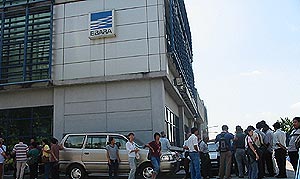
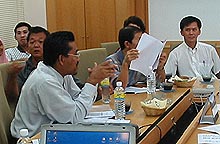 Today, a group of 40 residents from Broga new village, Semenyih, submitted a memorandum to Ebara Environmental Engineering (Malaysia) Sdn Bhd (EEEM) in protest of the project.
They went to the company's premises in Bukit Jelutong, Selangor, unannounced at 11am. About 15 residents then presented their case to five Japanese and local company officials as to why they are opposed to the incinerator.
The residents, led by pro-tem Broga sub-committee chairperson Dr Zulkefly Mohamad Omar, expressed their disappointment with Ebara..Caught by surprise, Ebara officials struggled to explain the project.
Expressing their fears and concerns over health and environmental issues, they asked Ebara not to work on the project.
EEEM managing director Masakiyo Kuratani tried reassuring the group about the safety mechanisms within the technology, touted as the latest zero emission incinerator technology developed in Japan.
"Don't be afraid because this technology is the best for today...Our technology is safe as it is based on the same system in Japan," he told the residents.
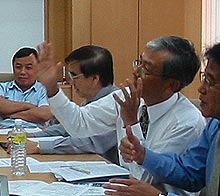 Responding, resident Daniel Wong asked why the incinerator was not proposed in administrative capital Putrajaya instead if it is as safe as Ebara claims it to be.
Masakiyo said the top managers will first study the memorandum before considering sending it to Ebara's head office in Tokyo.
The 90-minute meeting was interspersed with heated debate, especially when several residents started relating their worries over the project, ever since the location was chosen.
Together with the memorandum, the sub-committee had attached several Japanese-language news clippings on Ebara's allegedly questionable business practices.
However, Masakiyo, who appeared disturbed with the sudden visit, dismissed some of articles as propaganda material from the Communist Party of Japan.
Speaking to reporters after the meeting, Zulkefly said they were not satisfied with the explanations given by Ebara officials.
"They keep telling us the technology is safe but none of them wants to give a written assurance. Furthermore, they were talking based on information sourced from Ebara itself," he said.
Problems reiterated
In the memorandum, the residents argued that the incinerator will not burn 100 percent of the garbage, and that it will emit 30 percent toxic waste comprising heavy metals, dioxin and poisonous gases.
"Ebara's involvement as the main pillar in the Broga incinerator project is disastrous and a bigger catastrophe for local residents and Malaysians who receive dangerous and risky technology," it said.
 The four-page document, including signatures of local residents, also listed related developments in Japan including a study by the Environmental Research Institute on dioxin contamination among fish, leading to a sharp drop in domestic production.
It reported that the fish contained over 2.8 times dioxin contamination compared to imported fish whereas other types of seafood caught locally had 5.2 times higher level compared to deep-sea fishing.
"The US Environmental Protection Agency has listed 26 types of fish in Japan as inedible. In 1999, the United Nations had declared that Japan had released 50 percent of the dioxin produced in the world."
The memorandum also highlighted Ebara's purported bad track record, citing a Nikkei Industrial News report in April last year that "incinerator designer and builder Ebara Corp" had laid-off 400 workers out of the total 1,800 in its engineering section.
The company was reported as having registered losses amounting to 27 billion yen (US$225 million) last year.
"We wonder how this company could have convinced our government (to undertake the project) when it is losing money and the incinerator technology is increasingly proven to be dangerous to health and the environment," read the memorandum.
The residents also reiterated the importance of preserving the water catchment area which supplies drinking water to 1.5 million people in over 330 housing estates in Klang Valley.
"Furthermore, more than 50 percent of the project sits on a slope exceeding 25 degrees, prohibiting any form of development."
The memorandum also recorded the residents' disappointment over the attitude of minister Ong Ka Ting who has refused to meet with them despite numerous letters and phone calls over the last two years.
"Don't deny the rakyat's right to a safe and comfortable existence without the threat of toxic wastes and dioxins. Ultimately, public health is more important than the economy or huge profits raked in by a few corporate bodies and individuals," said the document.
"Any untoward incidents that occur due to the incinerator plant does not benefit anyone because we don't want the same accidents in Japan to happen here."


Report this comment
Are you sure you want to delete this comment?
This action cannot be undone.