




Top 10 news of 2004
Malaysians witnessed the making of history on several fronts. The unexpected release of former deputy premier Anwar Ibrahim came in the wake of the best-ever election outing for the Barisan Nasional, while scandals and sagas occupied the attention of watchdogs of the public interest.
Malaysians witnessed the making of history on several fronts. The unexpected release of former deputy premier Anwar Ibrahim came in the wake of the best-ever election outing for the Barisan Nasional, while scandals and sagas occupied the attention of watchdogs of the public interest.
1) Anwar Ibrahim wins release
 After six years in jail, former deputy prime minister Anwar Ibrahim was
finally freed
when the Federal Court allowed his appeal to set aside his conviction and six-year jail sentence for a sodomy offence.
After six years in jail, former deputy prime minister Anwar Ibrahim was
finally freed
when the Federal Court allowed his appeal to set aside his conviction and six-year jail sentence for a sodomy offence.
In its decision on Sept 2, 2004 - exactly six years after he was sacked from all posts - the court held that it was unsafe to uphold the conviction based on the uncorroborated evidence of the complainant and prosecution star witness Azizan Abu Bakar.
Anwar, who had maintained that the charges were fabricated, said his freedom proved that he was a victim of a political conspiracy led by former prime minister Dr Mahathir Mohamad who, however, continued to defend his decision to sack Anwar for sexual misconduct.
The release - which hogged the headlines for days - was welcomed by the opposition politicians, legal practitioners and human rights activists who said they believed the decision had improved perceptions of the judiciary. The stock market reacted positively as share prices rose sharply.
2) Religion hogs the headlines
Seldom has debate over religious sensitivities been so keen at different levels, with a number of issues being raised over the year.
The Subang Jaya municipal council's requirement for dog owners to get written permission from neighbours in order to keep their pets was initially attributed in part to objections from Muslims. A lawyer's attempt to discuss the issue raised more controversy when a link was made to controlling the volume of the azan (call to prayer) from neighbourhood mosques.
In Terengganu, the PAS government decreed that women were not to be seen in 'sexy clothes', while the Selangor government's Christmas open house came under scrutiny over a claim that references to Jesus Christ would not be allowed. This has since been denied.
Religious leaders blamed the rise of sexual crimes on the decline of social morals, partly due to the corrupting influence of suggestive commercials and soap operas, ' wild concerts ' and television programmes.
Public irritation with this turned to indignation when a preacher in Penang described the rape and murder of 10-year-old Nurul Huda Ghani in Johor as the " wrath of God ". A PAS youth leader in the state stoked the flames by suggesting the wrath could be stayed by the implementation of hudud law (Islamic criminal code).
 Debate on the relevance of Syariah law to
detentions under the ISA
and
apostasy cases
, proved to be an opportunity to discuss the scope and intent of the Federal Constitution with regard to Islam.
Debate on the relevance of Syariah law to
detentions under the ISA
and
apostasy cases
, proved to be an opportunity to discuss the scope and intent of the Federal Constitution with regard to Islam.
3) Landslide victory for BN
Malaysians went to the polls on March 21, called by new premier Abdullah Ahmad Badawi to seek a personal mandate. They handed a landslide victory to Barisan Nasional (BN), which took four-fifths of the parliamentary seats and won back the PAS-held government of Terengganu.
 The 'feel good' factor for Pak Lah's administration was reinforced by his promises to wipe out corruption and the importance he placed on educational opportunities. The opposition vote collapsed as a result, with only the DAP making inroads to win back ground lost in 1999.
Parti Keadilan Rakyat won just one seat through its president Dr Wan Azizah Wan Ismail, while PAS only narrowly retained Kelantan, which it has ruled since 1990.
The election was, however, marred by allegations of irregularities linked to problems with the electoral roll that prevented thousands from voting in some states, in particular Selangor.
On polling day, the Election Commission (EC) was forced to extend voting by two hours in Selangor due to discrepancies in the electoral roll. It also nullified polls for the Sungei Lembing state seat, in Pahang, and postponed voting to March 28 after the wrong party symbol was printed for the PAS candidate in the ballot papers.
4) Works Ministry under scrutiny
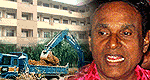 Works Minister S Samy Velly was kept busy deflecting blame over a number of infrastructural defects.
In August, cracks appeared on a flyover on the Middle Ring Road 2, resulting in the stretch being closed for three months. The minister threatened to shelve repair works if a graft probe was initiated.
In October, prior to the Hari Raya celebration, there was a mudslide along the North-South highway at Gua Tempurung, Perak, only about 10km from the site of a similar landslide in 1996.
Calls for Samy Vellu to resign intensified, reaching a crescendo when Barisan Nasional backbenchers joined in .
Samy Vellu hit back at his critics, claiming this was a political plot against him.
He later pinned the blame on the Project Management Consultants (PMC), which is under the Finance Ministry. He claimed that the PMC had usurped and hijacked the traditional role, responsibilities and powers of the Public Works Department to monitor and supervise government infrastructure.
5) Scomi's nuclear fallout
 Kamaluddin Abdullah Badawi, the prime minister's son, was briefly implicated in the supply of nuclear parts to Libya by Scomi Precision Engineering Sdn Bhd, by virtue of his 53 percent interest in the company.
Scomi had built centrifuge components that international intelligence agencies said were for Libya's nuclear enrichment programme. The case, which attracted worldwide attention , also revealed the existence of a black market for nuclear parts.
A connection was alleged between Scomi and a network led by scientist Abdul Qadeer Khan, the father of Pakistan's nuclear bomb. Sri Lankan-born businessman BSA Tahir admitted he was the middleman in the centrifuge deal.
A Malaysian police probe cleared Scomi of knowledge of the intended use of the components. However, Tahir was inexplicably detained for two years under the Internal Security Act a few months after the case was closed.
6) Mega-incinerator still under fire
After two years of sustained campaigning against the proposed construction of a mammoth incinerator - the biggest of its kind in the world - in Selangor's Broga, residents' hopes were dashed when the Department of Environment (DOE) approved the project on June 17.
 Devastated campaigners expressed disappointment in the government for failing to consider
environmental
and health issues surrounding the project, particularly the potential emission of fly-ash and bottom-ash, which are both internationally categorised as highly toxic and carcinogenic.
Devastated campaigners expressed disappointment in the government for failing to consider
environmental
and health issues surrounding the project, particularly the potential emission of fly-ash and bottom-ash, which are both internationally categorised as highly toxic and carcinogenic.
The government also came in for criticism for its continued lack of transparency in dealing with Ebara, the Japanese company selected to build the plant.
Ironically, in September, the DOE had rejected the environmental impact assessment study for a proposed landfill project in the same area, citing environmental reasons as the site would be in a gazetted forest reserve and water catchment areas.
Although elated by the decision, residents remain confused as to why the government has insisted on retaining the incinerator proposal.
The incinerator will take five years to construct and will have a lifespan of 20 years. Residents are continuing to fight the decision and to push for safer alternative methods of waste disposal.
7) The year of inquests
Several judicial inquests were called into custodial deaths and fatalities caused by the police in the course of enforcement operations. In the past, calls for such accountability had been ignored.
 The Attorney-General's Chambers has initiated at least 10 inquests to date. High profile has been accorded to a '
John Doe' inquest
that is underway to ascertain the identity of a decomposed body found in the Klang River on May 23.
The Attorney-General's Chambers has initiated at least 10 inquests to date. High profile has been accorded to a '
John Doe' inquest
that is underway to ascertain the identity of a decomposed body found in the Klang River on May 23.
The inquest was held after the Royal Commission on the Police intervened to resolve allegations by the family of detainee G Francis Udayappan that the Brickfields police were involved in his suspicious disappearance while in custody on April 16.
Another inquest will look into the circumstances surrounding the death of 19-year-old student V Vikines .
Inquests into the deaths of Ahmad Salleh, M Ragupathy, G Veerasamy and S Tharmarajen are underway, while dates are pending for those linked to the deaths of R Mageswaran, A Subramanian and Nagendran Rao.
8) Transsexuals seek new identity
Transsexuals who have undergone sex reassignment operations were able to revive attention to the need for official recognition of their new gender status, as this is currently not reflected in their identity cards.
However, their appeal immediately ran into problems. Women, Family and Community Development Minister Shahrizat Abdul Jalil said she was unsure as to who is responsible for the issue as this is a grey area.
 In November, the Ipoh High Court stoked more protests after rejecting an application by Wong Chiou Yoon for a
declaration that she is a man
, after the National Registration Department refused to recognise her change of gender following a sex-change operation. The court said it had no power "to usurp the function of Parliament".
In November, the Ipoh High Court stoked more protests after rejecting an application by Wong Chiou Yoon for a
declaration that she is a man
, after the National Registration Department refused to recognise her change of gender following a sex-change operation. The court said it had no power "to usurp the function of Parliament".
The Human Rights Commission (Suhakam) had no qualms about lending support to the transsexuals, saying it would be " ridiculous " if a person who has undergone the sex reassignment operation is not allowed not a change of identity.
Universiti Utara Malaysia academician Dr Teh Yik Koon said discrimination and absence of societal acceptance have led to transsexuals displaying self-destructive behaviour like drug abuse and suicidal tendencies.
9) PBDS loses battle for survival
The 21-year-old Parti Bansa Dayak Sarawak (PBDS) was deregistered on Oct 21. It was the first time that a political party went through a 'double' de-registration.
 PBDS was first
de-registered
on Dec 5, 2003 after a protracted leadership struggle between party stalwarts Daniel Tajem and Dr James Masing. It was
reinstated
on March 10 in a calculated move by the Barisan Nasional as it prepared for the general election later that month.
PBDS was first
de-registered
on Dec 5, 2003 after a protracted leadership struggle between party stalwarts Daniel Tajem and Dr James Masing. It was
reinstated
on March 10 in a calculated move by the Barisan Nasional as it prepared for the general election later that month.
After delivering the death-blow, the Registrar of Societies approved the application of the Masing-sponsored Parti Rakyat Sarawak (PRS) the same day.
The formation of the new party proved that Masing and his group had won the four-year long tussle, which evidently had the backing of Sarawak Chief Minister Abdul Taib Mahmud.
PRS is the third off-shoot to be formed after PBDS and Sarawak Progressive Democratic Party from the 43-year-old Sarawak National Party , whose own political life is virtually at the mercy of the court today.
10) Relief for refugees
The United Nations High Commissioner for Refugees (UNHCR) in Kuala Lumpur had reason for cautious optimism over the treatment of asylum seekers, as a result of the government's policy changes.
 Police
road-blocks
mounted outside the UNHCR office were dismantled, while the Home Ministry is looking into procedures to
issue identity cards
to the Rohingyas, a Burmese ethnic minority group that is not recognised in its own country.
Police
road-blocks
mounted outside the UNHCR office were dismantled, while the Home Ministry is looking into procedures to
issue identity cards
to the Rohingyas, a Burmese ethnic minority group that is not recognised in its own country.
There are an estimated 30,000 refugees - mainly from Burma, Aceh and the Philippines - and they are said to often suffer violation of their human rights in Malaysia.
The government is currently preparing to launch a nationwide crackdown on an estimated 1.2 million illegal immigrants, leading to fears that refugees too will be caught in the process and deported when the amnesty period runs out on Jan 1.
Editor's Note : This list was compiled before the devastating tragedy caused by a tsunami on Dec 26 which killed more than 60 people in Malaysia and almost 24,000 in the South Asian region.


Report this comment
Are you sure you want to delete this comment?
This action cannot be undone.