


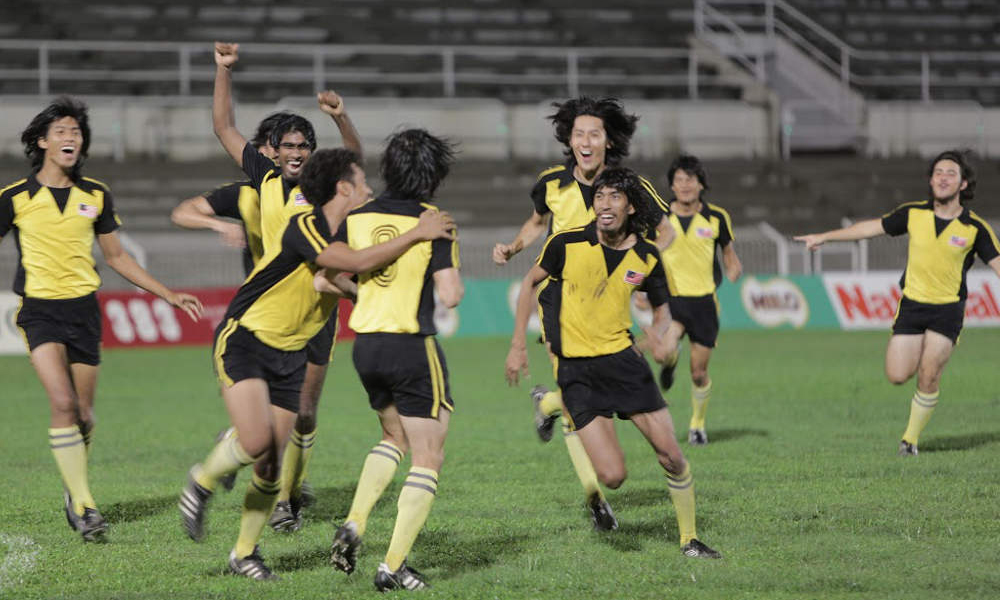

Oh, for the good old Bola days!
COMMENT What to make of the flood of nostalgia that is carrying the movie Ola Bola to box office success?
The movie is a depiction of Malaysia's 1980 Moscow Olympics football team which qualified for the event but could not go to what would have been the country's second appearance at the quadrennial summit of sport.
But because of a boycott of the Moscow Olympics due to Russia's invasion of Afghanistan, Malaysia did not participate in the Games.
Eight years earlier at the Munich Olympics, a Malaysian team captained by M Chandran, took part for the first time in the football competition and although eliminated at the group stage, the quality of what was essentially the same team was validated by its bronze medal success at the 1974 Tehran Asian Games.
Munich '72, Tehran '74 and qualification for Moscow '80 were the components of a blue riband decade for Malaysian football in the 1970s...
COMMENT What to make of the flood of nostalgia that is carrying the movie Ola Bola to box office success?
The movie is a depiction of Malaysia's 1980 Moscow Olympics football team which qualified for the event but could not go to what would have been the country's second appearance at the quadrennial summit of sport.
But because of a boycott of the Moscow Olympics due to Russia's invasion of Afghanistan, Malaysia did not participate in the Games.
Eight years earlier at the Munich Olympics, a Malaysian team captained by M Chandran, took part for the first time in the football competition and although eliminated at the group stage, the quality of what was essentially the same team was validated by its bronze medal success at the 1974 Teheran Asian Games.
Munich '72, Teheran '74 and qualification for Moscow '80 were the components of a blue riband decade for Malaysian football in the 1970s.
It must be that the crowds flocking to see Ola Bola, especially those old enough to flick way a teardrop of remembrance because they saw some of the matches in which those teams featured, either on TV or in person at the Merdeka Stadium, were driven by a yearning for the times when there was quality in the national team and more than a semblance of unity among the populace.
The latter sentiment, judging from comments of moviegoers posted on Twitter and Facebook , appears to be a common chord among the film's enthusiasts.
As one who was a young man in that decade and covered the play of the national team at the Merdeka Stadium, I can say that that quality was impressive and the fans' enthusiasm for their players transcended race and religion.
 Director Chui Keng Guan must be credited for tapping into a vein of nostalgia for a past of undeniable sporting quality and genuine sectarian-transcending warmth among sports fans and top sports performers.
Four decades have elapsed since those halycon days of performing quality and national unity, a span estranging and alienating enough to make those who have endured it doubt that there was indeed an edenic time before matters - in sports and politics - shunted into a downward spiral.
Though race riots had occurred in May 1969, the disturbances, shattering though they were, were swiftly consigned to a backburner and, in the aftermath, affirmative action policies were rolled out.
These were understood as imperative for the alleviation of poverty and the eradication of the pre-1969 social phenomenon of the identification of race with occupation.
Both goals were seen as necessary towards forging a new society, one that would be more united simply from being more equable and prosperous.
There was the unstated understanding that the sports arena would be exempted from the social engineering process afoot in Malaysia in all other fields of endeavour.
Road to dystopia
In retrospect, the halcyon days of Malaysian football in the 1970s is now viewed as having been possible simply because sports executives strove to keep their arena free from the quality-damaging effects of the social engineering process that had begun at the start of that decade.
Alas, it's an adult discovery that the road to dystopia is paved with good intentions.
Malaysia's football team now ranks 171 in Fifa's rankings, a good 25 places off the pace the national team set in the 1970s.
The 70s were also a time when the sport was as yet untainted by the practice of match-fixing and other scandalous conduct that began to creep in the following decade and after.
Fans knew their favourites played for pride more than for payment and the honour of donning national colours was prized beyond other considerations.
They thrilled to the exhilaration of watching a team where goal was capably kept by R Arumugam, and captained by libero Soh Chin Aun; directed in midfield by the creative vision of Shukor Salleh and Wong Choon Wah; and paced in attack by the power and penetration of Mokhtar Dahari.
The surfeit of skilful players in the seventies came on the back of good coaching from a decade earlier done by the likes of Choo Seng Kooi, with foreign refinements provided, successively, by Britain's Harold Hassel, Germany's Dettmar Cramer, Britain's Dave McClaren, and Germany's Karl Heinz Weigang.
The best Malaysian teams were fortunate to have in Harun Idris, menteri besar of Selangor (1964-1975), what was known in the trade as 'a player's manager'. Rare among politicians, Harun understood sport and knew how to spur players to give their best.
A decade-encapsulating moment of excellence from a time rife with it is italicised in the memory: the goal that Mokhtar Dahari scored at the Merdeka Stadium in April 1978 against an England B team.
A national selection forced an honourable 1-1 draw against the visiting England second stringers.
Our goal, a lobbed effort from 40 metres out that came when Mokhtar chased a punted pass from midfield, and eyeing goalkeeper Joe Corrigan well off his line, weighted his shot perfectly to carry over a retreating keeper into the net.
A packed stadium rose to its feet in celebration of what they saw was a tantalising glimpse of Malaysia's potential which observers felt, if nurtured systematically, would have gained Malaysia qualifications to not only the Olympics but also the World Cup.
Eleven years after his thrilling goal, Mokhtar died from the cruel affliction of muscular dystrophy, his illness and death serving as a sad metaphor for the decline of Malaysian football and of the unity it evoked among its fans.
The movie Ola Bola is a lyrical attempt to recapture memories of Malaysia's brief but shining decade of footballing excellence.
TERENCE NETTO has been a journalist for more than four decades. A sobering discovery has been that those who protest the loudest tend to replicate the faults they revile in others.


Report this comment
Are you sure you want to delete this comment?
This action cannot be undone.