




A year since twin Anwar-Nik Aziz tragedies rocked opposition
SPECIAL REPORT The year since the imprisonment of PKR de facto leader Anwar Ibrahim and the death of venerated PAS spiritual leader Nik Abdul Aziz Nik Mat has been a tumultuous one for the opposition.
Anwar was on Feb 10 last year sentenced to five years behind bars, after being convicted on a sodomy charge that critics insist was trumped up. Two days later, Nik Aziz lost his long battle with cancer.
For pollster Ibrahim Suffian of Merdeka Center, these two events marked the beginning of Pakatan Rakyat’s unravelling...
SPECIAL REPORT The year since the imprisonment of PKR de facto leader Anwar Ibrahim and the death of venerated PAS spiritual leader Nik Abdul Aziz Nik Mat has been a tumultuous one for the opposition.
Anwar was on Feb 10 last year sentenced to five years behind bars, after being convicted on a sodomy charge that critics insist was trumped up. Two days later, Nik Aziz lost his long battle with cancer.
For pollster Ibrahim Suffian of Merdeka Centre, these two events marked the beginning of Pakatan Rakyat’s unravelling.
"These two men were, in many ways, the glue that held the coalition together," Ibrahim told Malaysiakini .
Deep within what was Malaysia’s most successful opposition coalition, he said, there remained very little common ground among its three members – PAS, DAP and PKR.
Hudud trap
This problem worsened when both PAS and DAP "walked into the trap of the hudud issue", he said.
After the PAS-led Kelantan state government passed an enactment on hudud on March 19 last year, DAP and PAS began to lock horns publicly over the issue.
After a few months of feuding between the two parties, the Islamic party at its 61st general assembly passed a motion to sever ties with DAP.
This came as the faction championing Pakatan Rakyat suffered a crushing defeat in the PAS leadership elections. PAS was turning to the right.
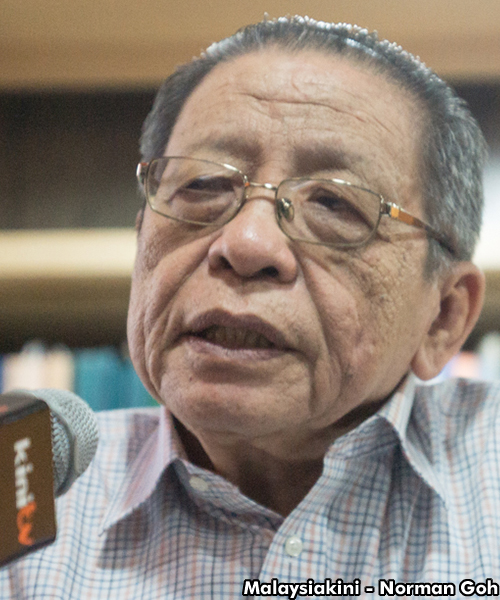 A day after PAS revealed this decision, DAP parliamentary leader Lim Kit Siang (
photo
) took it upon himself to
announce the death
of Pakatan Rakyat.
A day after PAS revealed this decision, DAP parliamentary leader Lim Kit Siang (
photo
) took it upon himself to
announce the death
of Pakatan Rakyat.
"All that is left are the funeral rites," Lim declared.
Ibrahim pointed out that by declaring Pakatan Rakyat dead and engaging in "tit-for-tat" with PAS, both DAP and PAS would lose the respective constituencies that are new to them.
"DAP will lose Malay votes and PAS will lose Chinese votes," he said.
Umno not the biggest enemy
With conservative hardliners grabbing key posts in the party, those pushing for a more inclusive approach jumped ship.
Defeated PAS deputy president Mohamad Sabu led the sails by forming a splinter group, initially an NGO called Gerakan Harapan Baru.
The comrades of Mohamad, who is better known as Mat Sabu, in this mission included former PAS vice-president Salahuddin Ayub and former treasurer Dr Hatta Ramli.
The NGO was meant to facilitate the formation of a new party and on Aug 31 last year, Gerakan Harapan Baru announced that it would take over a dormant political party, Malaysian Workers Party, and rename it Parti Amanah Negara (Amanah).
PAS now has a new enemy in the form of Parti Amanah Negara (Amanah), said political analyst Wong Chin Huat.
"If I'm PAS, my biggest enemy is not Umno now. It's Amanah, in the sense of real politics," Wong told Malaysiakini .
Picking up the rubble
In an attempt to consolidate the remnants of the Pakatan Rakyat project, Opposition Leader Dr Wan Azizah Wan Ismail called a meeting of the opposition leaders.
This would be Wan Azizah’s second time as opposition leader, taking up the mantel after her husband’s Permatang Pauh constituents loyally elected her to take over Anwar’s post as MP.
 Wan Azizah (
photo
), who is PKR president, was also doing what PKR had always done in Pakatan Rakyat – playing the role of mediator.
Wan Azizah (
photo
), who is PKR president, was also doing what PKR had always done in Pakatan Rakyat – playing the role of mediator.
This time, though, it would not work.
In what would set the tone for the months to come, PAS snubbed the invitation to the meeting. What resulted was a new coalition consisting of PKR, DAP and Amanah.
The birth of Pakatan Harapan led to many uncomfortable and yet unresolved situations.
For starters, the conciliatory PKR is trapped between two lovers.
It continues to honour its cooperation with PAS and DAP, to lead the Selangor government with both PAS and DAP executive council members – much to Amanah’s consternation.
No-confidence vote bid a show of weakness
As the opposition dealt with its internal problems, the ruling coalition was facing problems of its own.
Prime Minister Najib Abdul Razak has been plagued by a series of financial scandals since last year and in what is widely seen as an effort to silence dissent, he removed Umno deputy president Muhyiddin Yassin and vice-president Mohd Shafie Apdal from the cabinet.
This caused fissures within Umno, even as the financial scandals, deteriorating economy and plunging ringgit raised the people’s anxieties.
On Oct 22 last year, during the last parliamentary sitting of 2015, Wan Azizah submitted a no-confidence motion against Najib.
Though she said she was confident the motion would succeed, it was never tabled in Parliament.
 Instead of being energised by this effort to rally together to oust an embattled enemy, the no-confidence vote exercise instead showed how weak the opposition bloc is, Merdeka Centre’s Ibrahim (
photo
) recalled.
Instead of being energised by this effort to rally together to oust an embattled enemy, the no-confidence vote exercise instead showed how weak the opposition bloc is, Merdeka Centre’s Ibrahim (
photo
) recalled.
"They couldn't muster support among themselves, let alone try to persuade MPs from across the aisle.
"It's just a highlight of how weak they have become and how they have been unable to form a unified force against BN," Ibrahim said.
No more strategic ambiguity
In an effort to be more unified, Pakatan Harapan, at its first summit meeting, announced that it would no longer hold to the "agree to disagree" principle that was in the common policy framework of Pakatan Rakyat.
The concept of strategic ambiguity - where the parties "agreed to not be clearer" in their vision for the future - which was previously employed by Pakatan Rakyat, can no longer hold water with the rakyat, analyst Wong of the Penang Institute said.
So if Pakatan Harapan stuck to no longer using the "agree to disagree" principle, it could be a step in the right direction, he said.
But animosity with PAS – the second largest Malay-based party after Umno – continues to hamstring the opposition, as evident in the fight against the Trans-Pacific Partnership Agreement (TPPA).
Despite being on the same page against the 12-nation agreement, there was little coordination in the opposition’s campaign against the TPPA.
At the lukewarm anti-TPPA rally last month, PAS supporters gathered at Padang Merbok, while Amanah members remained at Dataran Merdeka – a visual representation of the ravenous gap within the opposition.
DAP supporters, who came out in force at the Bersih rally on Aug 29-30, 2015, were evidently absent at the anti-TPPA rally.
This was a converse of the Bersih rally, where the presence of PAS supporters was clearly felt.
Darker days?
Despite all that has happened to the opposition last year, Ibrahim said it is still too early to say what its prospects are.
It will all depend on what the opposition does, leading up to the 14th general election, he said.
But judging by the bickering , already in high gear over the imminent Sarawak election, things are not looking up.
Taking an optimistic view, Wong said the new coalition has a chance to learn from the past.
"Pakatan Rakyat was untested and it failed the test (in the 13th general election). Pakatan Harapan has to be a new format.
"You cannot pretend that you can go back to the past," Wong said.
Tomorrow: A divided Malaysia after opposition giants fade from centre stage


Are you sure you want to delete this comment?
This action cannot be undone.