


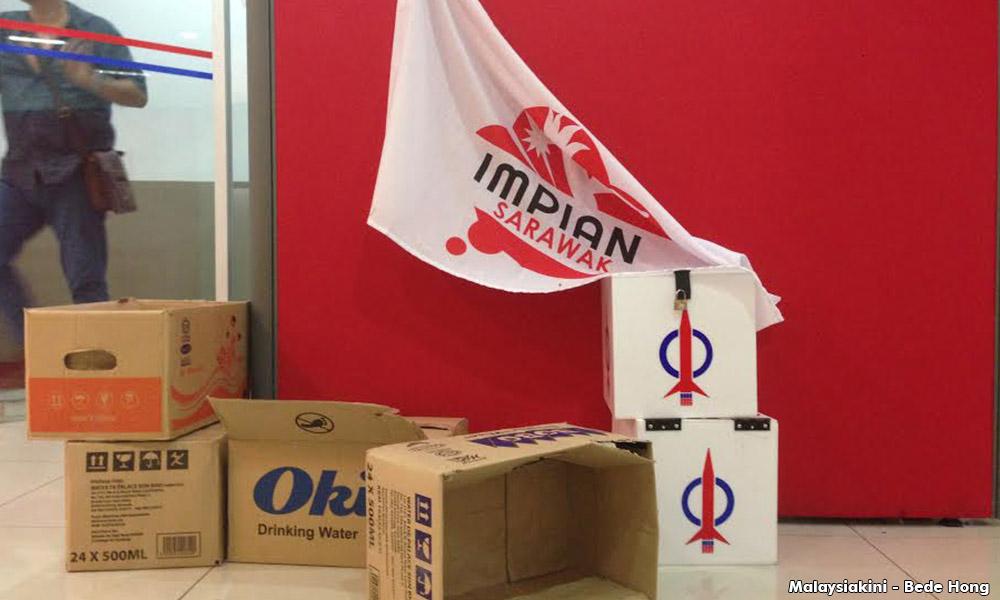

Voters turned off by DAP's 'lack of sexy issues'
ANALYSIS The DAP’s devastating loss in the recently-concluded Sarawak election has confirmed that national issues such as the state-investment fund 1MDB scandal do not resonate well among local voters, analysts say.
Political analyst Jeniri Amir told Malaysiakini that the DAP this time around has no “sexy issues” that can capture the voters’ support.
ANALYSIS The DAP’s devastating loss in the recently-concluded Sarawak election has confirmed that national issues such as the state-investment fund 1MDB scandal do not resonate well among local voters, analysts say.
Political analyst Jeniri Amir told Malaysiakini that the DAP this time around has no “sexy issues” that can capture the voters’ support.
“This time DAP has no 'sexy issues' unlike in 2011 when it was campaigning against (then chief minister) Abdul Taib Mahmud.
“That time the DAP's ceramah can attract up to 15,000 voters. This time, only during last night's grand finale, the party got 10,000 people,” he noted.
“1MDB is not a sexy issue in Sarawak,” he said.
He pointed out that newly re-appointed Chief Minister Adenan Satem's current popularity is much higher than Abdul Taib, who is now Sarawak governor.
In 2011, the DAP won in 12 out of 15 seats it contested, mostly in urban Chinese-majority areas.
his time, the party contested in 31 seats, but only won seven – losing in all new seats that it contested in as well as in five seats it previously held.
This is only one seat more than it held in 2006.
Great achievement
In reiterating that the performance of both BN and DAP should be benchmarked on outcomes in Chinese-majority seats, Jeniri said wresting away five seats was a great achievement for Adenan as state BN chairperson.
Adenan had kicked off BN’s campaign blitz last month by challenging the opposition parties, particularly the DAP, to fight the election only on local issues.
Political analyst Khoo Kay Peng, meanwhile, agreed with Jeniri’s observation that issues such as 1MDB have had little impact on voters.
“Sarawak politics is very different from that in the peninsula. It is very self-contained and localised.
“The changes under Adenan – offering olive branches, reaching out to Chinese voters – are all factors contributing to the vote swing against DAP,” he told Malaysiakini.
According to the Election Commission, the total voter turnout rate was only 52 percent when voting ended at 5pm.
Both Jeniri and Khoo concurred that the turnout – considered to be among the lowest in recent history – has affected the outcome of the election for both sides.
Jeniri, however, offered several factors that could have contributed to the situation.
He cited the opposition’s campaign against Taib in 2011 and the quest to take over Putrajaya during the 2013 general election as being key mobilising factors for voters from both sides of the political divide.
“This (2016 state election) is not an extraordinary election like in 2011 or 2013.
“At that time, both sides have to protect their interests and mobilise voters to come out,” he explained.
'Rightfully punished'
With the Gawai harvest festival coming up on June 1, Jeniri said Dayak voters living outside their constituency may also decide to not return to vote.
“Also, Chinese voters in some areas are in a dilemma. On the one hand, they like Adenan but they also wanted to vote for the opposition.
“So in the end they chose to abstain from voting,” he added.
Aside from the DAP’s seven assemblypersons, the Sarawak state opposition bench now comprises three incumbents from PKR who defended their seats in Ba’Kelalan, Batu Lintang and Krian.
Jeniri said the victories were expected based on their track records over the last five years.
Khoo, however, said the outcome only “clearly shows that PKR did not appear to be the aggressive party” in its clash with DAP.
PKR and DAP faced off against each other, BN and others in six constituencies – all of which were eventually won by BN.
Political analyst Andrew Aeria summed up the outcome as being a punishment for both Pakatan Harapan parties.
“There are loud lessons (to be learnt) for PKR and DAP. But will they learn?
“PKR and DAP are rightfully punished by the electorate.
“Leaders of both parties (Sarawak DAP chief Chong Cheng Jien and Sarawak PKR chief Baru Bian) should take responsibility for this debacle and resign from their party positions,” he said.
The newly-formed Sarawak state government under Adenan's leadership now controls the state legislative assembly with an 87.8 percent super-majority.


Report this comment
Are you sure you want to delete this comment?
This action cannot be undone.