


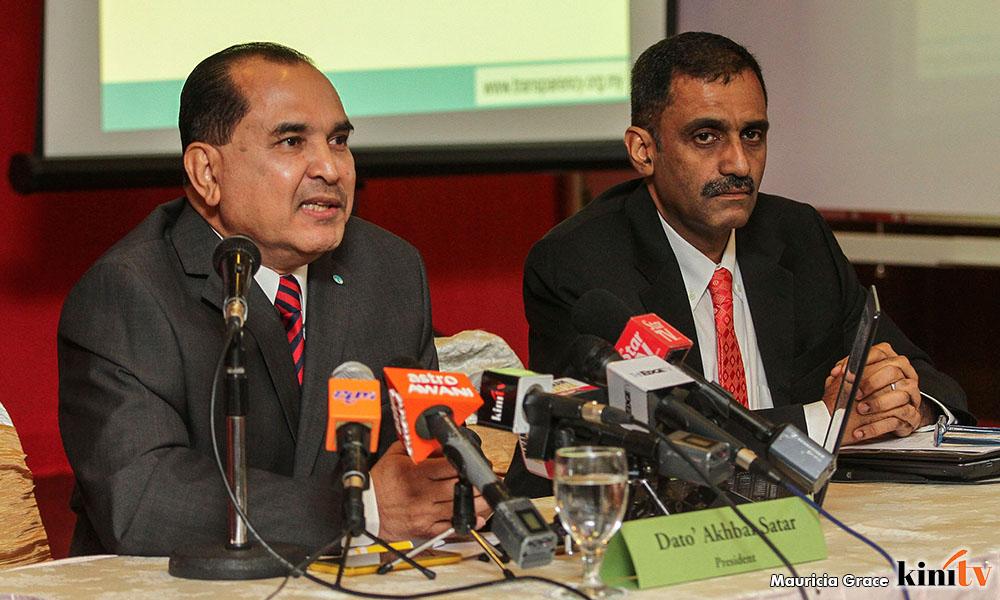

TI-M: All politicians corrupt, so choose the less corrupt
Transparency International Malaysia (TI-M) has asked Malaysians to choose between the lesser of two evils in the upcoming general election.
Acknowledging that it is difficult to find politicians who are not corrupt, TI-M president Akhbar Satar said voters should cast their ballots for those who are considered to be "less corrupt".
Transparency International Malaysia (TI-M) has asked Malaysians to choose between the lesser of two evils in the upcoming general election.
Acknowledging that it is difficult to find politicians who are not corrupt, TI-M president Akhbar Satar said voters should cast their ballots for those who are considered to be "less corrupt".
"It is best for society to choose leaders who are not corrupt, so we must make sure that we don't vote in corrupt politicians in this upcoming election.
"It appears, however, there is no politician who is not corrupt so we should choose the ones who are less corrupt," he told reporters after presenting the Corruption Perception Index (CPI) 2016 in Kuala Lumpur today.
Akhbar was responding to a question on how corruption can be curbed in Malaysia when corrupt officials hide behind the Official Secrets Act (OSA).
Malaysia slipped from the 54th to 55th spot on the CPI. This is far behind Singapore, which rose up one spot to 7th in 2016.
Akhbar said the lack of exemplary leadership is among the reason for the "sad" state of affairs.
However, he pointed out that the duty of stamping out corruption does not only lie on the shoulders of the federal government alone.
"This is not just for the ruling federal government but also those from the opposition; there are also corruption at state levels.
"So it is important that there are laws and that these laws are enforced, but then again, the politicians can also destroy these laws, can't they?" he asked.
"We must show a good example if we want people to follow us, it is simple arithmetic," he added.
Akhbar said enforcement bodies must also uphold integrity by not conducting selective persecution and prosecution.
"If there is a case and they refuse to prosecute, then they will have to wait and answer this on judgment day," he added.


Report this comment
Are you sure you want to delete this comment?
This action cannot be undone.