



Penangites want halt to development on M'sia's 'Alcatraz'
A public forum on #SavingJerejak yesterday concluded with participants submitting eight recommendations to the Penang government.
The participants want the state government to protect the island dubbed Malaysia’s Alcatraz.
A public forum on #SavingJerejak yesterday concluded with participants submitting eight recommendations to the Penang government.
The participants want the state government to protect the island dubbed Malaysia’s Alcatraz.
This follows alleged plans to redevelop 80 acres of the island, with 1,200 units of residential homes, a marina, hotels, a theme park, and an 11.5km round island cycling track.
The 150 participants urged an immediate moratorium on development on the 894 acre island, which is located off the shore of Bayan Lepas.
The group urged that the whole island be gazetted as a state heritage site under the Penang State Heritage Enactment.
They also seek for the island to be listed as a national heritage site under the National Heritage Act.
Led by Penang Forum, a coalition of 14 NGOs, the group wants the state to conduct public dialogues and seek feedback on development plans on the island.
“Commission an independent masterplan for Pulau Jerejak, taking into account its values as a socio, cultural and historical landscape,” said one recommendation.
“Gazette the island as state park, complete a full study and documentation of the natural biodiversity of Pulau Jerejak,” said another.
The session was conducted by Sharom Ahmat, Penang Forum’s spokesperson, at the Penang Institute, yesterday.
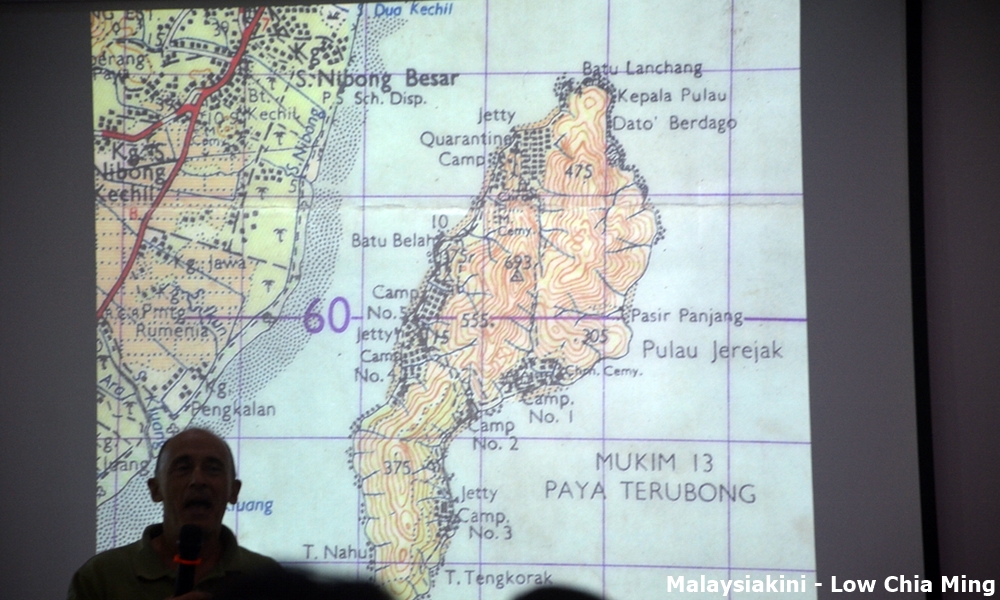
The two-hour session saw speakers Penang Heritage Trust (PHT) president Lim Gaik Siang, academician Por Heong Hong, British expat Mike Gibby and PHT honorary secretary Ben Wismen gave a detailed description of Jerejak’s historical, social, cultural and environmental landscape.
“Pulau Jerejak was also a detention centre during the Malayan Emergency; after 1969 (racial riots), it became a prison where many infamous criminals were held,” said Lim.
“Therefore, Pulau Jerejak holds great significance in the history of the nation,” she added.
Por said a place’s dark past is as significant as its glorious aspects.
“It is much a reflection of those who were marginalised and displaced as it is about those who implemented segregation and detention,” she said, reading out the presentation by lecturer Lim Yong Long.
“These legacies have a role in reminding us to keep a sense of justice when dealing with human segregation policies in the future,” she added.
Gibby, who lived most of his life in South-East Asia and Penang, said in 2000, plans were made to build a resort on Jerejak.
This is when many of the old historical buildings - the leprosy and quarantine camps - were demolished.
“Today, very few buildings remain, and the ones still standing are threatened by development of condos, a marina and spa”.
Wismen said the island is home to more than 120 species of plants and animals (50), birds (30), mammals (six) and bats (two).
The island was declared a forest reserve as early as 1884, he noted.
“The proposed development may fragment the island, destroying this natural in situ conservation habitat,” said Wismen.
“Two hundred and ninety five hectares of its forest are still waiting to be gazetted as a reserve, but until then, it’s susceptible to clearing and logging,” he added.
Plans for state park
There were proposals by the Town and Country Planning Unit, in the Draft Structure Plan for Penang, to convert Pulau Jerejak into a state park.
Chief Minister Lim Guan Eng had said that this would exclude land currently occupied by a resort and a shipyard.
Summarising the presentations, conservationist Loh-Lim Lin Lee dubbed Jerejak the Ellis Island of Malaysia.
She noted that from 1877 to 1940, 1.13 million people went through the island before proceeding onwards to Penang and the mainland.
“If any of your forefathers came within that period, they would have been processed at Jerejak,” she said.
These include all sea travellers who came from the Indian subcontinent, China or Muslims who went on the haj pilgrimage.


Report this comment
Are you sure you want to delete this comment?
This action cannot be undone.