




PAS will be sidelined in next polls, claims Rafizi
The next general election is shaping up to be a contest between Pakatan Harapan and BN, with PAS at the sidelines, claims PKR vice-president Rafizi Ramli.
Announcing the findings of a survey conducted by his NGO Invoke's Centre for Policy Initiatives (I-CPI), Rafizi highlighted that support for PAS is dwindling and the party would not fare well, even in three-cornered fights...
The next general election is shaping up to be a contest between Pakatan Harapan and BN, with PAS at the sidelines, claims PKR vice-president Rafizi Ramli.
Announcing the findings of a survey conducted by his NGO Invoke's Centre for Policy Initiatives (I-CPI), Rafizi highlighted that support for PAS is dwindling and the party would not fare well, even in three-cornered fights.
“The contest is steadily shaping up to be just between BN and Pakatan Harapan. PAS votes are still significant, but only limited to certain states.
“It is significant in Terengganu and Kelantan, but even its support in Kedah has gone down drastically because of the presence of (Parti Pribumi Bersatu Malaysia, its chairperson Dr Mahathir Mohamad, and its deputy president Mukhriz Mahathir).
“In other states, PAS was never strong to begin with, all these years,” he told a press conference this afternoon.
The latest I-CPI survey asked voters a total of 40 questions, most of these on their voting preferences in various scenarios involving straight fights or three-cornered fights in an election.
The aim was to measure the level of support for each Harapan component party against that of Bersatu, PAS and Umno, and the extent to which supporters of a Pakatan Harapan component party or Bersatu would also vote for another Harapan party.
It found that PAS was lagging 19 percentage points behind Umno in three-cornered fights, and 16.9 percent points in a straight fight. In both cases, it performed the worst, compared with PKR, Bersatu and Amanah.
At 87.2 percent, PAS supporters are also the least likely to express interest to turn out to vote in a three-cornered fight.
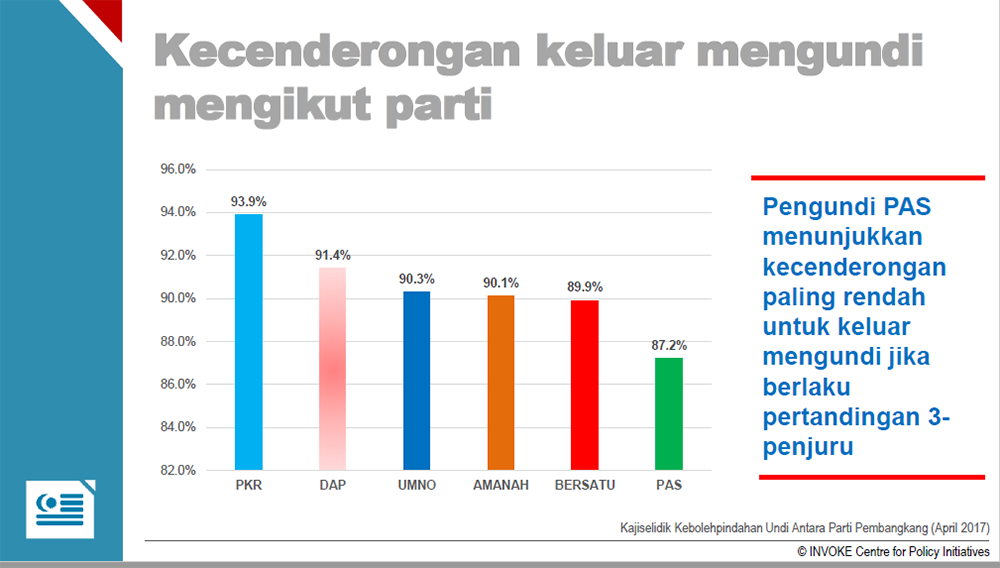
Those who had voted for Pakatan Rakyat in the last general election were also nearly twice as likely to choose a Pakatan Harapan party or Bersatu over PAS in three-cornered fights between PAS, Umno and any Pakatan component party or Bersatu.
Voting to be based on coalitions and causes
The survey also showed that Harapan supporters would vote based on coalitions and causes, rather than on individual parties.
“This should put into perspective the relative strength when you are on your own, (compared with) when you are in a coalition.
“Many of the votes in the 13th general election were from fence-sitters - people with no party affiliation. They support a cause. They don’t support political parties per se,” Rafizi said.
He said it was also “common sense” that support for PAS would dwindle. As the Islamist party appeals to only a segment of society and only in a small area, its importance in national politics diminishes.
Rafizi said this was why he had taken PAS to task for not raising the 1MDB issue in the recently concluded parliamentary session, as he already had the preliminary findings of the survey in hand at the time.
The survey entailed phone interviews conducted between Feb 6 and April 6 this year. A computer dialled 1.67 million phone numbers picked at random, of which 116,922 people answered the phone, and 10,523 completed the survey.
The data was stratified by race, gender, age and state to ensure a representative sample.
Survey to be used in seat talks
Rafizi said the survey would be used in seat negotiations and to identify areas for further cooperation between Pakatan Harapan parties and Bersatu.
However, this does not mean the parties with the most supporters would get to contest in the constituencies, as this would end up with only PKR and DAP representing Pakatan Harapan in the election and that wouldn’t be fair.
“It doesn’t work like that… While the result is going to be a good guide, it also shows us the gaps that we have to close.
“Chances are, we would have to be equitable to allow every party to have a strong presence in every election. We have to be equitable to Amanah and Bersatu.
“But for that to happen, that means Amanah and Bersatu have to make sure that the Malay votes are converted to DAP as well, and vice-versa.
“PKR and DAP have to help Amanah and Bersatu to convert more non-Malay votes, because if we give them these seats and we are not able to push up the non-Malay votes, then we will lose those seats,” Rafizi said.
The survey found that in event of a three-cornered fight between Umno, PAS and PKR, 87.2 percent of DAP supporters would vote for PKR. However, barely more than 80 percent of Bersatu or Amanah supporters would do the same.
Likewise, more than 80 percent of PKR and Amanah supporters would vote for a DAP candidate in a similar scenario, but only 69.8 percent of Bersatu supporters would support the DAP candidate.
Also, the survey found that 78 percent of Amanah supporters would be willing to vote for Bersatu, but less than two-thirds of PKR and DAP supporters would support Bersatu candidates.
Bersatu supporters are 68.2 percent likely to vote for an Amanah candidate over Umno or PAS, but only 61 percent of PKR and 65.5 percent of DAP supporters would do so.


Report this comment
Are you sure you want to delete this comment?
This action cannot be undone.