




Experts: Treat drug abuse as public health issue, not crime
A roundtable discussion on drug policy comprising health experts and enforcement agencies has resolved that the country's approach to drug abuse requires urgent reforms.
In particular, participants called upon the authorities to view drug abuse as a public health issue, and not as a criminal justice issue, in view of large volume of empirical research supporting this.
Several experts who presented their findings during the discussion outlined problems posed by the existing drug policies, such as how incarceration of an addict without treatment would cause relapse and other problems.
Alternatives to the current punitive approach, said the experts, was decriminalisation of individual drug users and diverting drug users from prison to community-run rehabilitation services.
"Not all drug users need to be in hospital and certainly not in prison.
"Through the discussions we have today, we hope to assist the police and others to relook at how things are being handled at the moment," said the dean of Universiti Malaya’s Faculty of Medicine, Dr Adeeba Kamarulzaman, who chaired the discussion at the Institute of Strategic and International Studies (Isis) in Kuala Lumpur yesterday...
A roundtable discussion on drug policy comprising health experts and enforcement agencies has resolved that the country's approach to drug abuse requires urgent reforms.
In particular, participants called upon the authorities to view drug abuse as a public health issue, and not as a criminal justice issue, in view of large volume of empirical research supporting this.
Several experts who presented their findings during the discussion outlined problems posed by the existing drug policies, such as how incarceration of an addict without treatment would cause relapse and other problems.
Alternatives to the current punitive approach, said the experts, was decriminalisation of individual drug users and diverting drug users from prison to community-run rehabilitation services.
"Not all drug users need to be in hospital and certainly not in prison.
"Through the discussions we have today, we hope to assist the police and others to relook at how things are being handled at the moment," said the dean of Universiti Malaya’s Faculty of Medicine, Dr Adeeba Kamarulzaman, who chaired the discussion at the Institute of Strategic and International Studies (Isis) in Kuala Lumpur yesterday.
The session was attended by more than 50 people, including Royal Malaysian Police Narcotics Crime Investigation Department deputy director Kang Chez Chiang, the National Anti-drug Agency (AADK), Ministry of Health representatives, Sungai Buloh and Kajang prison representatives, the Malaysian AIDS Council, transgender activists, lawyers, doctors, NGOs and researchers from Malaysia, Thailand, Australia and the United States.
The event was held ahead of finalisation of the National Drug Policy, which was being formulated by the AADK.
Problems with the current approach
John Hopkins Center for Public Health and Human Rights director Professor Chris Beyrer opposed putting drug users through the criminal justice system.
"Does mass incarceration of drug users help stop drug addiction and drug-related diseases like HIV? The answer is clearly no. In fact, imprisonment increases transmission of diseases," Beyrer said.
He explained how drug users needed to be seen as patients, as current drug users often suffer mental health issues, such as psychosis.
"Drug users are less likely to have any benefit from incarcerations and prison sentences. Plus they are a real challenge for criminal justice people, who are not trained to deal with psychotic people.
"The prison is a terrible place for people with psychosis and who are paranoid," he said.
Sixty percent of the Malaysian prison population are those serving drug-related sentences, Beyrer added.
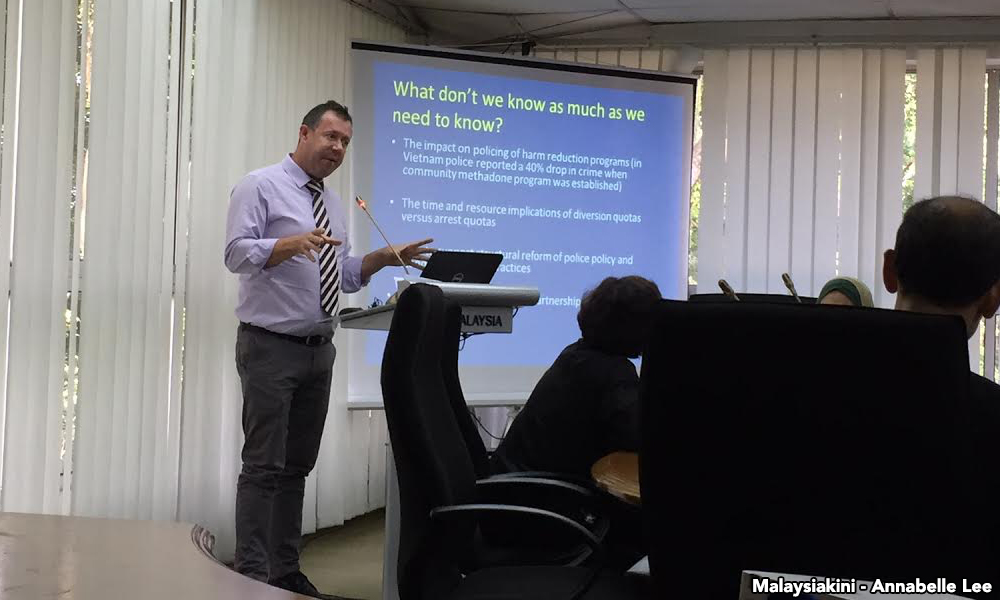 The programme director of the Law Enforcement and Public Health programme at the University of Melbourne, Australia, Nick Thomson (standing, in photo), explained that research has shown that incarceration ultimately targets the most vulnerable populations.
These people have the highest risk for many infectious diseases, Thomson said, as they are held in an environment where there is a lack of evidence-based treatment.
"(Thus) an individual's health often deteriorates in prison," he said.
Old methods don't prevent relapse
Adeeba recommended that the authorities adopt community-based rehabilitation programmes, citing the AADK's Cure and Care (C&C) programme against mandatory rehabilitation programmes (Puspen).
"We did a comparison of the outcome between patients... and results showed an amazing difference in terms of relapse periods - 30 days after being released from Puspen versus one year after going to a C&C," she said.
Concurring, Thomson said such models would require cooperation from the police to stop drug users from facing punitive action.
"Stopping people from going into the criminal justice system will give us the best chance in keeping them out (of further drug abuse).
"But for that to happen, the police would need the authority and incentive to divert, not arrest," he said.
Both Thomson and Adeeba raised the issue of how drug users were often left to fend for themselves after being released from prison or rehabilitation.
"Getting released back to the community is a very tumultuous process for a person and the people around them.
"We need models and systems that provide continuity of care, (or else) people risk remission and transmission of drug-related diseases back to the community," Thomson said.
The roundtable also saw the re-launch of two papers commissioned by John Hopkins University and UK-based medical journal The Lancet - "Public health and international drug policy", which included Malaysia as an area of research, and "HIV and related infections in prisoners".
Adeeba is among the authors of both papers.
The papers were funded by the Bill & Melinda Gates Foundation, the US National Institute on Drug Abuse and the US Centre for AIDS Research.


Report this comment
Are you sure you want to delete this comment?
This action cannot be undone.