



Harapan: PM shouldn’t direct EPF, Khazanah to invest in US
Prime Minister Najib Abdul Razak should not have “directed” the Employees’ Provident Fund (EPF) and Khazanah Nasional to invest in the US, Amanah strategy director Dzulkefly Ahmad said today.
He said both state-owned funds are professionally run and should be free of governmental interference.
“Investors are the worst cowards. They will only invest when they can get returns. But now Najib wants to take advantage of things and say things that shouldn’t be said because Khazanah and EPF are both professional investors.
“They cannot be directed by Najib to make infrastructure investments if it would not bring good returns for Malaysia, Khazanah and EPF,” Dzulkefly said at a Pakatan Harapan press conference in Petaling Jaya...
Prime Minister Najib Abdul Razak should not have “directed” the Employees’ Provident Fund (EPF) and Khazanah Nasional to invest in the US, Amanah strategy director Dzulkefly Ahmad said today.
He said both state-owned funds are professionally run and should be free of governmental interference.
“Investors are the worst cowards. They will only invest when they can get returns. But now Najib wants to take advantage of things and say things that shouldn’t be said because Khazanah and EPF are both professional investors.
“They cannot be directed by Najib to make infrastructure investments if it would not bring good returns for Malaysia, Khazanah and EPF,” Dzulkefly said at a Pakatan Harapan press conference in Petaling Jaya.
PKR strategy director Sim Tze Tzin, who was also present, cautioned that this may not be the best time to invest in the US, given that its stock market has been booming for nine consecutive years.
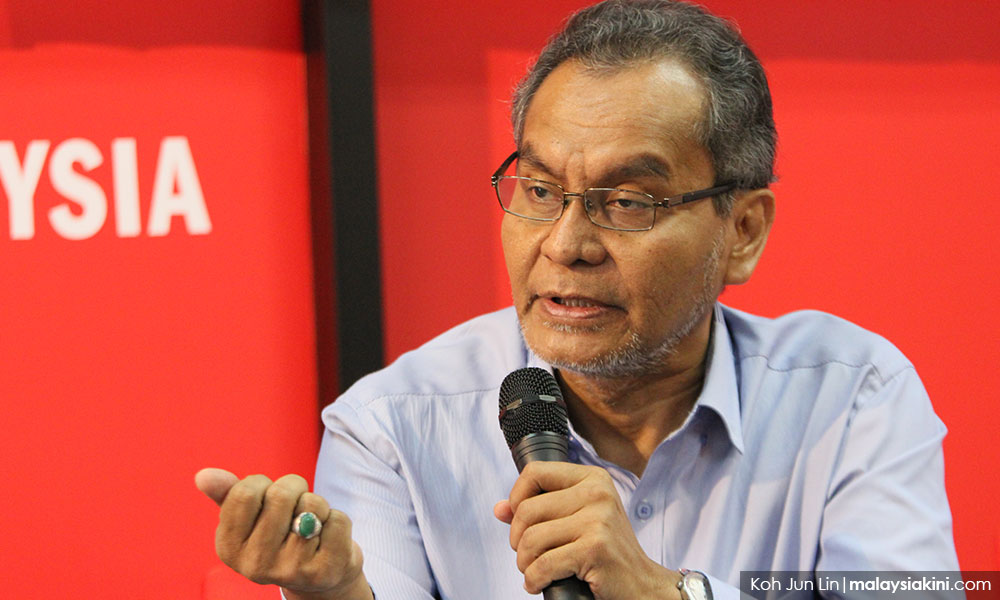
 While conceding that EPF is a well-run fund, Sim (photo) hoped the fund would perform with extra due diligence on its investments, instead of merely following the prime minister’s instructions.
“This is the biggest boom in the history of the New York Stock Exchange. So, word of caution: If you want to invest, you invest when it is low and then sell when it is high. Now it is at its highest.
“So we are worried about our funds, our money, because the margin you get may not be as good as when you are coming in (to the US market) after the subprime (mortgage) crisis in 2008 and 2009.
“Many Malaysians are expressing their worries and weariness. If something happens – touch wood (that nothing does) – and there is a ‘correction’ in the stock exchange, then their retirement money will be in jeopardy,” Sim said.
In his opening statement at his meeting with US President Donald Trump and his cabinet on Sept 12, Najib said the EPF has close to US$7 billion in equities in the US and would invest an additional US$3 billion to US$4 billion for infrastructure development in the US.
Rebuilding the US’ ailing and underfunded infrastructure was a key promise in Trump’s presidential election campaign.
Najib also announced that sovereign wealth fund Khazanah Nasional Bhd, which has an office in the Silicon Valley and has invested US$400 million in high-tech companies, would increase its investments.
Najib is the chairperson of the Khazanah board.
EPF gives its assurance
In response to the announcement, the EPF gave its assurance that every investment proposal would undergo “a stringent risk assessment and robust due diligence process to protect the interest of its 14 million members”.
It said it scrutinises foreign investment opportunities that fit its risk and return profile as a retirement savings fund, in line with its long-term overseas diversification programme.
As for aviation industry, Najib said Malaysia Airlines would buy 25 Boeing 737 MAX 10 aircraft and eight Boeing 787 Dreamliners, and there was also a “strong probability” of adding 25 more 737 MAX 10 aircraft to the order in the future. He also offered to help persuade AirAsia to purchase General Electric engines.
However, Parti Pribumi Bersatu Malaysia (Bersatu) policy and strategy bureau chief Rais Hussin questioned whether MAS could afford the purchase.
Rais pointed out that MAS had sold some of its planes as part of its restructuring exercise, and had retrenched its employees on several occasions.
“The idea was to reduce cost and bring profitability to the company again… so given all these backgrounds, does MAS really need the aircraft right now?
“How is MAS going to raise funds to buy the aircraft? We know that MAS does not have deep pockets, so how are they going to fund? Another bond? Another sukuk issuance guaranteed by the government? And guess what, if they cannot pay, what happens? Bailout again?” Rais said.
Najib justified the investments he announced by saying that it would reap returns and that MAS needed the new aircraft to remain competitive.
Several aviation industry experts had told Malaysiakini that the aircraft purchase is viable as MAS needs to replace its ageing fleet and comply with stricter regulations, but stressed the need for transparency in the deal.


Report this comment
Are you sure you want to delete this comment?
This action cannot be undone.