




The Msian who helped bring peace to Aceh
When the Acehnese rebels signed the Aug 15 peace accord with the Indonesian government, ending three decades of war, one man should have been at the momentous event in Helsinki, Finland - Malaysia's Prof P Ramasamy.
When the Acehnese rebels signed the Aug 15 peace accord with the Indonesian government, ending three decades of war, one man should have been at the momentous event in Helsinki, Finland - Malaysia's Prof P Ramasamy.
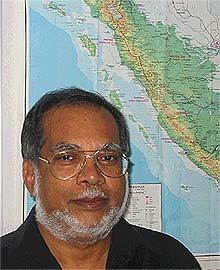 Considered a close friend by many top GAM (Free Aceh Movement) leaders, Ramasamy was often consulted for his views in the years leading to the peace negotiations.
The academic was at the first rounds of the talks in January as an observer.
And according to him, this resulted in his controversial sacking by Universiti Kebangsaan Malaysia last month.
"Apparently Indonesia protested to Wisma Putra (Malaysia's Foreign Ministry) about that. Otherwise I don't see why Malaysia should be concerned about it. I'm not the official advisor of GAM," he told malaysiakini in a recent interview.
"Of course, GAM came to see me and a lot of other people also came for advice. That did not mean I was their official advisor."
Elsewhere, Ramasamy's contribution to bringing peace to Aceh would have been recognised.
"Some people came to me and said, 'Prof, in some countries you could have been given an award'," he said.
"I contributed in some meaningful ways (to the peace process). They have a peace agreement now. Malaysia should be happy. At least, we can send home 40,000 Acehnese who are here."
Instead, his academic contract was abruptly terminated early last month.
Since Ramasamy retired at the age of 56 in March, he was given an unusual month-to-month contract to continue lecturing at the university until 2007.
Ramasamy spent his final day at UKM last Thursday. The shock termination had left many of his students in the lurch, including 12 PhD students who were under his supervision.
Labour rights champion
The political science professor, who had been with the university for a quarter of a century, started out as a campaigner for labour rights. He dedicated his time, when not teaching, to championing the rights of workers in plantations and the Felda scheme.
It was later that he developed an interest in the national liberation struggles around the world, especially the Tamil Tigers who are fighting for independence in northeast Sri Lanka.
In the course of his research, he had visited Tigers' occupied territories in the northeast and even met with their legendary and shadowy leader, Velupillai Prabakaran.
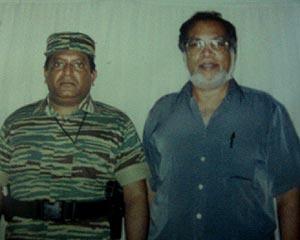 Until last week, a photo of Ramasamy and Prabakaran sat on his desk in the professor's office at UKM's Centre for History, Political Science and Strategic Studies.
Prabakaran was so impressed with Ramasamy that he was the only non-Sri Lankan appointed to sit in the rebels' Constitutional Affairs Committee to help draft a proposal for an interim administration in Sri Lanka's northeast in 2003.
Not surprisingly, Ramasamy is considered a world-renowned expert on the Liberation Tigers of Tamil Eelam (LTTE).
His interest in another national liberation movement, this time closer to home - the independence struggle of the Acehnese - came much later.
"There were number of Acehnese students at the university who worked with me, and I talked to them, listened to them. I was very sympathetic with their cause."
He subsequently helped to organise seminars for the students who had fled Aceh when martial law was imposed by Jakarta in 2002.
"We discussed about Aceh, Indonesia, Papua and I would give them information on how they (LTTE) were trying to resolve their problem. It was a fantastic exchange of opinions in a very sterile atmosphere in the university."
Self-governance in Aceh
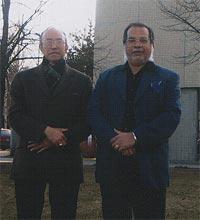 He was later introduced to top GAM leaders, some of whom are living in Malaysia, while others were in Sweden, including the rebels' self-styled prime minister and chief negotiator Malik Mahmud (
photo, left
).
He was later introduced to top GAM leaders, some of whom are living in Malaysia, while others were in Sweden, including the rebels' self-styled prime minister and chief negotiator Malik Mahmud (
photo, left
).
When the peace negotiations - brokered by Finland-based mediator Crisis Management Initiative - were mooted, GAM leaders sought Ramasamy's opinions, especially given his experience with the peace process in Sri Lanka.
"They (Acehnese) reject the special autonomy offer but they will go for the self-government of Wilayah Aceh. Independence is something integral and essential to them. They have talked about independence for 30 years. It doesn't matter," said Ramasamy.
"You can go for a deal with some dignity intact, some international support, and at the same time they are able to control their natural resources, allow for Indonesia to withdraw and also for European Union participation."
Eventually GAM signed a historic peace deal with Jakarta by dropping its long-held demands for independence, putting an end to a brutal war which claimed 16,000 lives.
Indonesia in turn promised an amnesty for all political prisoners, to allow the creation of local political parties in the province and to withdraw its security forces by the end of the year.
"The university should be proud that I was doing something good," said Ramasamy.
Instead, he said UKM was unable to accept that an academic can play a bigger role other than teaching.


Report this comment
Are you sure you want to delete this comment?
This action cannot be undone.