




Court clean-up mess resolved, janitors back to work tomorrow
Janitorial services at the Kuala Lumpur Court Complex are expected to be restored tomorrow, according to a spokesperson for sanitation contractor Perfect Three Solutions Sdn Bhd.
The spokesperson said that the company is taking steps to resolve the problem as soon as possible.
“Tomorrow we will start work. Tomorrow we will bring workers from some other sites,” he told reporters at a gotong-royang (mass volunteering) event to clean up court complex...
Janitorial services at the Kuala Lumpur Court Complex are expected to be restored tomorrow, according to a spokesperson for sanitation contractor Perfect Three Solutions Sdn Bhd.
The spokesperson said today that the company is taking steps to resolve the problem as soon as possible.
“Tomorrow we will start work. Tomorrow we will bring workers from some other sites,” he told reporters at a gotong-royang (mass volunteering) event to clean up court complex.
Chief Judge of Malaya Zaharah Ibrahim, who was also present at the cleaning session, said steps are being taken to ensure that such problems do not recur.
“We have an understanding with the contractor. We have had discussions with him, going around checking with him.
“We hope that whatever problem that we have will be resolved by tomorrow at least,” she said.
Chief justice Richard Malanjum said the contractor's problems with its employees is not a long-term issue, while Zaharah said there had been a misunderstanding “between what has been promised and what has been performed.”

On strike
According to the Perfect Three Solutions spokesperson, the problem started lasted Thursday and lasted for a week. He also denied earlier reports that the workers had gone on strike over unpaid wages.
“They had been paid last week. When we paid them, they promised to come, but somehow they didn’t come. We never expected this."
He said the company had about 120 workers in the building, but nearly 100 had since gone on strike.
His account, however, differed from those of several court officers, who told Malaysiakini that Perfect Three Solutions’ janitors have been on strike for weeks.
According to the government’s MyProcurement website, Perfect Three Solutions had been awarded a RM5,806,425.60 contract to not only clean up and beautify the court complex, but also provide landscaping and pest control services.
The website does not specify the tenure of the contract nor when it was awarded.
The Star reported yesterday that janitors had stopped receiving their pay since Ramadan, despite the government having paid the contractor for its services until the end of the year.
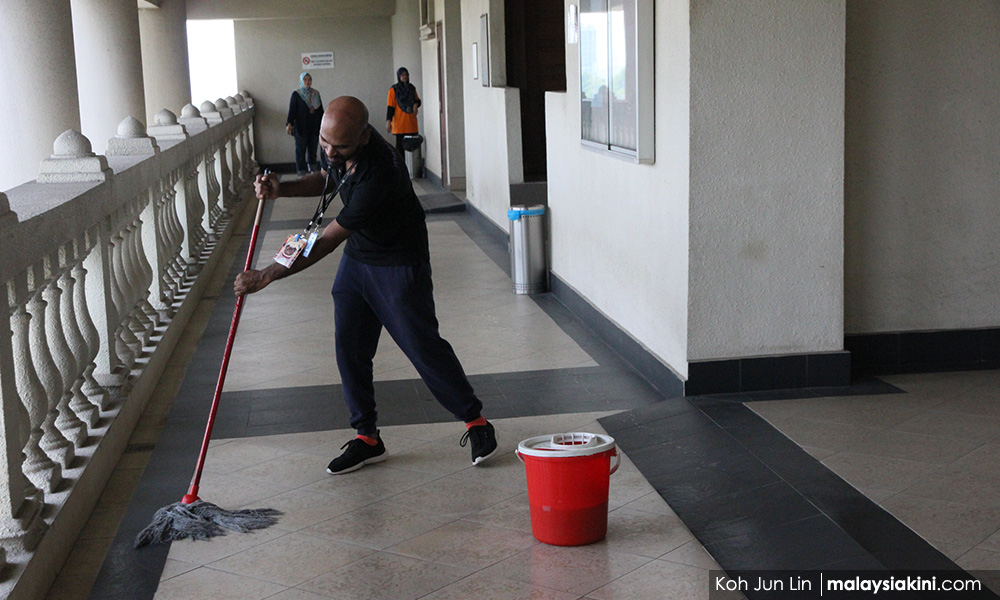
This resulted in court officers, including high court judges, being rostered to clean their own toilets for weeks, and lawyers complaining of the condition of the public toilets.
Mass clean-up
As a result, Malanjum called for a gotong-royong to be held today to clean up the complex, including its public toilets and other public areas.
He arrived at about 10am to launch the event, and then re-emerged at about 3pm, hours after the cleaning had already wound down. This is his first visit to the court after being sworn in as chief justice on July 11.
As the cleaning was going on, a legal officer, who declined to be named, said she began noticing that janitors were turning up less frequently in the first week of July, and then stopped turning up at all on July 9.
A court interpreter, who also declined to be named, said problems had began about two weeks ago, while a Sessions Court judge said it started after Hari Raya on June 15.
“It came suddenly. At first we were wondering why the janitors weren't coming to collect the garbage, since they usually come every morning. Later we were told they were on strike,” the court interpreter said.
In response to the cessation of janitorial services, Kuala Lumpur Court director Ahmad Kamar Jamaludin ordered court officers clean some court facilities according to a timetable, which would help keep the staff and executive toilets clean.
Unsurprisingly, this had caused some disgruntlement amongst the officers. Some said the contractor should be terminated, while others said they cannot always follow the schedule, especially on busy days.

“This is supposed to be managed by the contractor. If they are not giving the (services), then you terminate the contract.
“It’s not fair. It’s not our job. Yes, we can help but not to the extent of a month or two. I heard it’s until November, you know.
“So, the company took the money, don’t know go enjoy where, and we’re here, stuck, working. We don’t even get overtime or unrecorded leave and so forth,” the legal officer said.
She added that some officers had refused to participate in the cleaning on basis that it is not their job.
No other option
As for Malanjum’s move to hold a gotong-royong, the Sessions Court judge said there is no other option.
“We have no choice because to get a new contractor, it would definitely take time. I was informed that the existing contract will expire in December, so there is another four, five months.
“Everyday, when the public comes to court they use the toilet and facilities and they throw everything.
“So, what are the solutions can we have here? The gotong-royong is the only alternative,” she said.
The interpreter said Sunday is supposed to be a rest day for everyone, while the legal officer said it is not fair to notify court officers about the gotong-royong at the ‘last minute’ at the late hours of Friday, because some officers – especially parents like herself – may have other commitments over the weekend.

However, while launching the gotong-royong, Malanjum had said that the officers’ participation is voluntary, and they are free to leave whenever they wish.
Asked about this, the interpreter said she had to ‘clock-in’ when she arrived like a workday, while the legal officer said Ahmad Kamar had said that attendance is compulsory.
“Yeah, he said if you want to go home you can. But the problem is, would my boss let me go?
“So, it looks good on him (Malanjum), but the reality is… Would you dare if you have been given orders that attendance is compulsory?” she said.
Among the participants of today’s gotong-royong was lawyer Kitson Foong, who appeared to be the only lawyer present.
“The public perception of institutions that administer justice is important. Members of the public come here – foreigners, locals… Imagine how you would feel if you stepped into a court in England and it was in shambles.
“So, as a user, it’s the least I can do,” he said, while adding he hopes he won’t have to come often.
Foong expressed disappointment that other lawyers did not join the gotong-royong despite having complained about it.


Report this comment
Are you sure you want to delete this comment?
This action cannot be undone.