




Answer Dr M, Anwar tells Pak Lah
Prime Minister Abdullah Ahmad Badawi must respond to his predecessor Dr Mahathir Mohamad's criticism against national policies administered by the current government, said ex-deputy premier Anwar Ibrahim today.
Prime Minister Abdullah Ahmad Badawi must respond to his predecessor Dr Mahathir Mohamad's criticism against national policies administered by the current government, said ex-deputy premier Anwar Ibrahim today.
He said while Abdullah may have the liberty to ignore Mahathir on personal issues - which include the allegations of backstabbing and not being given the due recognition - the premier cannot ignore allegations concerning the economy, corruption, the media and the judiciary.
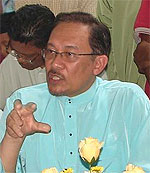 "Personal issues do not interest the people. But the criticism in regards to national policies [...] as a responsible leader I urge him to respond. He must do it clearly because the people must know the truth. The people must be given the chance to evaluate the authenticity and the veracity of these assertions.
"He cannot ignore this. He must deal with it otherwise he cannot have the moral claim of confronting these issues head on as he had made before," he said at a press conference in Taman Medan, Petaling Jaya.
Anwar was commenting on the row between Abdullah and Mahathir after the latter accused the former of breaking his promises and damaging the country by rolling back earlier economic initiatives.
Among the allegations made by Mahathir are abuses of the Approved Permits (APs) and the selling of motorbike firm Agusta by national car manufacturer Proton for RM4 to a 2-euro Italian company.
Anwar himself was Mahathir's heir apparent until he was sacked as deputy prime minister in 1998 for alleged sexual misconduct. Mahathir subsequently appointed Abdullah as his deputy.
Foolish allegations
Anwar also said Mahathir's claims that media was less constrained and that the judiciary had more credibility during his administration as 'foolish', adding that 'only ignorant people or those oblivious to the stark reality would believe so'.
He said that Mahathir's views were often skewed as he was surrounded by people wanting to be in the veteran politician's good books.
"He is surrounded by tok ampu (apple polishers) who never tell him the real picture. That is why he never gets the real truth. In that sense, I pity the man."
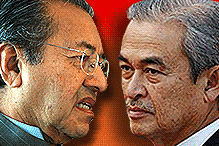 When asked to comment on Abdullah's difficulties in dealing with Mahathir, Anwar said the entire episode was nothing compared to what he had experienced with Mahathir.
"At least Abdullah has not been assaulted or stripped naked or thrown into jail. He should be thankful that he is now a prime minister. If he is still the deputy, God save him. Because then all the instruments of the government, the police, the judiciary and the media, will be used to hammer him without any possibility of defence."
To Mahathir's claim that Abdullah was a second choice, Anwar said that the problem was that the former premier could never be satisfied with anyone.
" I was the first choice but he disagreed. Then now his second choice also cannot, third choice pun tak kena (didn't materialise) Yang betul dia seorang sahaja (In actual fact, he's the only one)".
No improvement
Speaking on the current administration, Anwar said that little has improved since Mahathir stepped down.
"Towards the end of Dr Mahathir's premiership, the stable institution of the economy has declines adversely [...] there was a lack of confidence in governance, rampant corruption, widespread nepostism, decline in foreign investment. These are serious issues.
"Unfortunately, under Abdullah nothing seems to change. There is no direction. Apart from impressive rhetoric and pronouncement, I see no implementation. So certainly the present condition is certainly not satisfactory."
 He cautioned that these issues must be addressed as Malaysians would face a bleak economic future especially after the recent price hikes for petrol and electricity.
To proposals that he sit down together with Umno leader Tengku Razaleigh Hamzah and Mahathir to discuss issues involving the Malays, Anwar said his interest was more focused on a wider cross section of the people.
"For the people's benefit, Umno leaders must do the necessary to stop corruption, ensure a free media and continue the reform. If you have a problem with the agenda of the people, talk to them [...] this would be more useful."
When pressed whether he would be willing to engage into such discussions, he said he would study any proposal forwarded to him.


Are you sure you want to delete this comment?
This action cannot be undone.