




Muslim views: Resolving the interfaith stalemate
 special report
Four prominent personalities have expressed concern about the trajectory taken by
interfaith issues
and suggested ways to get past the stalemate that has stymied open discourse.
special report
Four prominent personalities have expressed concern about the trajectory taken by
interfaith issues
and suggested ways to get past the stalemate that has stymied open discourse.
 special report
Four prominent personalities have expressed concern about the trajectory taken by
interfaith issues
and suggested ways to get past the stalemate that has stymied open discourse.
special report
Four prominent personalities have expressed concern about the trajectory taken by
interfaith issues
and suggested ways to get past the stalemate that has stymied open discourse.
Over the last two years, contentious points raised by cases such as those involving S Shamala (child custody) and M Moorthy (religious status) have blown the lid off what Malaysians used to think as an exclusively Muslim domain.
Since then, either emotionally-charged or legally-sound arguments have emerged from both sides of the divide. The growing resentment among some Muslims spilled over on May 14 at a protest in Penang .
Sharing their thoughts with malaysiakini in the first of a five-part series are Muslim Professionals Forum president Dr Mazeni Alwi , constitutional law lecturer Dr Abdul Aziz Bari , Article 11 coalition member/lawyer Haris Mohamed Ibrahim and Jamaah Islah Malaysia president Zaid Kamaruddin .
Malaysiakini: How can the stalemate in frank discourse be overcome?
Zaid : At the moment, those pitched against one another over various issues including murtad (apostasy), the Penang protest and the proposed IFC (Inter-Faith Commission) are actually pitching the active and progressive elements of society together on different sides, and these people are the country's hope for reform. These are small issues but because they are highly-charged emotional issues, everyone has a strong opinion. Unfortunately, it pitches friends against friends for reform. We have to sit back and see what the net effect of such development is, because it can easily worsen and these are issues that have remained unresolved for a long time.
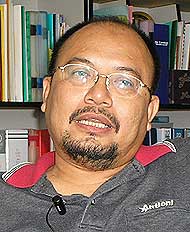 It's high time for leaders of civil society and political parties especially those who have tried to provide an alternative to really chalk out the areas of agreement, programmes and platforms that we can fight for together. Best to understand the ideological differences and get our priorities right before the situation deteriorates into a mud-slinging match.
This is a very thorny issue and frankly speaking, I don't think it can be resolved. I don't think there is a resolution that will satisfy both sides equally. But it's better that we agree on a certain process to resolve the conflicts. A better alternative would be if we had a law that we could act upon; that would be good although it may also be controversial and not satisfy both sides. In other words, even the Muslims may see and criticise it as giving leeway to apostasy.
We have to agree on which court is going to hear such matters. As it stands, it's the Syariah Court but that should not be construed as only for the Muslims because just like the other courts, the aim is to seek the truth of the matter. If someone really does not practise Islam, of course the Muslims themselves won't consider him a Muslim.
Abdul Aziz : Let's go to the court. The Kota Baru High Court in Daud Mamat's case for murtad is not protected by the constitution because it is an act and not a religion. What is protected by Article 11 is religion where, for the act of renouncing religion, for example, an atheist, there is no remedy under Article 11. To me, the Article 11 coalition is promoting a right that is not sanctioned by the constitution.
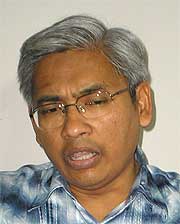 Most of those involved in this campaign are not practising Muslims and they are representing deviants. (They should) provide statistics to show that freedom of religion has been threatened or is being denied. To me, freedom of religion is not a big issue because even Muslims are facing the same problems as the non-Muslims who face rejection to build their house of worship due to scarcity of land and space.
As for the doctrine itself, for Muslims it is to pray five times a day. Muslims also complain about their children being occasionally exposed to propagation of other religions, something that is prohibited by the constitution. The fact is both sides have problems and concerns, even intra-faith ones like the conflict between the Christians and Hindus.
Muslims will not participate (in the Article 11 campaign) because we already know the agenda. Remember, Islam is a state-funded religion which makes it the responsibility of the state. Article 121(1)(A) says that anything that falls under the syariah jurisdiction does not involve the civil courts. The Syariah courts were in existence long before the civil courts. It is a pre-Merdeka, pre-colonial institution and the status quo was not touched by the constitution except to limit its jurisdiction.
Mazeni : The most important thing is sincerity. I suppose all religions are in retreat, not just Christianity, but Islam too. I think conflict between religions is really unnecessary and bad for society. It is very important for people of all religious faiths and non-religions to have a good understanding of one another. The proposed IFC is something like that but a lot of Muslims, including prominent ones who attended the meetings, were not very happy with the way it was formulated.
 We feel the best way is for interfaith understanding to come from the bottom. The IFC is supposed to have statutory powers as though people should be asked to have an understanding. I think this is not right. The best is for people who are very sincere in the practice of their religion to come together and discuss issues which might be controversial.
This is the best way of having good harmony between peoples of different religions.
The main thing is people should be sincere and want to practise sincerely and wish others to have the same thing. I also wish my Christian friends to practise their religion sincerely and to the best of their capability, and the same goes for my own Muslim people.
Haris : We must continue to try and I think we must continue to believe that at the end of the day, the greater majority of people here will be guided by good sense. The ones who say this about the majority (of Muslims) are themselves just a handful, the president of Badai, Accin, Teras, will hold themselves out as speaking on behalf of the Muslims.
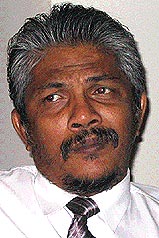 But who is mainstream, who is not? I have seen reports where they don't even make this distinction and claim to speak on behalf of Muslims in this country. Well, they don't speak on my behalf and daily we begin to see Muslims speaking out. If you look at the views they register, they are at odds with those who claim to speak on their behalf.
I don't think they speak on behalf of the majority of Muslims who themselves are very concerned about where these people are endeavouring to take this country to. They begin to question a lot what is proffered as the fundamentals of this religion and I think if people are given enough space and comfort to articulate, we will find that more and more people will begin to speak up and demonstrate that really Teras, Accin don't speak on behalf of Muslims in this country.
Has the language used to date been both divisive and a bridge to religious understanding?
Mazeni : Yes, I agree that Malay newspapers have a very specific leaning, as do some English-language papers. I guess it's up to the editors who have full power to decide what goes in. It's very difficult, for example, when I write to English-language (media), but very few (articles) get accepted except by malaysiakini .
 It's very difficult for us mainstream Muslims to express our views. It's as though I'm living in a foreign country. I cannot express our positions. Luckily, we have some other avenues and now there's the Internet, so we just pass them (views) around. Language itself as a tool of national unity is a big issue. A lot of Malays don't speak the national language at home and can't express in Malay, and there is a gap between English and non-English speakers just like the gap in IT literacy (digital divide) or the economic gap between the middle-class, upper middle-class and the poor. Same thing with language.
There is a big gap and it affects thinking, understanding and shaping of opinions. Speaking of newspaper owners and the media's role, if only they could have more people who can write in Malay articulating different viewpoints. The same goes for the English-language media, if they can accept viewpoints which so far have been excluded. The slants taken by the Malay and English-language newspapers is a reflection of the majority of the readership.
Abdul Aziz : Accin organised a forum to counter the IFC in early February in Kuala Lumpur but got only selective coverage in the Malay media. Why can't the English-language media, which is sympathetic towards the Article 11 campaign, talk to Teras or Abim if they are really serious about balanced reporting? We should not be pedantic (about this). It's not entirely off the mark, the implication of actions and words is clearly there.
Do Muslims recognise the injustices in the Shamala and Moorthy cases?
Mazeni : Yes, we do. To me, that wasn't right. It shows that we've been insensitive and have taken for granted the feelings of non-Muslims in this matter. Of course, there is recognition of the problems raised. This is the beginning and I hope the court systems on both sides will mature and become more responsible and more just in their dealings in similar matters. For example, in the Malacca case of a Chinese man who died officially a Muslim without his wife knowing his status, had the property channelled to the Baitulmal. Again, there was injustice on that part and we also wrote about it.
Eventually, Muslim converts must make an effort but it is difficult due to Islamophobia, the lack of understanding when their family member converts to Islam. There is a lot of prejudice and ignorance about Islam; when a Malay wants to convert out, the same thing happens on the other side. There is a lot of emotional opposition because religion still has a very strong hold on people's feelings and opinions in this country. Ignorance also has a fairly big role in the misunderstanding about Islam.
Zaid : Let's take the mode of dressing for Muslims which is a sensitive issue and more obviously so for women. The stronger accepted opinion of the great jumhur (almost total agreement) is to cover all within limits. But if someone doesn't conform, what do we do? It's an option and a decision that she makes, as long as she doesn't say that the right interpretation is not to cover.
On apostasy, some of the issues raised by, for the sake of this discussion, the other side (I don't really like to categorise people that way) is that sometimes there are people convert to Islam without real knowledge or for marriage; and when it breaks down later, they want to revert.
These are issues which are very sensitive and calls into question the issue of freedom of religion and the conflict between the constitution and Islam because our constitution conflicts a lot with Islam. Then we have cases of people who were never Muslims and for some reason were classified as Muslims. Those would be areas where the other side often asks us how to explain to their communities.
I concur that it would be very tough to explain this to their respective constituents. Even the constitution is a bit ambiguous on these issues and that ambiguity, I think, has stood well for Malaysia because it has postponed this sort of disagreement for a long time. As long as there are level-headed leaders and the willingness to compromise, it works. But if the conflict is highlighted, it's surely going to catch fire.


Report this comment
Are you sure you want to delete this comment?
This action cannot be undone.