




Interfaith - of sincerity, concerns and distortion
Some feel the time is not right to discuss the jagged edges of inter- and intra-faith conflicts while others believe it's long overdue. In addition to the reported human tragedies, several cases are currently pending a judicial outcome.
Muslim non-government organisations are convinced that proponents of an interfaith body lack sincerity. While Muslim politicians try to dialogue , hardliners are prepared to use force, if necessary, to stop such forums.
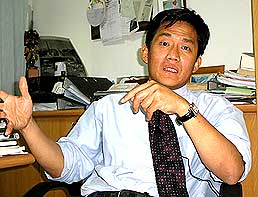
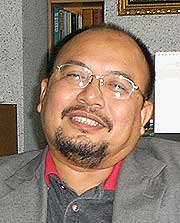
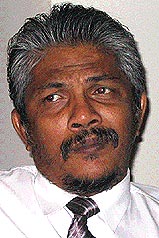
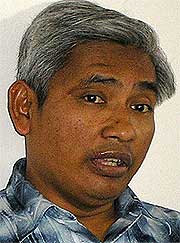
Article 11 coalition member/lawyer Haris Mohamed Ibrahim , Jamaah Islah Malaysia president Zaid Kamaruddin , International Islamic University law lecturer Dr Abdul Aziz Bari and Muslim Professionals Forum president Dr Mazeni Alwi explore the conflicting facets of a plural society with malaysiakini .
Some feel the time is not right to discuss the jagged edges of inter- and intra-faith conflicts while others believe it's long overdue. In addition to the reported human tragedies, several cases are currently pending a judicial outcome.
Muslim non-government organisations are convinced that proponents of an interfaith body lack sincerity. While Muslim politicians try to dialogue , hardliners are prepared to use force, if necessary, to stop such forums.
Article 11 coalition member/lawyer Haris Mohamed Ibrahim , Jamaah Islah Malaysia president Zaid Kamaruddin , International Islamic University law lecturer Dr Abdul Aziz Bari and Muslim Professionals Forum president Dr Mazeni Alwi explore the conflicting facets of a plural society with malaysiakini .
Malaysiakini: Do you think this is the right time to push for interfaith understanding?
Haris:
It is always a right time to have an open discourse. We have to debunk this constant harping about it being a sensitive issue so don't bring it up. That is an overused card to silence legitimate dissent, legitimate articulation of views, legitimate discourse and dialogue. It has been a card that has been continuously overused by those in power who do not wish to see dissent.More credit should be given to Pak Ali in the sawah padi (paddy fields) for his commonsense approach to a lot of everyday human problems we have. I think our Malays are very capable of compassionate approach to the everyday problems that citizens encounter provided there are no quarters that try to hijack and contrive it into an Islamic issue. I emphasise and underscore that the Article 11 coalition is carrying forward civil society issues, of civil liberty and not touching on Islam, with our point of reference being the constitution.
 Mazeni:
I don't think the issue is political. I think people take their opinions emotionally, cornering each other in a way which lacks empathy and civility on both sides, Muslims as well as those with a more liberal reading of Islam. The condemnations turn people off. If you go for such meetings (on the proposed IFC), you see very few Muslims because the way opinions are expressed regarding Islam is insensitive whereas that is what Muslims uphold very dearly.
Mazeni:
I don't think the issue is political. I think people take their opinions emotionally, cornering each other in a way which lacks empathy and civility on both sides, Muslims as well as those with a more liberal reading of Islam. The condemnations turn people off. If you go for such meetings (on the proposed IFC), you see very few Muslims because the way opinions are expressed regarding Islam is insensitive whereas that is what Muslims uphold very dearly.
I think there's a lack of sincerity in wanting to settle things from both sides. I don't think politics has anything to do with this. There's nothing wrong with race and religion as long as we practise them properly. If we follow the teachings of Islam properly it brings a lot of good to a lot of people, not just the Malays because we have to respect other people's rights to their religion and we have to protect that right very well. But a lot of things got muddled up and that confused a lot of issues. It became very emotional, unfortunately, but I don't think it's such a huge problem that a small spark will cause bloodshed and violence. I don't think it's that bad.
I wasn't there (at the meetings) but one of those who attended the preliminary meetings used the word 'shadowy' because a lot of mainstream Muslims, Muslim organisations and leaders were (said to have been) excluded from the meeting. Only certain Muslim NGOs were given prominence and that really turned them off. Those with a mainstream understanding or interpretation of Islam were brushed aside. Only one interpretation of Islam is accepted. The problem is, the Muslim groups represent a big bulk of mainstream Muslims. We recognise their right to exist but I think there should be a fair representation of voices.
Haris: My question to those who make these allegations is, were you there at these forums? Because it is easy to make these remarks premised entirely on conjecture, on the marketplace. If you look at the photographs of the protesters in front of Cititel Penang, look at the banners protesting the IFC. One complaint from a group of Muslim NGOs was that discussions, debates and considerations should be confined to inter-faith and not intra-faith.
This meant that problems within any particular faith should not become a subject matter for consideration. This becomes problematic when you're considering a commission to address problems in the country that come up from time to time pertaining to faith. It becomes unrealistic and impractical to put a fetter to the scope of reference of such a commission, say for instance, if the Ahmadiah group comes before it. We couldn't see that as workable.
Secondly, only mainstream Muslims as they understood it should be permitted to partake in this exercise. Those whom they perceived to be non-mainstream including myself should be excluded. We took a position from the word 'go' that we would be all-inclusive, that nobody would be an 'outcaste', if you will, but they didn't take too kindly to that.
They voiced concerns that the IFC was being envisaged as an adjudicatory body when it was clarified in 2001 that it will be advisory and conciliatory. This is a distortion that they have carried till today. How else was it to be dealt with if not rejected. Here was an attempt to be all-inclusive and they wanted to hijack this and make it exclusive. It was inevitable that their views would be declined.
Is religious insecurity driving the objections to open discourse on interfaith issues?
Mazeni: I can't speak for others but I totally disagree with the demonstration at the (Penang) meeting. To me it's not right and being the majority religious group in the country, to protest in such a way is not proper and inappropriate. There are other ways to express our opinions, perhaps by holding a similar forum elsewhere. Then again, most Muslims are not really bothered (to counter the campaign). They're either here or there because they know that they are living in Malaysia and the rights of Muslims and non-Muslims are there.
 Zaid:
It's not insecurity but more of concern. Insecurity is more or less a sign of weakness. I don't think it's that. If you see the list of people (speakers/organisers), they are generally taken as not very friendly to Islam or the Islamic movement. If it is a debate, the situation would be different. But you call it a public forum and people felt the Islamic perspective was not being represented.
Zaid:
It's not insecurity but more of concern. Insecurity is more or less a sign of weakness. I don't think it's that. If you see the list of people (speakers/organisers), they are generally taken as not very friendly to Islam or the Islamic movement. If it is a debate, the situation would be different. But you call it a public forum and people felt the Islamic perspective was not being represented.
I've actually not attended their forum but what I understand is an effort, besides the freedom of religion, to assert the supremacy of the Federal Constitution over the syariah courts. This is a human rights approach. The supreme law of the land is the constitution but Article 121(1)(A) is only a small part of the justice system pertaining to jurisdiction.
The actual syariah legal system covers the whole thing, politics and all but the syariah referred to in the constitution is what is there in the State List which is mostly limited to personal matters. The way I see it, the campaign is to re-assert the position pre-1988 amendment to that clause but the Islamic movement would be referring to pre-1988 cases where the Federal Court overruled the syariah courts, making the situation untenable.
Is racial-religious identity crisis the actual problem?
 Haris:
That is the political dimension to it. I think it is part and parcel of the divide-and-rule policy that we have seen perpetuate from our colonial masters right through to where we are today. As long as the Malays think of themselves as Muslims and must look after this brotherhood in the context of the economic or political circumstanced, that we Muslim-Malays must hold political power because the non-Muslim Chinese hold the economic power, then you will continue to perpetuate this.
Haris:
That is the political dimension to it. I think it is part and parcel of the divide-and-rule policy that we have seen perpetuate from our colonial masters right through to where we are today. As long as the Malays think of themselves as Muslims and must look after this brotherhood in the context of the economic or political circumstanced, that we Muslim-Malays must hold political power because the non-Muslim Chinese hold the economic power, then you will continue to perpetuate this.
As long as you continue to perpetuate the notion that Malay-Muslims enjoy the protections under Article 153, then you will continue to perpetuate this merging of Malay and Muslim identity which is all political. I think the founding fathers were far-sighted and put into place provisions in the constitution which if adhered to and not tinkered with, would have aided in taking this country to a nation of one people - Malaysians.
Article 153 is not about privileges, it's about protections. There is a difference between protective measures and provisions according privileges, which is protectionist, and it was well thought-out. Article 11(4) is not about protecting Islam but protecting the balance between the various races. It's not about protecting Islam. Islam doesn't require protection.
It is about protecting the balance that we had back then from overzealous evangelists. Nowhere does article 11(4) envisage that a Muslim himself cannot go to a Christian bookshop, buy books, take it home and read it. It's about protecting the balance that was built by our forefathers.
Do you see the Article 11 campaign as facilitating apostasy?
Mazeni: I have not attended any of the forums but came to know about it from the media. One important thing to know is that more Muslims are becoming more educated, more modern and more liberal. Some will go for a very liberal thinking and yet want to remain Muslim and that's not a problem but there are a lot of Islamic teachings considered as mainstream Islam which is based on consensus and which ordinary Muslims accept.
It's also fine if someone wants to move away from that and practise according to what they think is the best way to be a Muslim as long as they don't impose this and accuse those who refuse the same idea as fundamentalists, orthodox and extremists. That's not right. Name-calling is bad. The same goes for mainstream Muslims. They shouldn't be violently objecting to people who want to express their ideas which are very modern, very liberal and very secular.
It's an individual's right but when it comes to what should be the normative rules of the country, I think that should be left to the people. At the moment in Malaysia, a lot of Muslims are still conservative and very rigid in their thinking but I think there is plenty of room for people who don't want to be restricted by Islamic traditions.
What do you think led the Penang protesters to misconstrue the forum?
Haris: The detractors after the conference of February 2005 have been extremely successful in disseminating distortions and lies about the IFC's effort itself. Go to the Accin memorandum and look at matlamat #4 which says ' meminda ...' (amend). Now, go back to the draft IFC bill and tell us where this allegation is coming from. Imagine taking this allegation of pushing for a commission to change the basic fundamentals to Islam to the marketplace and disseminate it to the Muslims, of course you get concerns about an agenda to hijack Islam.
The attempt to scuttle the IFC effort has been very successfully premised on distortion of the truth. Now, look at the attacks on the Article 11 campaign in the media. Have the detractors ever attacked the four requests in the open letter to the prime minister? Never. Invariably, it has been a case of convoluting Article 11 with the IFC.
Do you think the Federal Constitution is Islam-unfriendly?
 Abdul Aziz:
Not true. To me, it is rather Islam-friendly and attempts to be fair to all. It's not there to sustain an Islamic state which is itself a notion that remains very vague. It's the job of the court to declare bad, unjust law. I'm not sure the judges even remember their oath of office to defend the constitution which is the supreme document in the country and everyone else must be judged against this backdrop, not the other way around.
Abdul Aziz:
Not true. To me, it is rather Islam-friendly and attempts to be fair to all. It's not there to sustain an Islamic state which is itself a notion that remains very vague. It's the job of the court to declare bad, unjust law. I'm not sure the judges even remember their oath of office to defend the constitution which is the supreme document in the country and everyone else must be judged against this backdrop, not the other way around.
For a legal definition of a Malay, a person must meet three constitutional criteria. He/she must profess Islam, speak the Malay language and practise Malay custom. So, a non-Malay could be defined as Malay upon conversion provided the other two criteria are met.
Haris: The word Malay doesn't appear in Article 11. It appears in Article 153. The suggestion that due to 160(2) the Malays will die as Muslims was articulated by Justice Faiza in Lina Joy's case first instance. The fact that the Court of Appeal could not dismiss the appeal based on those grounds suggests that it has no foundation at all. Note the language in the constitution, the word 'Malay' is not found in Article 11, so there is no question of defining or delimiting the full scope of Article 11 when it comes to Malays.
Is the constitution being tailored towards being a syariah-compliant document?
Abdul Aziz: It is not always clear what is constitutional, hence the need for arguments to define it further. I'm not sure what the attorney-general meant by syariah-compliant but I think that it's about ensuring that Muslims' rights are protected. However, the AG (Abdul Gani Patail) can't make statements independent of the government, which has been the case of late which are irreconcilable with the government's stance. He should be mindful of what he says or revert to the previous position of having an elected AG who is a part of the Cabinet. The AG is still a part of the government although he tries to sound independent.
No, I haven't seen the open letter by Article 11 nor attended any forum. I'm not interested in listening to their stuff. I've read (Prof Dr) Shad's (Saleem Faruqi) writings before so why should I go and waste more of my time?
While the orgnisers think they have the right to discuss freedom of speech, you have to bear in mind the sensitivities involved. I don't think the speakers represent the majority. The government is also confused on this issue and acting silly. The government is in disarray as if it doesn't know that the demands are unreasonable.
Haris: In a Harakahdaily article, Teras kept talking about Malaysia being an Islamic country. Firstly, I don't know what that means. I'm not encouraged by the fact that in my lifetime, I have not witnessed any Islamic state, Islamic country anywhere on this globe that has not ultimately ended up in oppression. So, the statement of Teras' president is one instance of certain quarters who would like to have us believe that Malaysia was intended from the outset to be a theocracy.
At a recent international conference, experts from Malaysia proceeded on the basis that this is a moderate Islamic country. Unfortunately even within our leadership, the PM from time to time keeps referring to Malaysia as a model moderate Islamic country. It doesn't help that the leadership continues to perpetuate this misinformation and disinformation.
The AG's Chambers hasn't helped in the positions taken in some of the cases where they appear to be on a path to elevate the status of Islam to a point that was never envisaged or intended in the formulation of the Federal Constitution. If you go to the AG's website, one of their stated objective is to undertake a complete review of all laws to ensure syariah-compliancy. Now, that is a very disturbing development in the chambers. One would expect to find such a committee embarking on a review of syariah laws to ensure constitutional-compliancy. So, one has to ask them what their point of reference is. Is it the constitution or the syariah?
The final part of this series will be published on Monday
Part 1: Muslim views: Resolving the interfaith stalemate


Report this comment
Are you sure you want to delete this comment?
This action cannot be undone.