




NEP equity methodology: Lets have it now
Prime Minister Abdullah Ahmad Badawi and his deputy Najib Abdul Razak have been urged to honour their public undertaking to immediately reveal the government's methodology in computing the bumiputera equity ownership, or face the scenario of losing their credibility.
Prime Minister Abdullah Ahmad Badawi and his deputy Najib Abdul Razak have been urged to honour their public undertaking to immediately reveal the government's methodology in computing the bumiputera equity ownership, or face the scenario of losing their credibility.
The calls were made following a malaysiakini report which showed that a Universiti Malaya (UM) research paper in 2002 had drawn a similar conclusion to the controversial Asian Strategic and Leadership Institute (Asli) report which came into public focus last month which said the government's 30 percent bumiputera equity ownership has been reached as targeted.
 During the height of the public debate over Asli's findings a fortnight ago, Abdullah and Najib had both said the government had
no problem
in revealing the methodology used by the Economic Planning Unit (EPU) to calculate bumi equity ownership in order clear the air. The EPU maintains that the figure is 18.9 percent.
During the height of the public debate over Asli's findings a fortnight ago, Abdullah and Najib had both said the government had
no problem
in revealing the methodology used by the Economic Planning Unit (EPU) to calculate bumi equity ownership in order clear the air. The EPU maintains that the figure is 18.9 percent.
However, there have been no moves to reveal the methodology to date.
"The thunderous silence and failure in the past two weeks to make public the EPU methodology and data seems to indicate that the government is having a very serious problem in 'walking the talk' about transparency," Parliamentary Opposition Leader Lim Kit Siang said in a statement.
Contacted yesterday, Lim said the government will 'have no choice' but to reveal its methodology since there are now two separate research papers questioning the government's stance that the 30 percent bumiputera equity ownership targeted under the New Economic Policy (NEP) has yet to be reached.
'Give due attention'
"(The UM research) further highlighted the need for the whole NEP equity issue to be discussed in a rational manner, away from racial connotations. The government must reveal the methodology to convince the public," he stressed.
Lim said he will further grill the government on the matter when the Dewan Rakyat resumes sitting next Monday after a month-long break due to the fasting month of Muslims.
BN member Gerakan, which has been vocal on the issue, has also called for the EPU methodology to be exposed. Its Youth wing's deputy chief Lim Si Pin asked the government to do this as soon as possible.
 "We should read the reports (Asli's and UM's) with an open mind and rationally, rather than just shooting them down or being emotional because every scholastic research uses a different methodology," Si Pin, an economist by training, told
malaysiakini
.
"We should read the reports (Asli's and UM's) with an open mind and rationally, rather than just shooting them down or being emotional because every scholastic research uses a different methodology," Si Pin, an economist by training, told
malaysiakini
.
"We would like to know what are the methodologies. We are not saying these methodologies are exhaustive in nature but they do give an indicative representation of how wealth has been distributed throughout the country," he added.
Asli's Centre for Public Policy Studies chairperson Ramon Navaratnam welcomed the existence UM's research. He also expressed hope that the EPU would give due attention to it.
"We welcome this research and anything else which would seek to improve the (present) methodologies. This is necessary for more effective planning and implementation of the Ninth Malaysia Plan that will lead up to a more reliable realisation of the Vision 2020," he said.
"It will be useful if all the available studies in universities or elsewhere are brought to the attention of the EPU. This will enable them to improve the quality of planning, the need for which is inevitable anywhere," he added.
Feathers ruffled
CPPS director Dr Lim Teck Ghee who formulated the Asli report resigned in protest after Asli president Mirzan Mahathir's retracted his report saying the methodology used in the report 'was flawed'. The retraction came amidst increasingly vocal calls from government quarters and Umno the report be abjured.
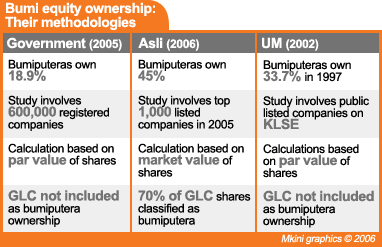
The report published early this year said the bumiputera corporate equity ownership - using the market values of some 1,000 listed companies - was around 45 percent, almost double the government's figure of 18.9 percent.
 This ruffled feathers within the ruling Umno party with the premier warning various quarters to 'not stir trouble' by questioning the credibility of the government's figure.
However, malaysiakini in an exclusive report two days ago reported the research done by the team of researchers from UM led by academician Dr M Fazilah Abdul Samad way back in 2002 which found the NEP target was reached in 1997 when it hit 33.7 percent.
The research, entitled 'Bumiputeras in the corporate sector: Three decades of performance 1970-2000' was based on a 10-year analysis of bumiputera equity ownership between 1988 and 1997 based on public listed companies on the Kuala Lumpur Stock Exchange, now called Bursa Malaysia.
The research calculations was done based on the par value of the KLSE companies, not their market value, which generally considered as a more accurate measure of wealth.
Interestingly, the EPU also used par value calculations in its tabulation. However, the government's methodology involves some 600,000 registered companies.
Bold blueprint
UM's 10-year analysis on bumiputera equity ownership did not cover the post-Asian financial crisis in 1997, thus it was not known how the crisis affected the ownership structure.
Nevertheless, the UM academician said in her research that both bumiputera and non-bumiputera companies were equally hit by the crisis.
Critics have alleged that the government undervalues the bumiputera share of corporate equity - which stands at 18.9 percent - to justify the continuation of the NEP and its related policies which give favourable treatment to bumiputeras.
The NEP was enacted in the 1970 as part of a bold blueprint to reduce income disparity among different ethnic groups in Malaysia.
It was given a life span of 20 years but the racially-based affirmative action policies continued after 1990 under a different name, the New Development Policy.
The government has recently announced that the NEP's racially-based measures will remain for another 15 years until 2020.


Report this comment
Are you sure you want to delete this comment?
This action cannot be undone.