




Judge Dr Ms policies fairly: Ex-ISA detainee
exclusive For someone who was jailed at the behest of Dr Mahathir Mohamad, biologist and author Dr Munawar A Anees surprisingly harboured some grudging respect for the former prime minister.
exclusive For someone who was jailed at the behest of Dr Mahathir Mohamad, biologist and author Dr Munawar A Anees surprisingly harboured some grudging respect for the former prime minister.
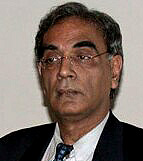 Anees, 58, who was arrested under the Internal Security Act eight years ago possibly on orders of Mahathir, refused to allow his bitter personal experience to colour his opinion of the former strongman.
"The 1998 tragedy notwithstanding, when Mahathir also held the portfolio of home minister with the authority to order draconian detentions under the ISA, political squabbles should not diminish Mahathir's contribution to the Malaysian society."
According to Anees, who was speech writer and close confidant of former deputy premier Anwar Ibrahim, Mahathir's staunchly nationalist policies must be fairly judged.
 "While it would be erroneous to build a personality cult either around Anwar or Mahathir, it is equally spurious to let their contributions fade in a political haze," he said.
"Nations who fail to pay due homage to their leaders enjoy little respect."
Anees, a Pakistani-American writer who is a biologist by training and an internationally well-respected Islamic intellectual, was caught in the hysteria of 1998 when Anwar was purged from the ruling party, Umno.
He was arrested on Sept 14, 1998 and held in incommunicado by the police for five days, tortured and forced to make a false confession of "allowing himself to be sodomised" by Anwar and subsequently spent four months in prison.
In this second part of an email interview with malaysiakini , Anees talked about his emotional reunion with Anwar, his views on the spat between Mahathir and his handpicked successor, Abdullah Ahmad Badawi, and his gratitude to those who stood by him in his darkest hour.
Malaysiakini: When did you meet Anwar after he was released in September 2004?
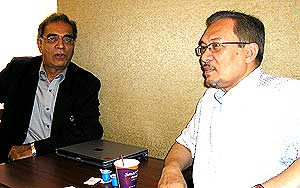 Munawar A Anees:
Our first meeting took place in London in early 2005, about three months after Anwar regained his freedom. I was invited there for an international conference on bioethics and Anwar was in Oxford. It was an emotional reunion. Our meeting lasted for just about 30 minutes. I was sad to see Anwar's physical condition since he was still complaining of pain.
Munawar A Anees:
Our first meeting took place in London in early 2005, about three months after Anwar regained his freedom. I was invited there for an international conference on bioethics and Anwar was in Oxford. It was an emotional reunion. Our meeting lasted for just about 30 minutes. I was sad to see Anwar's physical condition since he was still complaining of pain.
The next meeting was a few months after, at Anwar's invitation in Washington and we spent four days together. I wanted to know about his plans for the future as much as he was curious about mine. We discussed a lot of issues of common interest particularly living in the post-9/11 world. Anwar and I remain in regular contact with each other through email and phone.
Do you think Anwar has a future as an opposition leader?
Anwar's flair for leadership is a given fact, straight from his days at Abim (Islamic Youth Movement of Malaysia). So the question as to whether he will prove to be a better leader in the opposition or in the government does not arise. One can argue about the style of leadership but Anwar's track record leaves little room for doubt.
If I am not mistaken, he was perhaps the one who held the highest number of portfolios, some twice: sports, agriculture, education, finance, and then deputy prime minister. Not to mention International Islamic University and Unesco. Of course, sitting on the treasury benches gives you an added advantage to implement your programmes, something that the opposition is deprived of, usually.
In a democratic system of governance, therefore, the role of leadership must be assessed in terms of values rather than political positions. On that count, Anwar's past leadership carries several points to his credit. Unlike Mahathir, he is not known to be an institutional builder. He is a man of ideas with a global span.
While Mahathir physically translated his vision of Malaysia as a developed nation through infrastructure and urbanisation, Anwar held a similar view but on the intellectual landscape. I vaguely recall Mahathir's positive comments on this complementarity during one of his interviews to Asiaweek.
What is your opinion of Prime Minister Abdullah Ahmad Badawi?
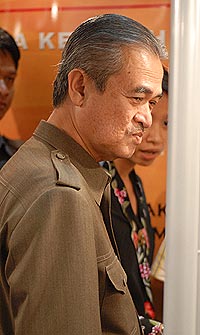 I met Prime Minister Abdullah only once while he was not in Mahathir's cabinet. That was prior to his assuming the charge of Wisma Putra. Anwar's press secretary, Khalid Jaafar, and I were sipping coffee one afternoon in Bangsar when we spotted him walk by. He was kind enough to join us. I found him to be a person of mild manners and courteous.
Unfortunately, the Malaysian tragedy has kept me from knowing him more closely. But whatever I read in the media since he became the prime minister tells me that under his leadership Malaysia is going through a refreshing change.
Mahathir's long presence on the Malaysian scene and his dynamic policies had certainly raised the level of popular expectations. To sustain that momentum of growth continues to be the immediate challenge for Prime Minister Abdullah.
Similarly, it would be interesting to observe how his initiative on Islam Hadhari leads to some tangible progress, particularly at a time when both internal Muslim disputes and Islamophobia are acting to tarnish the image of Islam.
And how do you feel about Dr Mahathir Mohamad's meddling in the current government?
In the tradition of Voltaire, I defend Mahathir's right to say whatever he wants to but I am discomforted to know that he has chosen to publicly criticise Prime Minister Abdullah. This seems to run contrary to the grace of an elderly statesman. At the same time, as Anwar has stressed, legitimate criticism must be addressed.
The 1998 tragedy notwithstanding, when Mahathir also held the portfolio of home minister with the authority to order draconian detentions under the ISA, political squabbles should not diminish Mahathir's contribution to the Malaysian society.
From a more human perspective, Anwar has admirably defended Mahathir's right to express his opinions. He is even reported to have said that Mahathir was free to join a political party of his choice. This creates a healthy atmosphere where personal differences are set aside in the interest of political stability. Likewise, Prime Minister Abdullah's visit to see Mahathir after he suffered a mild heart attack is commendable.
Mahathir's staunchly nationalist policies must be fairly judged. While it would be erroneous to build a personality cult either around Anwar or Mahathir, it is equally spurious to let their contributions fade in a political haze. Nations who fail to pay due homage to their leaders enjoy little respect.
Tell us, what happened after you were released from prison in 1999?
Consequent to the torture that I endured at the hands of the Special Branch, I remained hospitalised as a cardiac and psychiatric patient for almost 126 days.
The then foreign minister of Pakistan, Sartaj Aziz, took extraordinary measures in twice summoning the Malaysian high commissioner to Pakistan to ensure that I received some humane treatment. The High Commissioner of Pakistan to Malaysia, Musa Javed Choohan, and his senior staff personally oversaw compliance.
In spite of their efforts, I was kept round the clock handcuffed to my hospital bed. After regaining my freedom, I was driven from the hospital straight to the official residence of the high commissioner of Pakistan where I stayed for a few days before I left for Islamabad. I spent my first evening at his high commissioner's residence mingling with a lot of well-wishers and feasting upon a fabulous dinner.
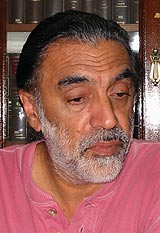 (Lawyer) Manjeet Singh Dhillon (
left
), the man who epitomises goodness in all its manifestations, went yet another extra mile in facilitating my departure from Malaysia. He and (lawyer) Balwant Singh Sidhu accompanied me and Nadia to the airport and waited till my plane left the tarmac.
(Lawyer) Manjeet Singh Dhillon (
left
), the man who epitomises goodness in all its manifestations, went yet another extra mile in facilitating my departure from Malaysia. He and (lawyer) Balwant Singh Sidhu accompanied me and Nadia to the airport and waited till my plane left the tarmac.
The two protocol officers from the Pakistan High Commission, who escorted me through the immigration desk, succeeded in convincing the immigration officer - who had raised the spectre of a travel ban - to let me go. Grateful acknowledgment is made to Foreign Office in Islamabad and the entire staff of the Pakistan High Commission in Kuala Lumpur for their valuable support.
After finishing their semester at the French school, (daughter) Aisha and (son) Omran had left earlier in December for Paris with (wife) Nadia's elder brother, Dr Bekkaye. Nadia, though left alone but not relenting on her mettle, stayed back and took care of some paperwork and other chores. She had disposed off or given to charity much of the household belongings.
What happened next?
My arrival in Islamabad was a moving moment. My elder brother, Mubasher Ahmad (may God bless his soul), who had worked tirelessly to ensure that no further harm came to me, went into an ecstasy after seeing me alive. I still feel the triumphal joy that he exuded. But no comfort came close to the loving embrace of (mother) Ammi Jan, studded with prayers and tears. Suddenly the pain was transformed into a bliss. So precious is the touch of mother!
(Younger sister) Suriya was there in her glory with her wizard son, Ali Waqas, and so were my other sisters, Khair-un-Nisa, Qamar-un-Nisa, and my elder brother, Muzaffar Ahmad, with their families. They all had prayed and strived for that day of freedom. In spite of geographical distance, their support helped Nadia in those difficult times. They made it possible for her not to feel alone.
In the crowd at home, I was thrilled to see one of my students, Tariq Ismail. He was instrumental in staging protest demonstrations in front of the Malaysian High Commission in Islamabad, mass distribution of leaflets, and in mobilising public opinion in my favour.
At home, as I struggled to retrain my fingers on the keyboard, another surprise was waiting for me: some 65,000 email messages from friends and concerned individuals from all over the world. It was an absolutely humbling experience! In the wake of these overwhelming emotions expressed by known friends and unknown well-wishers, not even a book-length "thank you" note would suffice. I bowed my head in gratitude.
When did your wife joined you?
 After about two weeks, Nadia (
right
) reached Islamabad and deservedly received a glorious welcome. She was buried under colourful garlands for her extraordinary feats. She merited and received the choicest hugs and kisses from Ammi Jan. But time would put her to much more severe challenges in raising Aisha and Omran without the loving presence of their father.
After about two weeks, Nadia (
right
) reached Islamabad and deservedly received a glorious welcome. She was buried under colourful garlands for her extraordinary feats. She merited and received the choicest hugs and kisses from Ammi Jan. But time would put her to much more severe challenges in raising Aisha and Omran without the loving presence of their father.
From Islamabad, I went to Paris and gave lasting hugs and kisses to Aisha and Omran for their resilience in the face of this terrible misfortune. I was amazed at how Nadia's enchanting love kept these little ones unscathed and fully self-composed. They showed no sign of deficit in their academic achievement. But deep inside, I could sense the emotional scars.
Both of them, cruelly removed from the comfort of their home to the forced beginning of a new and arduous life, have now turned into knights for human rights. I realised how distress acts as a spark to ignite the innermost core of human virtue. This reminds me of a similar phenomenon when there was an outpouring of human sympathy after a devastating earthquake in Pakistan last year. A recent documentary, 'When the Mountains Moved', elegantly captures those precious moments in human behaviour.
What are your children doing now?
 In Aisha's footsteps, Omran (
left
)
ctively engaged in the Model United Nations where he is the youngest elected student. He is expected to graduate from high school in 2008. Aisha has advanced to her fourth year in medicine on a dual MD/PhD track.
In Aisha's footsteps, Omran (
left
)
ctively engaged in the Model United Nations where he is the youngest elected student. He is expected to graduate from high school in 2008. Aisha has advanced to her fourth year in medicine on a dual MD/PhD track.
After Pakistan, where did you go to next?
Before returning to America, I wanted to personally thank some of my friends who had launched a highly effective campaign on my behalf. Spearheaded by Naseer Ahmad from Canada, they put up a coalition called Friends of Dr Anees . Their website, kept alive by an incredible dedication of Safeer Rammah, Baseer Hai, Anees Ahmad, Dr Naeem Siddiqi, Dr Jamal Mubarak, and Dr Kamal Mubarak (webmaster), attracted enormous traffic particularly from Malaysia where the official media was maintaining a cloak of secrecy.
Recalling what was the state of the Internet at that time, the Australian Financial Times paid them rich tributes for putting the Internet to a highly efficient use in mobilising world opinion against atrocities committed to advance a heinous political agenda.
While my web warrior friends maintained the pressure, the print media did its own magic. Take, for instance, Nathan Gardels, a long-time friend and editor of the Los Angeles Times/Global Viewpoint Syndicate . After Nadia called him on that fateful day, he sprang into action. Following some discussion, Alvin Toffler immediately wrote a lengthy piece in the International Herald Tribune demanding Mahathir to free me.
Later, Nathan went for a personal interview with Mahathir. Moreover, in his prestigious New Perspectives Quarterly , he published excerpts from my statutory declaration and gave wide coverage to the events. Do I have words to thank friends of this moral stature?
The climax of my visit to Canada was reached in a tearful but joyous embrace with Margaret John from Amnesty International. We were joined for dinner at her place by the former president of Singapore, Devan Nair and his wife Dhanam. From thereon, for several years, Devan remained a source of wisdom until he passed away.
Beyond the call of volunteerism, Margaret made such a remarkable personal contribution in securing my freedom that continues even to this day. A magnificent and caring friendship with Margaret and her husband Brian are among the blessings that I count on. Amnesty International and its worldwide teams of volunteers deserve our most profound gratitude for making freedom possible by keeping the hope alive.
For long, one of my closest friends, Afzal Janjua, with whom I have spent some of the most productive and fulfilling years of my life in America, unfortunately remained unaware of my predicament in Malaysia. But his sustained support after my return has undoubtedly fully compensated for his absence. Afzal's inspiring presence is one of my cherished treasures.
Tomorrow: Dealing with the post-9/11 world
Part 1


Report this comment
Are you sure you want to delete this comment?
This action cannot be undone.