




Syed Husin: We wont be over-confident
Opposition Parti Keadilan Rakyat (PKR) is confident of winning more seats in the next general election but will remind itself not to make mistakes that may cost it dearly.
Opposition Parti Keadilan Rakyat (PKR) is confident of winning more seats in the next general election but will remind itself not to make mistakes that may cost it dearly.
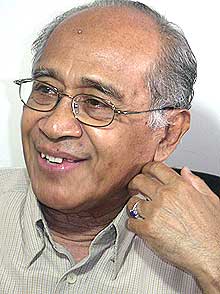
In an interview with malaysiakini last week, deputy president Dr Syed Husin Ali said he would not want the party to be over-confident, despite optimism that it can win more seats than in 1999 when it first contested as Parti Keadilan.
Keadilan won five parliamentary seats and four state seats in 1999 but suffered a severe setback when it won only one parliamentary seat in the 2004 general election.
(PKR was formed in 2003 through a merger between Keadilan and Parti Rakyat Malaysia. Its president Dr Wan Azizah Wan Ismail is the MP for Permatang Pauh.)
 In the
first part
of the interview posted yesterday, Syed Husin talked about defending his post during the upcoming party election, but said he would not contest a general election again.
In the
first part
of the interview posted yesterday, Syed Husin talked about defending his post during the upcoming party election, but said he would not contest a general election again.
In the conclusion of the interview, the veteran politician, 70, gives his views on the party's preparations for the general election and on the leadership of Prime Minister Abdullah Ahmad Badawi.
Malaysiakini: Assuming that the Registrar of Societies (ROS) allows (party adviser) Anwar Ibrahim to hold a party post, what would you expect during the upcoming general election?
Syed Husin : He is an added asset, but you know an election is not only (about one) individual. There are various other factors (such as) the economy and political and press freedom. Such issues will be important in determining the process of an election. Anwar will be able to hold the party together and I am sure the (same will happen for the) opposition parties' co-operation.
Is he saying the DAP should come back to Barisan Alternatif?
I don't know the nature of the co-operation. I am not saying there is going to be a kind of coalition but certainly the bottom line is that we won't be in a three-cornered fights (among ourselves). That is the consensus.
Will PKR contest more seats in the general election this time around?
I don't think there will be very much of an increase in the number of seats (that we will contest). There is always some kind of assumed understanding on how the seats will be distributed. The problem of seats contested is either between PKR and PAS or between DAP and PKR. You hardly have such problems between PAS and DAP - they operate in different geographical areas. The only problem with them is that one party doesn't want to be associated with the other because of their (ideology).
With current issues help the opposition to do better in the election?
There will be issues but the government has always been able to black out the issues and black out the opposition (too). They are already doing it now. There is a process of blacking out Anwar and PKR (to make sure) only good things are said. Of course they have said there is improvement in trade performance but compared to (other countries in the) region, this is nothing great. They have control over the media to make sure that only their lies, their interpretation and their picture of the whole country prevails. We have to work very hard via the alternative media.
The current sentiments on the ground seem more favourable to the DAP for the general election. What is your evaluation of the situation for PKR?
It looks like the Chinese are moving away from Barisan Nasional and MCA. This, I suppose, will partly benefit the DAP but not all Chinese look at the DAP as an alternative. There are other alternatives also. The question will be how PKR and DAP can co-operate in order to take full advantage of the swing in Chinese (votes).
Is PKR feeling pressured to keep its distance from PAS? PAS president Abdul Hadi Awang recently spoke about the Islamic state again.
 The thing is this - there are more Malay-majority constituencies than Chinese ones. What we need to do is not to abandon either but to make sure that we can co-operate so we can get the benefits. We hope that with Anwar, PKR will be able to lift its co-operation with various opposition parties and probably also certain NGOs (non-governmental organisations) and NGIs (non-governmental individuals). (laughs)
So PKR will continue to be the bridge between PAS and DAP.
That's the main role of the party. Umno (can) distort whatever Hadi or PAS says in order to create dissatisfaction among the Chinese. I am not defending Hadi here, but if you look closely at (his statements), he has said it is the right of parties to promote their own ideas - if there is a party that promotes socialism or capitalism, why can't (another) promote Islam? But this is always distorted (by the ruling coalition) to sound something like 'Look, (PAS) wants to have an Islamic state' which he (Hadi) didn't say. In fact, over the past three years, PAS has restrained itself from talking about the Islamic state and this is part of the understanding that we have.
Looking at the number of the parliamentary seats, how confident is PKR in winning more?
Certainly more than in 1999. We have identified what we called kawasan tumpuan (focus areas), areas on which we will concentrate. We will work there and we will prepare our campaign there. Some of the kawasan tumpuan of course were formerly our areas, while others are those where PAS and DAP stood. We hope that with negotiations, those seats will be given to PKR.
How many seats are you confident of winning?
We won't make a mistake of being over-confident but at the same time, we are optimistic that we will do quite well.
PAS is having a tough time ruling Kelantan with a majority of just one. Is this why it invited Anwar ( photo ) to contest in Kota Bahru, to rekindle the 1999 scenario?
 That might be one of the reasons why it wants Anwar to be there but it is up to him to decide and up to the party to approve where he should stand. We will make sure he stands where he is not only assured of winning, but also where he will be of help to the party first and to the coalition. As such, he is needed more than just in Kota Bahru. (laughs)
Do you really have faith that PKR will rule the country one day?
That's my hope. (laughs) It's my hope and my prayer, we are working towards it.
What about bringing in new blood? Recently you lost (Youth leader) Ezam Mohd Nor who has been with the party since it was set up - he was deemed to be a charismatic leader.
He is still a party member, he will be doing (his work) within his NGO (just as) he (worked) with the party. He still has contributions to make. I don't think he has severed his relationship with the party.
How strong is PKR financially?
Very weak.
Where do most of the funds come from?
All kind of contributions from individuals and organisations, (but) we find it difficult to even pay our full-time staff and the office (expenses).
What is the party's greatest strength and weakness, four years after the merger?
The party is made up of at least five types of people or groups - ex-Umno, ex-PRM, ex-NGO, ex-Abim (Malaysian Muslim Youth Movement) and ex-JIM (Jamaah Islah Malaysia). They have had different experiences but the beautiful thing now is they are almost united in their stand in this struggle. This is strong at the grassroots and it is important for the grassroots to be strong and committed. They need to have knowledge of our struggle because they will be the ones to explain to those at community level and to the public at large.
Comparatively we are still weak in that our link with the community is still not very strong - it is getting stronger but there is much room for improvement. We are quite new compared to PAS or even Umno, which have been around for 40-50 years in building up their grassroots (support).
Our strength is that we are committed to a struggle which is multi-ethnic. (Within this), we are concerned more about people at large, that's why we are talking about keadilan untuk semua (justice for all) and kepedulian rakyat (concern about the people).
There is a view that the party's standing is not up to Anwar's international standing. What do you have to say about this?
There is a gap indeed between Anwar and ordinary party members. His international standing was partly built on two things - the fact that he was deputy prime minister and that he was detained unjustly. That made him a very important figure. The gap can be reduced by experience and commitment to the party platform. In other words, it's going to be a process where the level of consciousness and commitment will be raised not only among the leaders but also among the grassroots supporters.
What is your view of the corruption probe against Anti-Corruption Agency director-general Zulkipli Mat Noor?
 It is not about individuals. The level of corruption is getting rampant. When we talk about Zulkipli (
photo
),
orang melompat
(people get angry) but when we talk about (cabinet ministers) Rafidah (Aziz) or (S) Samy Vellu, the reactions are different.
It is not about individuals. The level of corruption is getting rampant. When we talk about Zulkipli (
photo
),
orang melompat
(people get angry) but when we talk about (cabinet ministers) Rafidah (Aziz) or (S) Samy Vellu, the reactions are different.
Sometimes the revelation is also about who is involved rather than the substance of the charge. (Ex-premier) Mahathir did not succeed in membongkarkan (exposing) (Prime Minister) Abdullah (Ahmad Badawi) but it could be that Mahathir has done the same thing. Iit's a case of the pot calling the kettle black, but people don't believe.
How do you evaluate Abdullah's capability in fighting corruption?
There is no evidence that the corruption has been curbed or that it has gone down. Furthermore, our ranking on the perception index on corruption is declining.
What about the economy? Many statements are being made about how well it is performing.
When we look at our pond, we say there is a lot of fish. Try comparing it with ponds in South Korea, Taiwan, Singapore and even Thailand and Indonesia, where there are more fish and 'delicious' ones too, from an economic angle. Our newspapers do not have the opportunity to draw a comparison.
How would you judge Abdullah's performance as the premier, if you were to grade him?
 I will give him a 'C', I would't fail him. Things are happening in spite of him. We have a civil service that is relatively stable - you can have both the prime minister and deputy prime minister (Najib Abdul Razak) out of the country and the government still goes on.
The economy still grows despite the over-expenditure and waste taking place. The education system is a mess, the healthcare system is very expensive and getting even more expensive. Soon there will be the FTA (Free Trade Agreement) and generic medicine won't be available any more, so you will have to buy patented drugs which will be very expensive. The cost of keeping healthy will be very high. There is no sign of us resisting the FTA.
What about cronyism? It used to be in the spotlight during the old regime - is it worse or better now?
I think it is still there. It was in a sense more widespread during Mahathir's time because there was a lot of money available for big projects. Now there are fewer mega-projects, (but) not because they don't want it. If they can, they want it... (but) they don't have the money.
Anwar has been promoting the New Economic Agenda, but it looks like a race-based economic policy will remain for quite some time.
People like Khairy (Jamaluddin, Umno Youth vice-chief) and that lot feel they have to talk about not only the involvement of Malays, but of Muslims in the economy to make sure they are really in control of a bigger pie.


Are you sure you want to delete this comment?
This action cannot be undone.