




Federal Court completes Subashini hearing
The decision of where jurisdiction is vested should be based in the enacted law from which the matter arises, lawyer Malik Imtiaz Sarwar told the Federal Court today as it wrapped up its hearing on the R Subashini case.
The decision of where jurisdiction is vested should be based in the enacted law from which the matter arises, lawyer Malik Imtiaz Sarwar told the Federal Court today as it wrapped up its hearing on the R Subashini case.
Representing secretary Subashini, Malik told the three-member Bench led by Justice Nik Hashim Nik Abdul Rahman that recent case law held that courts have to consider the relevant legislative provision said to vest jurisdiction in the respective courts.
 "Jurisdiction is vested in the High Court and syariah court by enacted law. The marriage between Subashini and her husband was made under civil law, Law Reform (Marriage and Divorce) Act 1976," he said.
"The court must follow this decision unless it can be established that the decision (in those case law) is wrong, uncertain, unjust, outmoded or obsolete."
 Subashini, 28, a Hindu, is
trying to stop
her 31-year-old husband T Saravanan - who now goes by the name of Muhammad Shafi Saravanan Abdullah - from taking matrimonial proceedings to the Syariah Court.
Subashini, 28, a Hindu, is
trying to stop
her 31-year-old husband T Saravanan - who now goes by the name of Muhammad Shafi Saravanan Abdullah - from taking matrimonial proceedings to the Syariah Court.
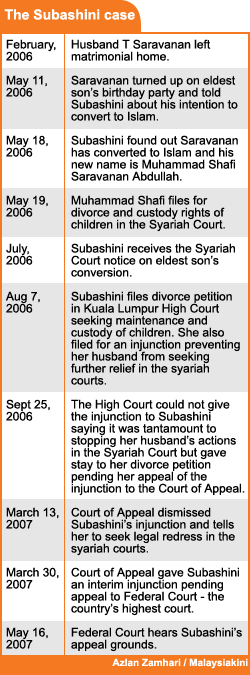
Her battle began when her husband converted to Islam in May 2006 and converted their eldest son, Dharvin Joshua, 4, as well.
The husband then launched proceedings in the Syariah Court for divorce and custody of their second son, Sharvin, 2. He is represented by Mohamed Haniff Khatri Abdullah.
Malik also rebutted Haniff's earlier argument that Section 51 of the Law Reform (Marriage and Divorce) Act 1976 (LRA), which governs civil marriages, was unjust and unconstitutional.
The provision states that only a non-Muslim spouse can become the petitioner in a divorce petition and applicant in the civil court, while the Muslim spouse is compelled to remain as a respondent.
"Section 51 was drafted to protect women and children against (the actions of) Muslim converts. The husband cannot shield himself from responsibility under LRA by shielding himself behind Article 121(1A).
"Conversions such as his (Muhammad Shafi's) could undermine the legislative scheme put in place for all the parties including the children."
Article 121(1A) states that the civil court has no jurisdiction on matters under the purview of the Syariah Court.
Parent's right
On the issue of Dharvin's conversion, Malik noted that Article 160 read with the 11th schedule of the Federal Constitution provides that words in the singular also includes the plural and vice-versa.
Muhammad Shafi has contended that he had a right to convert his child because Article 12(4) states the right of a 'parent' to determine the religion of a child.
"Article 12(4) entrenches the right to choice of religion of both parents. This is consistent with guarantee of gender equality in Article 8(2)," he said.
 After he concluded his submission, Malik was quizzed by judge Azmel Ma'amor about the position of Islamic law in the country and whether remedy is afforded for Muslim converts in civil law.
Malik explained that, for religious law and rulings to have an enforceable effect on an individual, it must first be codified. Any law that is not codified is not recognised by the courts and is therefore not enforceable.
The other judge presiding over the case is Abdul Aziz Mohamad.
The Bench reserved judgment, saying it would require more time to go through the written submissions on the appeals concerning the divorce and custody dispute.
"There are too many points in law to be considered. We will need more time to look at it, the decision will be on date to be fixed," Nik Hashim said.


Report this comment
Are you sure you want to delete this comment?
This action cannot be undone.