




Q&A: Iron hand needed to clean the rot but...
Former Bar Council chairperson Raja Aziz Addruse feels that the country needs a chief justice who knows that the judiciary is rotten and will ensure that judges work properly.
Former Bar Council chairperson Raja Aziz Addruse feels that the country needs a chief justice who knows that the judiciary is rotten and will ensure that judges work properly.
The senior lawyer who led sacked Lord President Salleh Abas' defence team in 1988 opines that the uphill task would be getting rid of corrupt judges.
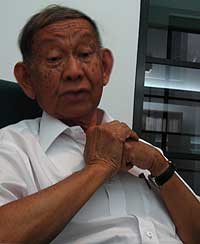
Looking relaxed in a crisp white shirt and neatly pressed black slacks, the 72-year-old lawyer shares his thoughts with Malaysiakini on de facto law minister Zaid Ibrahim, current Chief Justice Abdul Hamid Mohamad and the judiciary’s future.
How has the judiciary been since 1988?
 I think it has gone from bad to worse. Nobody has the confidence in the judiciary anymore. The sad thing about it is once you have the head of the judiciary who is pliable, that’s why we had Hamid Omar, the chief justice at that time, when he was appointed, the judiciary came under his control. All future appointments were left to him and once you have all these appointments made, you cannot remove them anymore because there is a procedure for removing judges.
Now, if the appointees are bad, then you have a judiciary that is bad for a long, long time. You might have the new ones appointed to the High Court and they are going to come up to the appellate courts. They are full of them now. So how are you going to get rid of these people now?
Most people feel the impact of this. Many of us senior lawyers go to court as if we are dealing with judges from those days but we know we’re not. I’ve been appearing in cases where I now realise that the judges and lawyers may have an arrangement of their own. It is like we’re fighting like it is a proper case but in fact, we’re not. You suddenly find the other side is writing the judgment for this case but you are fighting like mad for your client. This is what is happening to the judiciary.
What are your views on the steps taken by de facto law minister Zaid Ibrahim in trying to restore the glory of the judiciary?
I think it is beginning in a sense that until now, everybody has been pretending that the judiciary is alright. Justice is still being denied to many people by these judges so I am not sure. This is a beginning but I am not sure if we can go further. How do you get rid of all these people?
Do you think a Judicial Appointments Commission (JAC) will make things better?
The JAC is not for what has happened before, it is going to be on who is going to be appointed. From now on, you can only appoint certain people according to certain standards but we have other people now who are already appointed and we can’t do anything about it.
What do you think are the necessary steps needed to restore the judiciary’s independence?
 Well, you’ve got to fix it. First of all, we need a CJ (chief justice) that knows that the judiciary is rotten and we'd better get all these judges working properly. But at the moment I am not sure whether we have that sort of iron hand that can say, "Look we are not doing this job right." The rot can be got rid off but I don’t think it can be done overnight. It has to take a long time and the effort of everybody and because once the rot sets in, it is not easy to get rid of it.
What about constitutional amendments?
I’m not sure if the government is serious about that. Do you think they would want to restore Article 121? And you will find every time the government uses ISA (Internal Security Act) and PPPA (Printing Presses and Publications Act) and people ask for a judicial review, do you think they would want that? Is the government strong enough for that?
Do you think they are not strong enough?
Well, I am reluctant to say. It is one thing to make all these statements about how we want to be democratic but it is another thing to do it. Wanting to say and wanting to do, I’m not sure if they are prepared to do it.
How do you think the Bar Council has been dealing with this judiciary crisis?
I think the Bar Council has been doing very well. They stood up to all these things and have been commenting on it but one can only comment if the people who know it is wrong don’t do anything about it, the comments are not very effective are they?
I’m sure the government knows about this. Like corruption for example, it’s not like we don’t know about it. There is a lot of corruption but they are saying, "We are doing something about it." But what is being done?
Are you sad over what has happened over the years?
 Of course. There are many lawyers who don’t feel enthusiastic for practicing in the courts anymore because you go there and you present your case as best you can then you just hope that somebody listens. You don’t even know what arrangements are being made with regards to your case.
You look at the Eusoff Chin case decided by Justice Hishamudin Yunus in Shah Alam in the Raja Segaran case (where the latter judge upheld constitutional provisions pertaining to freedom of association and expression). Hishamudin is one of the good judges but how many are there?
Is it disheartening for lawyers to be able to see the difference between good and bad judges?
I think we know straightaway from the judgment. Half the time, once they make a judgment, they get transferred somewhere else and that itself shows you the kind of people who are at the top. Why would they want to transfer somebody who is good, just to teach him a lesson?
This is what happened in 1998. The five judges told the tribunal to stop until we have decided whether or not the constitution of the tribunal was valid. There was the speaker, the CJ that was to succeed Salleh, another chief judge from Borneo who is junior to Salleh, a person from Singapore known to be very pro-government and one more from Sri Lanka who nobody knew about anyway.
So the whole thing was challenged because it was not constitutional. The Supreme Court which granted the interim order to prohibit the tribunal was suspended two days later. They were being punished. This is the same thing with people like Hishamudin. There is no difference to me - you suspend the five or you transfer this fellow - the lesson is there.
Do you think it would bode well for the judiciary when the current President of the Court of Appeal Zaki Azmi moves up to the top spot after current CJ Abdul Hamid Mohamad retires?
 Zaki has been seen as very political. He’s very connected to Umno. Of principle it would not have been a good idea to appoint him if we’re going on the principle that judges must be impartial and independent. What happens if there are cases that involve conglomerates and things like that, where will he stand? What happens if the PM or another minister suddenly gets investigated for corruption or something? What will he do?
These are questions which should have been avoided because if you appoint somebody that is impartial and independent, you don’t ask these questions anymore, I mean, he will do his job. If you feel it is incorrect, you will appeal. But now even before the case comes up, you begin to questions what is going to happen to this case? This invites a lot of unnecessary questions for a judiciary that is already under siege.
What do you think about Abdul Hamid?
He is a very honest person. He’s very straightforward. The only thing that disappointed me was when he said there was no separation of powers. That I think is contradicting everything that we learnt in constitutional law.
What are your views on the ex-gratia payment received by the former judges?
I think that is a matter between them. It’s not for us to say. I think there is a recognition that something done in 1988 was wrong. Somebody wants to feel that they are doing something about it. I think it is a good start. The judges themselves say they will accept it and everybody knows that they are not in the wrong.
Whether or not it was a means of silencing them, I’m not sure that would work. Everybody knows what has happened anyway, what is there to silence any more? Azmi was speaking out and Justice Ian Chin is speaking out. I don’t think the payment has anything to do with it. You can’t just silence the judges, they don’t have much to say anyway.
Do you think the payment has glossed over the judiciary crisis where the issue of whether the judges have been wrong is over?
I don’t think that would ever happen, 1988 is history, it is there for everybody to read. But you can’t say 20 years later, you pay everybody, the history never happened. I don’t think that would work. It would be silly for people to think that.
Do you think Chin acted in order when he spoke up about what happened to him in his proceeding notes?
It depends. We can’t say what is proper and what is not proper anymore now. Whatever that has been done to the judges was very improper. It could be that during those times, he could not say anything about it. Now if he wants to say everything about it, let it come out. I think people should know what has happened. The judiciary is very bad anyway and in order to improve you should know exactly what’s been going on.
Where do we go from where? What is next? What should we expect next?
I think we should ask those who can do something about it, what are they going to do? I think Zaid is doing something. I don’t think he would be in a position to do much more. He can only make suggestions but there are some people who probably would have the power to do something but will they do it?
Do you see the political will being there?
 I don’t think so. I think Zaid has done a good job, I give him a lot of credit for that. Even if he resigns, it is not because he has failed. It is because he has principles that are being breached and he cannot stand for it. I think that is a very good thing to do. Very little people do that nowadays.
Do you have hope that things will get better?
It has to be better but I don’t know how it is going to get better. It can’t be like this forever. It’s at its lowest ebb at the moment. I thought it was at its lowest ebb when (former CJ Mohamed) Dzaiddin (Abdullah) came in. It has gone down. Now we have this disclosure about judgments having been written by lawyers on the other side and lawyers saying he can arrange the appointment of judges. It’s gotten lower and lower. Now, we can’t just go on like that so we must get better but I’m not sure whether it will not get worse first.
Do you anticipate anything that could possibly make the current state of the judiciary more worse?
 I did not anticipate that lawyers were brokering the appointment of judges. When I heard Dzaiddin say it was the lowest ebb, I thought he was right but he wasn’t. I did not know anything about (the video clip) until it came out. I knew there were close relationships between parties in cases. I did the case where Vincent Tan sued Tommy Thomas, Skrine and Param Cumaraswamy.
Vincent Tan was a very well-connected person at that time, with the PM and so on. And of course, Eusoff Chin was part of it because of his photographs with (lawyer VK) Lingam. But he was appointed by Mahathir and Hamid Omar anyway. But I did not know anyone that was brokering the appointment of judges.
What do you think about the recommendations made by the royal commission of inquiry into the Lingam tape?
I think they should be looked into. It is not for us to question whether they did it right or not. I think what they did was a good job.
What kind of judiciary would you like to see?
Have you seen how parties are treated in the Court of Appeal where judges tell them they have no case? I mean that is not the way it should be. In those days when we had people like (former Lord Presidents) Tun Mohamed Suffian (Hashim) and Raja Azlan Shah, they listened even if the argument is something that I myself sitting in court think needs more work.
But they listen because it is their job. They may not agree with you but somebody may say something in three sentences that could change your mind. So they listen but I am not sure if they do this nowadays.
Were you ever approached to be a judge?
 I will not answer that (laughs). Most people won’t accept because in those days people were still having children to educate. Judges salary in those days wasn’t very good. You will not be able to educate your children unless you have other means.
Tomorrow: Suspended Supreme Court judge Azmi Kamaruddin talks about what happened on that fateful day and how he has suffered since.


Report this comment
Are you sure you want to delete this comment?
This action cannot be undone.