




KT by-election: Why Umno fairness is unfair
Umno’s top brass politicians have been desperately pushing their KT campaign with catchy words like “fairness” and “equality”. But will the voters see through the hypocrisy?
Wisdom tells us that there are two things in life that we cannot recycle. The dual elements of time and history, both intricately linked that can neither be changed nor recycled by mortal beings.
Unfortunately this did not stop some of our top politicians from foolish acts perpetrated through their campaign speeches by misinterpreting history and “spinning” a concoction of half-truths and empty rhetoric.
We recently heard and read Umno-top politicians desperately pushing their campaign agenda with a generous display of catchy words like “fairness” and “equality”.
As a matter of fact, searching the “truth” to such claims on fairness and equal treatment does not require much effort on the part of the “thinking” voters.
Truth is the epitaph in history while frivolous claim, a re-cycled falsehood, will be “stranger-than-fiction”.
The re-cycling of history when manipulated can only project falsehood.
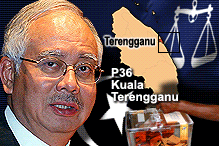 “We give equal treatment to all races, including the Chinese,” Umno deputy president Najib Abdul Razak was reportedly to have said during his campaign trail at Kampung Tiong recently.
He is the second top Umno leader who has uttered this in reminiscence of Prime Minister Abdullah Badawi who also sang the same tune at the MCA’s annual general assembly last year.
Voters do not have short memories
A blogger remarked: “It seems that politicians walking the corridors of power chose to ignore history.
“No wonder, follies (in history) are frequently repeated by politicians, thinking they can be cushioned by the (false) assumption that voters have short memories (of history).”
“Political campaign utterances nowadays are constantly being scrutinised for truthfulness not only by rival parties but increasingly by voters too,” a local academician said.
“Yet, with the advent of a better educated voting population and supported by a litany of historical records, the comfort zone of tongue-wagging politicians especially during bitterly-fought election campaigns like the one in Kuala Terengganu looks to be increasingly vulnerable,” he added.
What do words like “fairness” and “equality” mean by definition when judged by historical records?
Has the Umno-led BN coalition government been fair in tackling sensitive and critical issues affecting the various minority communities? Some examples come to mind in recent history of its governance.
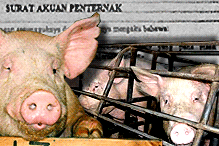 On claims that Umno always take care of all races...what about BN-led state governments enforcing closure of pig farms (affecting the Chinese community) on the ground of environmental pollution?
Chinese cemeteries, notably Bukit Cina (Malacca) and Kwang Tung (KL) were also threatened with new development proposals during 1983 and 2000 respectively.
Frustration of the Chinese community
The Umno leadership also has a strange definition of “fairness and equality” in providing education opportunities.
In 1979, the MCA leadership wrote a letter to Prime Minister Hussein Onn expressing serious concern on the urgent need to resolve the dissatisfaction and frustration of the Chinese community over the new intake of students into local universities with decreasing opportunities for higher education since 1971.
Reminding the prime minister, the letter states: “This is in consonance with the Barisan Nasional 1978 general election manifesto which declares ‘We (BN) will continue to raise standards and expand opportunities for education at all levels and guarantee fair and just opportunities and facilities for all the people.”
The letter also mentioned that the Education Minister (in 1978) had told Parliament: “I accept the fact that since the launching of the NEP in 1970, the government has provided greater and rapid opportunities to our bumiputra students to further their studies at university level.
“But in this process, many students of non-bumiputra origin were disappointed in not getting places although they were highly qualified.”
 Yet 30 years later under BN-government, in 2008, former MCA vice-president Fong Chan Onn in his parliamentary speech raised the same concerns on the need to be fair and equal in providing educational opportunities to all races.
“Allocation of places to local universities that are fair and equitable, scholarships and financial assistance to deserving students, a policy of meritocracy which in the long run will enrich our human capital - these are areas in education that beg to be looked into,” he said.
The unfairness was also reflected in 2004 when more than a hundred outstanding students were denied application for medical courses at a local university despite scoring full marks.
Hindraf, the offspring of Indian dissatisfaction
“The rakyat is also unhappy with the treatment of vernacular schools. They questioned: Why are such schools being marginalised and not regarded as in the mainstream of the country’s national education system?
“Why should such establishment be regarded as political compromises?” Fong added.
On cultural policies in the 1980s, have BN policymakers been fair to other races?
In 1984, a memorandum on national culture was submitted by 10 major Indian associations of Malaysia to the Ministry of Culture, citing complaints against the BN-led government, namely (1) Obstacles in the way of others in the development of their cultures, religions and languages. (2) Discrimination on the basis of religion. (3) Condoning of Islamic extremism. (4) Ridiculing of other religions, and (5) Propagation of the slogan of one language, one religion and one race.
“Indian ladies were told not to wear ‘sarees’ to certain functions.”
Academician Tan ET presenting a seminar paper in 1986 on Malaysian national culture, wrote: “State and local governments also initiated regulations restricting the use of Chinese or size of Chinese characters on advertisement billboards, name plaques of corporations, decorative arches, school buses etc.
“There were even instances of forced removal of advertisement boards of Chinese-run business premises.”
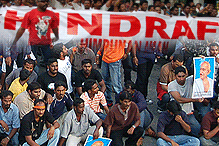 Twenty-three years down the line, in 2008, the Hindraf movement bore testimony to the dissatisfaction on unfair treatment of the Indian community.
Again in 1988, on new villages, MCA complained the allocation of funds for the development of new villages was “piecemeal” on an ad hoc basis.
It was alleged that such funding was done at the discretion of Umno at their political whims and fancy. (Source: A report from MCA Youth to the MCA presidential council dated April 19, 1988)
These are only a handful of historical examples on the narrowly-defined BN’s terminology on “fairness” and “equal treatment” under its divide-and-rule policy.
These illustrations do not include the hundreds of feedback on complaints (during the NEP’s 1986-1990 period) by the Chinese community on perceived discriminations on implementation deviations under the BN-rule and governance.
Politicians should heed the wise saying that “those who live in glass houses should not throw stones.”
Voters in Kuala Terengganu should be told the truth because Umno-led BN governance lacks an impeccable record in upholding the values of “fairness” and “equality” in treating the minority community.


Report this comment
Are you sure you want to delete this comment?
This action cannot be undone.