




The danger of royal arrogance
comment The achievement of some of the heights of Muslim history has been under the aegis of great sultans.
They worried not one whit about what is nowadays called ‘Islamisation of knowledge’. They supported and protected the great scholars, scientists and artists of their age. And their support was in the highest tradition of the original meaning of ‘secular’.
Honouring the Prophet’s own tradition on the pre-eminence of the ‘ink of the scholar’ over the ‘sword of the soldier’, these sultans granted complete freedom to their intellectuals to explore, experiment, and discover the best principles of their arts and sciences.
comment The achievement of some of the heights of Muslim history has been under the aegis of great sultans.
They worried not one whit about what is nowadays called ‘Islamisation of knowledge’. They supported and protected the great scholars, scientists and artists of their age. And their support was in the highest tradition of the original meaning of ‘secular’.
Honouring the Prophet’s own tradition on the pre-eminence of the ‘ink of the scholar’ over the ‘sword of the soldier’, these sultans granted complete freedom to their intellectuals to explore, experiment, and discover the best principles of their arts and sciences.
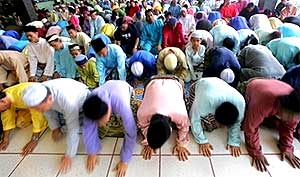 Of course, it helped that no alien ideology was competing with the Muslims’ own substantial knowledge.
Islam had no competitors, such as the ideology of science as is now exported to all areas of the world from the West. Nevertheless, the role emphasised here is that of protection - royal protection was the key to the Islamic ‘Golden Age.
Sultan Salahuddin Al Ayubi’s reputation grew steadily as a generous and virtuous but firm ruler, devoid of charade, extravagance, and cruelty. He courted scholars and preachers, founded institutions of traditional Islamic sciences and mosques for their use, and commissioned them to write edifying works.
Through assertive moral rejuvenation, which was a genuine part of his own way of life, he tried to re-create in his own realm some of the same zeal and enthusiasm that had proved so valuable to the first generations of Muslims when, five centuries before, they had conquered half the known world.
So where does democracy enter the picture? The problem of ‘royal protection’ was exemplified by Ferdinand and Isabella, for example, who plundered Muslim Spain and then used that plunder to attack Columbus’ New World territories and reduce its ancient cultures (Maya, Aztec and Inca) almost to extinction. Later, King George V of England tried to plunder his own colonial possessions in the future US in similarly cruel fashion.
This is the danger of royal arrogance. In order to guard against this arrogance, the American colonists instituted the basic principles of secular democracy. The European royals had been dishonouring their duty to protect the worldly, or ‘secular’, activities of their subjects, including their freedom to worship God as they saw fit.
From the Native American Iroquois Nation, as well as from the better part of Freemason ideology, the principles of representational democracy were formulated, independence from the British throne was declared, and the human spirit entered a new era of freedom and achievement.
Now it seems the ‘protective’ function of democratic government has also gone the way of corruption. In Malaysia, the royalty has become involved in the struggle for a two-party democracy, which Malaysia along with most other Muslims nations, has never known.
The problem with kings and one-party democracy is that corruption has no checks and balances if the incumbent powers have no fear of losing their access to the riches and privileges of government, through public elections.
The function of royalty in the modern ‘age of democracy’ has evolved to be the repository of incorruptibility soaring above and beyond the democratic struggles, from which position they try to reassure the citizenry that ‘right’ will triumph over ‘might’.
However, if any royal patron shows favouritism of any sort down on the ground of democratic processes, he or she has lost the integrity and incorruptibility that is so important as an anchor in times of struggle and instability, such as we all face today.
Admit mistakes and apologise
It would appear that a certain royal preference has been expressed in favour of the ruling coalition in Malaysia.
Now whether or not this is evidence of royal corruption, favouritism to democratic parties on the ground will always be viewed as compromising the integrity of the royalty. This is why they must remain neutral, and be seen to remain neutral.
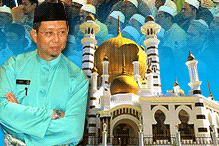 In Malaysia, the confusion as to who actually holds the top executive power in Perak has now been referred to the Federal Court. Royalty suffers yet again in becoming beholden to the judiciary, which is not right. Between royalty and judiciary, which would be the more easily ‘bought’?
If we do not render our royalty as figureheads only, if we wish them to recover their long and honourable history of safeguarding the moral fibre of the nation, how can we avoid the American mistake of declaring them entirely illegal? The American constitution criminalises the use of any and all royal titles or rank.
It won’t help to subject royal decision to judicial review. If a mistake has been made, it is the responsibility of the people themselves to enlighten the royals involved, and this can best be done through a public vote or referendum.
If the sultan forbids or pre-empts such referendum, it may become difficult in the modern democratic age to rescue Malaysia’s royalty from their demise to purely ceremonial duties.
Fascism raises its ugly head if the coalition-in-power also obstructs the universal suffrage of public election, or goes so far as to criminalise the people’s legitimate right to assemble and try to correct the situation.
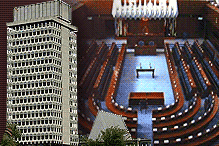 Parliaments meet at the people’s pleasure, not the pleasure of the King or the ruling coalition, whose obstruction of assemblies in which they obviously lack the security of a majority rule, inevitably will be characterised as fascist.
And that is the danger we face, unless the royalty can redefine its present position as caretakers of the public will and preference, instead of opposing it. In other words, the long-standing Malay phobia for admitting mistakes publicly must be overcome.
American leaders have had no problems in doing so. Both Bill Clinton and Barack Obama have apologised publicly for one thing or another. The people’s respect for these leaders has been increased, not damaged, by such admissions.
When asked by Aisha (Radiyallahu ‘anha) why he was exerting himself so arduously in worship, when Allah had forgiven any mistakes he may have committed; Rasulullah (saw) responded by saying, "Should I not then love to be a thankful servant?" ( Mutaffaqun ‘Alayhi )
Surely the Sunnah of the Prophet (saw) is Malaysia’s best guide out of her present confusion and insecurity. All parties in the dispute owe us, the citizenry, apologies for their many mistakes of recent days, and, more important, owe their regret and remorse to Allah swt .
And, InsyaAllah, these political and royal leaders alike must be seen to feel genuine remorse for their mistakes. This is the only possible path to regenerating an enlightened and incorruptible royalty for the new Malaysia.
AZRIL MOHD AMIN, a lawyer by profession, is vice-president of the Muslim Youth Movement of Malaysia (Abim).


Are you sure you want to delete this comment?
This action cannot be undone.