




Britons labour to elect a new government
In the UK, Bid-Up TV is digital television's answer to E-bay. It may be a shopping channel, but unlike its other competitors, Bid-Up TV sells by auction.
On any given day, its presenters sell products by announcing a base price, and then telling viewers to "watch those prices TUMBLE!" when more and more items are sold.
The current campaigning for the British general election bears a curious resemblance to Bid-Up TV. Hardly a day goes by without a proclamation by one of the parties to "vote for us because we will INCREASE spending" on something or other - naturally by x% more than the party that had previously announced its own spending plans.
Elections in Britain have traditionally been a race between two political parties, the Conservative party (or Tories) and the Labour party. A third contender, the Liberal Democrats, usually finish third and sundry other parties or independent candidates may win a smattering of seats.
In 1997, a journalist named Martin Bell, standing as an independent, famously unseated the Tory MP Neil Hamilton.
In the UK, Bid-Up TV is digital television's answer to E-bay. It may be a shopping channel, but unlike its other competitors, Bid-Up TV sells by auction.
On any given day, its presenters sell products by announcing a base price, and then telling viewers to "watch those prices TUMBLE!" when more and more items are sold.
The current campaigning for the British general election bears a curious resemblance to Bid-Up TV. Hardly a day goes by without a proclamation by one of the parties to "vote for us because we will INCREASE spending" on something or other - naturally by x% more than the party that had previously announced its own spending plans.
Elections in Britain have traditionally been a race between two political parties, the Conservative party (or Tories) and the Labour party. A third contender, the Liberal Democrats, usually finish third and sundry other parties or independent candidates may win a smattering of seats.
In 1997, a journalist named Martin Bell, standing as an independent, famously unseated the Tory MP Neil Hamilton.
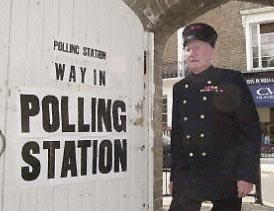 The Tories, being the inheritors of the Whig Party (the party of landowners and aristocrats in the old days), is largely a party of the right, with a strong belief in capitalism.
Labour, traditionally made up of the working classes and the trade unions, has up till recently, stood to the left of the political spectrum with a strong socialist belief in how to organise society.
During the last Labour Government in the mid - to late 1970s, the top rate of taxation was an astonishing 83%. Strikes - organised by powerful unions - were so common that Britain faced many three work-day weeks.
The Tory government headed by Margaret Thatcher changed all that. It steadily cut taxes (by the time Thatcher left office in 1989, the top rate of taxation had gone down to 40), privatised many industries and crippled the unions.
During this time, the Labour party stubbornly refused to acknowledge that Thatcher's policies had changed society - whether for good or worse is still fiercely debated in Britain - and clung to its traditional left-wing ideology. It did not win many votes.
Enter the young Tony Blair - he understood that if the Labour party was to regain power, it had to change. The New Labour project was born - the party positioned itself to the centre of politics, toned down its socialism and told the electorate taxes would not increase. The electorate, fed up with 18 years of Conservatism, voted for Labour in droves in 1997.
Similar views
Eight years on, it is becoming increasingly difficult to separate the two. On many of the issues that matter - crime and order, health, education - both parties seem to be offering much the same thing.
Blair's party says it will not raise taxes (a distinctly un-socialist act), but will finance huge spending in the public sector; thus enlarging the state, which is a provider of public services like health and education.
Tory leader Michael Howard refuses to cut taxes - even though the Tories have traditionally been the party of lower taxes - and pledges to maintain current spending in public expenditure.
Thus Labour aims to emulate Tory policies of old, and the Tories aim to imitate Labour policies that have proved so attractive to voters.
Both are keen for more private sector involvement in the provision of public goods. This is, of course, a more capitalist view of society. The Tories helped create many private companies out of the old state-run industries.
The likes of Virgin and EasyJet would have found it hard to operate had the airline industry remained a state concern. The provision of water and electricity in Britain is now largely in the hands of private companies.
The Labour party of old strongly disagreed with such policies. Public goods should be provided by the state, not (money-grabbing) capitalists. Today's Labour party have largely dissociated themselves with such left-wing ideas - and is prepared to wage battle with its own more traditional-leaning members.
Its reforms of the National Health Service (NHS) means that by the end of this year, 4% of publicly financed treatments on the NHS will be provided by private contractors. This is a move that the Tories would have introduced (and indeed, agreed with).
Certainly, there no longer appears to be any ideological battles left to be fought - both main parties sit so closely on the centre-right of the political spectrum that there hardly seems to be any real choice for the voters to make.
Disinterested voters
This may explain why voters have become so apathetic in recent years. During the last general election, only 59% bothered to vote. Psephologists fear even fewer will turn out this time. There is much discussion on how to get the electorate more "interested", and many bemoan a population that seems to prefer voting in popular television contests like Pop Idol and Big Brother instead of a general election.
There is even talk of Internet and SMS voting. Indeed, the Labour government relaxed the rules on postal voting in order to encourage more people to vote.
But all this is missing the point. The British electorate is sophisticated enough to know when there is choice on the table - and when there isn't. It also knows when its vote matter, and when it does not.
The constituency where I live - Kensington and Chelsea in London - is solidly Tory, and always has been. The other parties would probably never win here, and know it. It shows - there are hardly any posters or electioneering going on. The outcome has already been decided.
The same is true in many other constituencies where the incumbents won the last time around with huge majorities. Accordingly, many have decided that their votes don't matter, and don't bother to go to the polls.
There is another more disturbing reason why people are so apathetic about voting. They don't trust politicians anymore. The public is becoming more cynical - thanks in part to the actions of the current government.
The Labour party came to power promising "to uphold the highest standards in public life" and to be "purer than pure". In its eight years of power, this government has behaved in ways inappropriate to its position.
Ministers have been sacked for improprieties, only to find their way back to power. The government is not beyond asking foreign governments to help the millionaires and billionaires who have contributed to the Labour war chest - even if these people are not British citizens.
It claimed that income taxes would not increase - then raised contributions to National Insurance (which is income tax in all but name).
Discomfort over choices
Then of course, there is Iraq. Like a ghost, this issue continues to haunt the government. The publication last week of the Attorney-General's full advice to the prime minister on going to war brought this issue back to the fore.
The advice was full of caveats and doubts about the legality of the war without a second UN resolution on Iraq. The cabinet however, did not see this document. Instead, it was briefed orally by the Attorney-General who now concluded that it was legal for Britain to go to war - less than a fortnight after issuing his previous advice.
Allegations are now being made that the prime minister broke the official Ministerial Code of Conduct by not handing over the full advice to the cabinet.
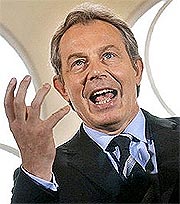 As a direct consequence of the Iraqi war, Blair himself is being challenged in his own constituency of Sedgefield. An independent candidate, Reg Keys, whose son Tom was killed in action in Iraq, is standing as a candidate there.
Despite all this, it is unlikely that the Iraq war will have a great impact on the election. Should the British vote Labour out of power, they would still have to vote someone else in, and current polls show that there is not much stomach for a Conservative government, with the Lib Dems lagging behind both as usual.
There is still a great deal of mistrust in the Tory party - its popular perception is that of a party of old fuddy-duddies who are uncomfortable with the realities of modern Britain. The Tories, it is felt, would not be able to accurately represent gay Britons or the ethnic minorities. Many also feel they remain the party for the rich and the upper classes, and have few sympathy for the lower and working classes.
The Tory campaign is also putting many people off. Take immigration, for example. In a television interview, Blair was repeatedly asked how many illegal immigrants there are in Britain, but was unable, or unwilling to come up with a figure. The interviewer concluded that Blair "had no idea" - which chimed perfectly with the public perception that the government had lost control of the entire immigration process.
The Tories must have thought immigration a sure winner. Unfortunately Tory calls for an annual limit on the number of asylum-seekers and withdrawal from the 1951 Geneva Convention has resulted in many voters seeing them as cruel and racist.
Added to that is the reputation of Howard himself. During the John Major government, Howard was home minister. He was uncompromising and tough, and was deeply unpopular; so much so that one of his colleagues remarked that there was "something of the night" about him - a comment that has stuck ever since.
Possible outcome
There is though, one possible outcome. Barring a miracle, it is quite unlikely for either the Tories or the Lib Dems to topple Labour.
Blair will probably remain as prime minister (unless of course if the people of Sedgefield throw him) - but for how much longer?
His future as premier in fact will greatly depend on the number of Labour MPs returned to power. In the last Parliament, Labour commanded a 251-seat majority. A significantly reduced one this time will mark Blair out as a weak leader - and there is one person in the wings waiting to take over.
For years, a rumour that Blair and his Chancellor of the Exchequer Gordon Brown made a deal regarding the transfer of power circulated in the political world. So pervasive is this rumour that a television documentary has already been made about it.
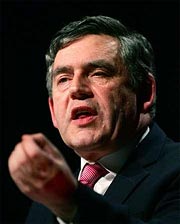 Given the two men's often stormy relationship, it would not surprise anyone if the rumour was true. In the past, Brown has certainly exhibited signs of wanting to wrest power from Blair.
Though Brown is more of a socialist than Blair, he has gained the reputation of being a sound Chancellor. He is currently in an enviable position - whatever mess the government finds itself in, Brown has always managed to stay above it.
Blair's integrity may be under attack, but not Brown's. Blair's supporters may be wavering, but Brown's are solidly behind him.
As a result, Brown has made himself extremely popular amongst both traditional Labour believers and some in the business community. He is also becoming a more attractive choice to those fed up with Blair. Consequently, it would not be beyond the realms of possibility for Labour to win the election with Blair, but find itself with a new leader quite soon after.
This may precisely be what many British voters want - after all, as those behind Bid-Up TV know, there is nothing so attractive as an item that comes with the right price tag and an offer of 'buy one, get one free'. The 6th of May will be an interesting morning to wake up to.
FARAH FAHMY works as a consultant in the United Kingdom. She is intrigued by the similarities and differences between home (Malaysia) and England. She adores walks in the countryside, scones and teas, nasi lemak, reading and observing people.


Are you sure you want to delete this comment?
This action cannot be undone.