




Exploring US policy on Burma
Malaysiakini interviewed Associate Professor Jatswan Singh Sidhu at Universiti Malaya.
In March, a Myanmar/Burma task force of the Asia Society in the US released a comprehensive, and detailed report entitled ‘Current Realities & Future Possibilities in Burma/Myanmar: Options for US Policy’.
Many regional think-tanks, including Malaysia's Institute of Strategic and International Studies (ISIS) participated in the collection of data and observations as well as analyses for the report.
Malaysiakini interviewed Associate Professor Jatswan Singh Sidhu at Universiti Malaya.
A specialist in Southeast Asian history and regional relations, Jatswan also teaches at the Malaysian Armed Forces Staff College and Malaysian Armed Forces Defence College.
He participated in a roundtable discussion on Myanmar/Burma organised by ISIS in Kuala Lumpur last September. The discussion was included as the Malaysian perspective in the Asia Society report.
The report has observed that ‘the US’ ability to solve Burma's problems and to influence the course of the country's governance is extremely limited’ and that ‘US influence in Burma is unlikely to outweigh that of increasingly powerful Asian neighbours’. Why has it taken so long for the Americans to come to this realisation?
Jatswan Singh Sidhu:
It is not just now that the Americans have realised the shortcomings of their policy toward Burma. In fact, even before the 2009 election, there was some talk of reviewing the country’s Burma policy. However, the (Bush) administration was bent on not reviewing its policy although there had been some criticism from the academia over the failure to induce the regime in Burma to undertake political reform.In spite of the pressure of the 20-year isolation and sanctions by the US as well as domestic opposition like the 'Saffron Revolution' in 2008, the military regime in Myanmar/Burma seems to be still strong without any sign of crumbling. Why? What factors, whether 'hard' or 'soft', have contributed to the regime stability?
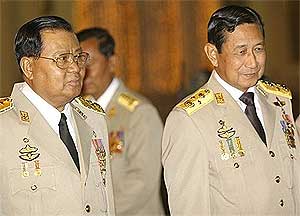 One has to understand that the military
(tatmadaw)
has been in power since 1962 which means for almost 48 years. The period between 1962-1988 saw the entrenchment of this institution such that draconian laws were introduced, thus strangling whatever was left of political space in the country. All other institutions were made subservient to the
tatmadaw
with the presence of military personnel in every aspect of the country’s bureaucracy.
One has to understand that the military
(tatmadaw)
has been in power since 1962 which means for almost 48 years. The period between 1962-1988 saw the entrenchment of this institution such that draconian laws were introduced, thus strangling whatever was left of political space in the country. All other institutions were made subservient to the
tatmadaw
with the presence of military personnel in every aspect of the country’s bureaucracy.
What further facilitated this process of entrenchment was the country’s closed-door policy that was declared by its military rulers and namely General Ne Win. It must be remembered that we are not dealing with a military that usurped power in 1988 but in fact in 1962. Another aspect is the organisational structure of the military where more often than not most regional commanders are loyalists of the country’s top brass.
During the 20 years, Asean, India and China adopted the policy of ‘constructive engagement’. Why did the US, Asean, India and China differ in their respective policies? In your opinion, what are the successes and failures as well as strengths and weaknesses of the policy of ‘constructive engagement’?
Basically, the difference is based on how each of these players/actors view Burma. For China, Burma has all along been considered a satellite state and this is clear when one looks at Chinese investments in Burma. Apart from that, Burma’s top military leaders maintain extremely close relations with Chinese leaders, such that very often China maintains its silence on human rights violations in Burma.
India reviewed its policy of isolating Burma in the early 1990s (as part of its Look East Policy) such that it has been engaging Burma’s military junta at many levels. Indian policy has been driven by the need to contain Chinese influence in Burma which is deemed a threat to its national security.
Asean, in spite of its constructive engagement policy, has failed to induce the Burmese junta to undertake political reform. All of these three actors have been engaging Burma for reasons other than persuading the Burmese junta to undertake political reform. The difference in policy between the US, on the one hand, and Asean, India and China, on the other, is a clear indication of the lack of a coherent and concerted policy to address issues in Burma.
After Barack Obama became president, the US has changed its official policy of isolation and sanction to one which is based on ‘pragmatic engagement’. In your observation, what are the successes and failures as well as strengths and weaknesses of ‘pragmatic engagement’ thus far?
Despite the US overtures, the Burmese junta has not reciprocated positively, which in turn, clear indicates that Obama’s pragmatic engagement policy has failed, at least for the moment. More importantly, although the US has shifted its policy to one of pragmatic engagement, sanctions nevertheless remain in place.
 This carrot-and-stick policy employed by the US has shown little progress because by and large, the Burmese junta continues to defy internal criticism and pressure. One example is the law that denies Aung San Suu Kyi
(left)
from participating in the forthcoming elections. One probable approach that can be undertaken by the stakeholders here is to ensure that there is concerted policy towards Burma which should include the US, EU, China, India, Japan and Asean.
This carrot-and-stick policy employed by the US has shown little progress because by and large, the Burmese junta continues to defy internal criticism and pressure. One example is the law that denies Aung San Suu Kyi
(left)
from participating in the forthcoming elections. One probable approach that can be undertaken by the stakeholders here is to ensure that there is concerted policy towards Burma which should include the US, EU, China, India, Japan and Asean.
The military regime in Myanmar/Burma has occasionally responded to Obama's ‘pragmatic engagement’ like meeting American officials. However, it is still in defiance of the US central demand for the regime to release all political prisoners and hold free, fair and credible elections. What are the considerations in the mind of the military regime in Myanmar/Burma in deciding whether to engage or defy the US?
For the Burmese junta, meetings with foreign officials, namely the US, are frequently used for propaganda purposes at home. For the junta, it appears that they are going to stick to their seven-point plan of implementing ‘disciplined democracy’ which will merely civilianise military rule in the country, with little headway towards real political reform.
The US seems to be also interested in specifically engaging the armed forces and police in Myanmar/Burma. Why? Is the US going to compromise or trade off its well-publicised ‘democracy and human rights’ commitment to the people in Myanmar/Burma in order to achieve the objective?
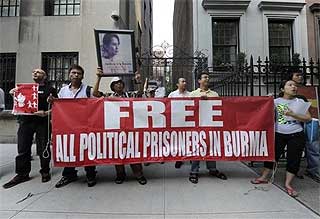 I don’t think by engaging the
tatmadaw
, the US is going to compromise on its commitment for democracy and human rights in Burma. What basically the US is doing is looking for openings or windows of opportunity of engaging the country at as many levels as possible and I certainly believe this should be the way forward. The US has also made it clear that, while it engages the military junta, its commitment to civil society groups within and without Burma remain.
I don’t think by engaging the
tatmadaw
, the US is going to compromise on its commitment for democracy and human rights in Burma. What basically the US is doing is looking for openings or windows of opportunity of engaging the country at as many levels as possible and I certainly believe this should be the way forward. The US has also made it clear that, while it engages the military junta, its commitment to civil society groups within and without Burma remain.
Is there a possibility of the military regime agreeing to defence or security cooperation as a form of engagement with the US? If so, under what circumstances (internal or external to Myanmar/Burma) and what would be the considerations on the part of junta?
At the moment, I don’t think there is such a move of even talk of it. But more importantly, even if the US makes such overtures, the Burmese junta is surely going to consult the Chinese before making a decision.
JAMES WONG WING ON is a former member of Parliament (1990-1995) and a former columnist for the Sin Chew Jit Poh Chinese daily. He read political science and economics at the Monash University in Melbourne, Australia. While in Sin Chew, he and a team of journalists won the top awards of the Malaysian Press Institute for 1998 and 1999.


Report this comment
Are you sure you want to delete this comment?
This action cannot be undone.