




Financial or multi-dimensional crisis? (Part 1)
Private equity company Blackstone Group LP head Stephen Schwarzman has said that up to 45 percent of the world’s wealth has been destroyed by the global credit crisis, according to a Reuters report of March 12.
“Between 40 and 45 percent of the world’s wealth has been destroyed in little less than a year and a half. This is absolutely unprecedented in our lifetime,” Schwarzman told an audience at the Japan Society.
Private equity company Blackstone Group LP head Stephen Schwarzman has said that up to 45 percent of the world’s wealth has been destroyed by the global credit crisis, according to a Reuters report of March 12.
“Between 40 and 45 percent of the world’s wealth has been destroyed in little less than a year and a half. This is absolutely unprecedented in our lifetime,” Schwarzman told an audience at the Japan Society.
The very poor across the globe are in ‘permanent crisis’ from a class and crisis perspective, because that is the way the mainstream global economic structure and process works.
Even for many analysts and academics, there cannot be a situation when we will not have the poor among us.
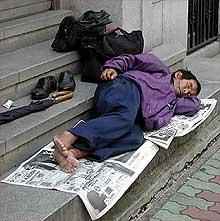 The poor are, in a sense, in perpetual crisis - no permanent shelter, no food security, no regular contractual jobs and no secured future. Their suffering is never seen as crisis. Nor is the situation of the billions a focus of the mainstream media.
It is estimated that more than 1 billion people are chronically hungry across the world. For millions, there is already no food security.
Even in the supposedly wealthy US, it is estimated that about 35 million Americans do not know where their next meal will come from. There is enough food to provide for the hungry, but they do not qualify for it.
Perhaps from such an angle, the Hollywood-Bollywood film 'Slumdog Millionaire' is a soft critique of the mainstream economics and celebration (and to a good extent, romanticisation) of the spirit of poor people who are always in the state of ‘permanent crisis’ but creatively trying to deal with it. Of course it does not offer a solution as much as a dream or fantasy.
For those who have been gainfully employed - the middle classes, entrepreneurs, financial wizards and bankers - the economic downturn is a damning crisis. It is not the way their life should be.
A crisis is a crisis. People have a bad time. The human cost is more pain. For instance, crisis-related suicides have increased across the globe. Japan, which has the highest number of suicides in the developed world, recorded more than 30,000 suicides in 2008 - or more than 25 suicides per 100,000 persons. There is a general increase in suicides in Asia, as during the 1997 East Asian financial crisis.
In countries like Australia and the US, special units and suicide hotlines are being set up to deal with depression. In Australia, between October and December 2008, there was a 34 percent rise in suicide-related calls for help due to financial pressures.
 Millions of people have lost their jobs. ILO labour market projections for this year show definite deterioration in the global labour markets for both women and men.
Two scenarios are given. In the best-case scenario, 18 million jobs will be lost, which would amount to a global unemployment rate of 6.1 percent. In the worst-case scenario, there will be a loss of more than 50 million jobs, which would equate to a rate of 7.1 percent. Of this, about 21 million will be women.
If the worst-case scenario happens, the number of poor working people who will be unable to earn enough to lift themselves and their families above the poverty line (US$2 per person per day) may rise to 1.4 billion. This is nearly half of the entire world’s employed.
Furthermore, some 200 million workers earning US$1.25 or less a day, mostly in developing economies, could be pushed into extreme poverty.
The periodic crisis makes it even more difficult for those in the ‘permanently in crisis’ list.
Identifying the causes
The economic crisis has now offered the world a new intellectual enterprise and it is gaining strength. From across the political spectrum, analyses of causes of the present financial crisis and economic downturn are being offered and, in the same breath, solutions are being presented.
As can be expected, some of these solutions, particularly from the right, are being sold. For many, the economic crisis, of course, offers business opportunities. The Chinese term for crisis captures both the notion of ‘danger’ and ‘opportunity’. The intellectual response to crisis has also provided both these elements. The only difference is that way opportunity is perceived.
Just walk into any bookstore and you will see many books from across the political spectrum - from 'free market' to 'new imperialism' theorists. Radicals to Nobel laureates to pop management gurus generously offer their thoughts and solutions.
If one has been following the intellectual output during the various crises from the distant and/or recent past, it is easy to find rehashed arguments and solutions just as much as you will find some writers who have been consistent in tracing and monitoring these crises and predicting future ones.
Looking more closely, one group just wants to look at the sub-prime mortgage crisis in the US, and to deal with the present crisis from that starting point since it kicked up the whole problem for the US, European and global economies.
They want to re-examine financial regulation nationally and globally, tighten it, do more tinkering to the present system and move on. It is business as usual, with some tweaking.
The other group, looking at the crisis more historically, wants to go beyond the crisis. They look at sub-prime mortgages as only one of the many responses to inherent structural problems of the global economy based on the profit-only bottom line tendency (and on the appropriation of value produced by one group by another group).
For many in this group, the present problem has its roots in the period after the end of World War II and begins with the post-war economic reconstruction of Japan and Germany/Europe. They want us to re-examine and fundamentally change the way we organise our economy and manage our society.
Perhaps a revealing analysis is the fact that from post-war period onwards, there has been progressive degeneration of the ‘real economy’ and progressive growth of the ‘finance economy’. Real wages, productivity and demand have fallen or shrunk. With many new locations of increased production and capacity, we are also now faced with the problem with overproduction.
Over the years, political, industrial and financial leaders have tried many ways to deal with long-term structural economic problems.
 Addressing complex needs - the dotcom bubble, global war on communism then and terrorism now, Afghanistan and Iraqi wars and their reconstruction efforts, and sub-prime mortgages in the US - were attempts to deal with the problems of national and global economies.
Political and economic leaders looked for ways to prop up economic activity. While the US acted as a leader, a transnational group of entrepreneurs from across the globe benefitted. It is instructive to know that using war to benefit national and global economies is built into the mainstream economic system. It is central to financing and sustaining the ‘American dream’, which has been appropriated well beyond domestic shores.
Real productive enterprises provide goods and service that do something better than what exists, creating jobs and increasing productivity and overall efficiency.
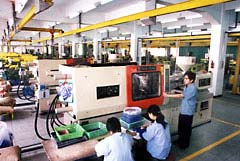 Economic growth and progress in the real world takes place because of ‘product entrepreneurs’ and the labouring community who make profit or earn wages, invest these earnings in creating new products or enterprises, or in consuming the produce of the real economy.
According to one UN Report, since 1980, ‘economic decline or stagnation has affected 100 countries, reducing the incomes of 1.6 billion people. For 70 of these countries, average incomes are less in the mid-1990s than in 1980, and in 43, less than in 1970’.
Financial or multi-dimensional crisis? (Part2)
DR M NADARAJAH is a sociologist by training. He belongs to the Asian Public Intellectuals community of film-makers, theatre people, songwriters, poets, activists and academics working in Thailand, Malaysia, Indonesia, Philippines and Japan for a better Asia. His work focuses on cultural and sustainability issues.


Are you sure you want to delete this comment?
This action cannot be undone.