




Indonesian ninjas and Malaysian sub
Ever since the days of Indonesian Konfrontasi in the 1960s, the bilateral relation between Malaysia and Indonesia have always been quite cordial, despite the occasional verbal skirmishes that is only to be expected between neighbours.
The biggest obstacle towards better bilateral relations has to be the conflicting territorial claims between the two countries. Since 1980, Indonesia has submitted 36 diplomatic protest notes to Malaysia over the issue since 1980.
In March 2005, Indonesia accused the Malaysian navy vessel, KD Renchong, of ramming its military ship, KRI Tedung Naga. The incident caused minor damage to both vessels. That incident too caused a great deal of negative excitement in the Indonesia media.
Ever since the days of Indonesian Konfrontasi in the 1960s, the bilateral relation between Malaysia and Indonesia have always been quite cordial, despite the occasional verbal skirmishes that is only to be expected between neighbours.
The biggest obstacle towards better bilateral relations has to be the conflicting territorial claims between the two countries. Since 1980, Indonesia has submitted 36 diplomatic protest notes to Malaysia over the issue since 1980.
In March 2005, Indonesia accused the Malaysian navy vessel, KD Renchong, of ramming its military ship, KRI Tedung Naga. The incident caused minor damage to both vessels. That incident too caused a great deal of negative excitement in the Indonesia media.
On Dec 17, 2002, the International Court of Justice (ICJ) – the principle judicial organ of the United Nations – awarded the islands of Sipadan and Litigan to Malaysia in a case to settle the dispute between Malaysia and Indonesia.
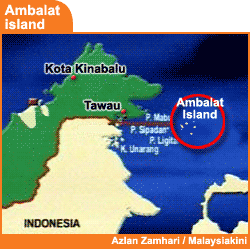 At present, the most contentious issue is the claim on Ambalat by both Malaysia and Indonesia. Ambalat is a sea block in the Sulawesi Sea located off the coast of the Indonesian province of East Kalimantan and south east of the Malaysian state of Sabah.
The deep sea blocks contain an estimated 62 million barrels of oil and 348 million cubic meters of natural gas. Other estimates place it substantially higher: 764 million barrels of oil and 3.96 × 10¹⁰ cubic meters (1.4 trillion cubic feet) of gas, in only one of nine points in Ambalat.
It is because the economic stake is so high in these waters off Sabah coasts that our newly purchased super-submarine is being based in Sepanggar Port near Kota Kinabalu in Sabah. We pray we many never have a war, but to keep the hardware ready is a way of deterring war as well.
The Ambalat problem will have to be resolved diplomatically, and in the ICJ eventually.
Beware of stars-throwing ninjas
That kind of international dispute we can understand, but this business of Indonesia whipping up a nationalist frenzy about Malaysia stealing their culture is down right ludicrous.
First, there was this noisy riot in the Indonesia newspapers over Malaysia stealing the Pendet dance that originated from Bali. The dance was inserted in a 30-second clip as part of Malaysian attractions in a Discovery series to promote Malaysia as a travel destination.
 It was probably a genuine mistake by the culturally illiterate production house in Singapore. No Malaysian would err that way. The question is: why wasn’t a Malaysian company commissioned to produce tourism promotional materials for our own country? Why wasn’t the offensive material not vetted by officials from our Ministry of Tourism?
The newspaper riot in Jakarta soon spilled into the street. A vigilante group called Benteng Demokrasi Rakyat blocked a road in the plush Menteng district in Jakarta in a hunt for Malaysians.
Fifty men armed with ‘bambu runcing’ — sharpened bamboo poles — stopped motorists and demanded their identity cards. Police were called in and they broke up the group within an hour.
Bendera leader Muchtar Bonaventura said: “In so many ways, Malaysia has stolen from us and insulted Indonesia. We feel offended and angry.
“We are going to organise more actions against the Malaysians in the next few days. This may include declaring war against them,” he said. He claimed about 500 volunteers had signed up and were ready to go to war against Malaysia.
 “We have started gathering weapons like samurai swords and ninja throwing stars and conducting military training for our volunteers who will go and fight in Malaysia in October,” he said.
I was not worried about that threat of invasion. We have our recently purchased super submarine to protect us from invading boatloads of Indonesian samurais wielding their swords and throwing ninja darts. It looks like such an unequal fight.
By now, we should know the domestic politics that has agitated such crass skin-deep anti-Malaysia nationalism in Indonesia. In a series of very insightful articles in his blog The Other Malaysia, Farish A Noor has analysed the reasons for this wave of petty xenophobia against Malaysia.
 There was a presidential election there recently, won by Susilo Bambang Yudhoyono (SBY). His opponents are trying to stir up local anger against non-existent Malaysian sins against their national pride, to make SBY look weak and fearful of Malaysia.
Stupidity begets stupidity
The best way for Malaysian government and Malaysians in general to deal with this non-issue is to ignore those over-zealous but stupid Indonesian protestors, and wait for diplomats to work things out. But stupidity in one country begets stupidity in another in this kind of cultural spat.
 Our very own Tourism Minister Ng Yen Yen is now laying claim to intellectual property ownership to quite a few food items like laksa, nasi lemak, Hainanese chicken rice, chilli crab, bak kut teh, etc ,etc, etc.
How do you claim intellectual property rights over folk culture like food and drink? Where do you register your patent?
This is the same MCA woman minister who objected to the import of maids from mainland China for fear that Malaysia husbands will succumb to the charm and seduction of China’s Little Dragon Ladies. So we can understand how badly she needs some education on affairs of the world.
Elements of folk culture like dances, music, food and drink, handicraft, clothing, folklore, and even architecture live in the minds of the common people who create and recreate them everyday. They are not things like islands to be occupied and exploited for oil and gas.
Cultural practices also grow and evolve over time, and absorb elements from other cultures along the way. For instance, the wayang kulit in Malaysia tells the story of the Indian epics of Mahabhrata and Ramayana, and so do the Balinese dance being displayed before millions of foreign tourists every year.
Are these practitioners of folk art in Malaysia and Indonesia stealing what is essentially Indian culture?
Are Malaysians “stealing” culture from the People’s Republic of China when they perform their lion dance?
The curry was probably invented by the Indians on the Indian sub-continent. Now it is spread throughout the world, like Chinese food from China. Who is “stealing” from whose culture? Nobody!
In short, nationalist claim for cultural ownership is a very misguided and superficial form of primitive nationalism. If the culture warriors from both Indonesia and Malaysia only crawl out from under their mental coconut shells, and cast their horizon far enough, they will then realise that the best of folk culture from any society eventually should be treasured and cherished as an integral part of the collective cultural heritage of the entire human race.
Cultural non-issues
There are indeed serious bilateral issues between Indonesia and Malaysia that ought to be debated in the public airwave.
The problem of millions of legal and illegal Indonesian maids and workers in Malaysia needs more serious attention from the governments of both countries. The problem of annual haze drifting across the border from Indonesia to Malaysia to choke and pollute our lungs has yet to be resolved. There are outstanding trade issues, and there are the territorial disputes.
That a lot of hot air has been cooked up over cultural non-issues on both sides is a clear indication that both Malaysia and Indonesia are still a long way to go towards evolving into mature, enlightened, and open democracies. But then, what else is new?
SIM KWANG YANG can be reached at kenyalang578@hotmail.com.


Are you sure you want to delete this comment?
This action cannot be undone.