




Caught between hate-mails and cow-heads
Whether one believes in a personal God, or don't, what matters ultimately in our earthly life is this, 'if your enemy is hungry, feed him. If he is thirsty, give him something to drink'.
Arriving home after months overseas, I saw a blue-red placard staked on my front lawn. ‘What's that?'
"It's a gospel campaign ...", my son said.
"That's good. Any reactions yet?"
"Not yet".
Alas, it came. An unnamed letter, crookedly cut from a scrap paper, arrived in our mailbox a few days later. Part of it read: "Some of us have interests and beliefs but do not spoil the look of the area by placing signs on our lawns. I suppose they do this in Hong Kong, Singapore or wherever you come from. NOT HERE!!!!! I would suggest you take the sign down as soon as possible".
 A friend remarked mockingly. Between Australia and Malaysia, I'm caught between anti-religion racists and zealous cow-head stompers. A bad mix. But, the placard stayed staked.
The 'Jesus All About Life' billboard campaign began on Sept 7. It moved on to television commercials on Sept 27 until October ends. The campaign by the Bible Society of New South Wales to attract converts and increase church attendance has attracted mixed reactions - most deriding the church for ‘pushing their beliefs' into the public domain.
Anonymous atheists have even set up websites, mostly dimwitted, to parody the campaign and ridicule the Christian community. The church is turning the other cheek.
Although most unwelcomed, the hate mail was unsurprising. Anonymous objector. Cowardice is so annoying. And, I'm peeved. Every car that drives past daily is a suspect racist ‘anti-Christ' hate-mailer.
"Would you be happy to share the experience of receiving the hate mail in Sunday church?", my pastor asked.
'Such things are to be expected'
"The idea is not to complain about it", he assured me. "Or discourage others [from putting up the JAAL sign] who might not cope with such mild 'persecution', but to encourage people that such things are to be expected".
He quoted a few verses - 2 Tim 3:12 which assures that those who want to live a ‘godly life' will be persecuted; and James 1:2-4 (Count it all joy, my brothers, when you meet trials of various kinds, for you know that the testing of your faith produces steadfastness. And let steadfastness have its full effect, that you may be perfect and complete, lacking in nothing)".
I replied my pastor: "I'm not too sure if I can honestly say I ‘rejoice' at the mild ‘persecution'. I'm actually quite peeved with the offensive mail". There goes my steadfastness.
The placard has gone missing too - perhaps nicked by the objector in the dark of night. Or, blown away during the dust storms that engulfed Sydney and Wollongong on Wednesday. An act of a nasty nature.
Indeed, since religions were organized into institutions, they have copped many hate mails, much public scorn and ridicule for its perceived cloistered worldviews and overt uncompromising stand on issues of morality (abortions, homosexuality, alcohol), evolution and creationism, marriage within the faith. None shall be unequally yoked.
Fuelling the public cynicism are the occasional headlines of moral aberrations among religious leaders, militancy, extremism and bigotries of various shades by ultra-conservative religious groups.
Religious conservatives who interpret literally their respective scriptures then blame the devils of post-modernism, [western] hedonism, liberalism, materialism, relativism, humanism and other -isms for the ebbs and flows of anti-religionism.
What do we see? We see the parallel universe of jihadists and crusaders - each answering their own spiritual call to win over the public hearts and minds, while at the same time defending their faith against the intellectual onslaughts of atheists who proclaim complete faith in human reason and science as the only way to know the natural world, just as the believers profess complete faith in their God's revelations in knowing the spiritual world beyond.
Religions remain divided
While it's a truism that all religions share common values for doing good and serving others, organized religions remain divided by their exclusive claims to absolute religious truth and revelation of their God's direction for a ‘purpose driven life'.
When one claims with certainty from a position of extreme secularism that God does not exist, while the other claims in absolute faith that God exists, the conversation becomes problematic. One professes complete faith in empiricism; the other, complete faith in things not seen.
Passion trumps reason. Conversion defines the conversation. Would not conversions be better achieved if one shares from a position of cultural empathy, mutual respect, moral and epistemic humility rather than spiritual superiority?
Meanwhile, the Christian preaches ‘Jesus Christ is the living Son of God, the way, the truth and the life'. The Muslim proclaims, ‘Muhammad is the last prophet. Jesus, too, was just a prophet and messenger of Allah'. The Buddhist says there is no personal god, only an impersonal force made up of all living things that hold the universe together. And, to a Bahai - Jesus, Mohammad and Buddha, they're all manifestations of God who came to spread peace and love on Earth.
Understand the world by reason
As a journalist and a journalism educator my mind's moulded to understand the world by reason and to take what I hear, read and see with skepticism. As a church-going Christian, the weekly sermons I hear teach that faith is to believe in things not seen, that positivist human query will never be satisfied unless one's mind is open to revelations by a creator God. A spiritual journey has its many surprising turns.
I recall my parents and my friends' praying to different gods and deities. The hope they placed in their prayers and obeisance to a higher force to carry them through uncertainties are vivid memories of my childhood in Penang where mosques, temples and churches coexist in peace. The muezzin's call to prayer at the break of dawn
 till the fall of dusk is as calming as Buddhists' chants, the hymns of the Baptists, and rings of puja bells. All roads, they pray, will lead to the same heaven.
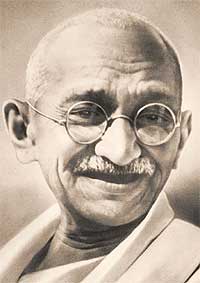
Wouldn't it be refreshing if today's hate-mailers and cow-head stompers are open to to the overlapping truths taught in the teachings of Christ, Muhammad, Siddharta and Baha'ulah? Include in this spiritual journey, the philosophies of Gandhi (right) , Plato, Gibran, Confucius and the great Islamic thinkers - we'd all be so much richer in spirit and poorer in prejudice. Whether one believes in a personal God, or don't, what matters ultimately in our earthly life is this, 'if your enemy is hungry, feed him. If he is thirsty, give him something to drink'.


Are you sure you want to delete this comment?
This action cannot be undone.