




Doing the right thing, we sleep better
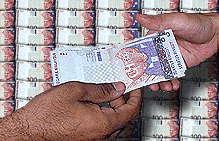
With a five-dollar note stashed in my ‘L-lembu' licence, the plastic sleeve smudged through frequent fiddling, I handed it over.
"Boleh selesai kah, Tuan?" Five dollars was a lot of money in 1974.
From muted mutter to bold proposition, slipping duit kopi to traffic cops got easier each time I was nabbed in my Honda-cub ride to Universiti Sains Malaysia.
Next stop, the RIMV (now known as the JPJ)
After months of learning to drive in a boneshaker green Mini, which often stalled between first and second gear, it was time for my test.
With a five-ringgit note stashed in my ‘L-lembu' licence, the plastic sleeve smudged through frequent fiddling, I handed it over.
"Boleh selesai kah, Tuan?" Five dollars was a lot of money in 1974.
From muted mutter to bold proposition, slipping duit kopi to traffic cops got easier each time I was nabbed in my Honda-cub ride to Universiti Sains Malaysia.
Next stop, the RIMV (now known as JPJ)
After months of learning to drive in a boneshaker green Mini, which often stalled between first and second gear, it was time for my test.
"You want guarantee or not?" my instructor asked.
"Not."
I saved $100.
 Next, PKNS Shah Alam. After years of sharing a one-room flat with a pack-a-day smoker, it was time to own my privacy. Medium-cost flats near Institut Teknoloji Mara were up for sale.
"Berapa cepat you nak?" asked the clerk.
Six months on, my application was still buried under a growing pile of forms. That was in 1984.
A quarter of a century on and after a change of two prime ministers with new slogans and cabinets of incumbents and apparatchiks in tow, has systemic corruption been significantly curtailed?
No. From the many casual testimonials I hear each time I come home, fraudulent practices seem to permeate the private and public sectors - which in itself is not news. But it's certainly troubling to actually hear business colleagues relate the euphemisms and layers of ‘goodwill money' that grease the system.
Land of opportunities
‘Bribes' are ‘coffee money'. ‘Palm greases' are buah tangan . ‘Cronyism' is ‘helping out a friend'. ‘Nepotism' is ‘grooming future leaders'. ‘Cover-ups' are justified as necessary for ‘national security'. And, so forth.
‘I know the Datuk (or the principal, the director, the boss and so forth) - is an acceptable part of social and commercial transactions. ‘Can you pull some strings?'
Currying favours and returning them is normalised. For those with no power connections, bribery opens up a crooked way to opportunities beyond one's grasp under normal circumstances.
Our image as a ‘clean' country to do business surely needs a thorough clean up. Fat chance, the cynics say.
The Transparency International Global Corruption Report consistently shows that Malaysia is one of the most corrupt countries in Asia, which we hope would mortify our government. But, no. TI's report is generally pooh-poohed as biased.
As TI Malaysia Chapter president, Paul Low reportedly said: "You may not like the contents, but it is the international perception of what's happening (in Malaysia)."
Indeed, foreign academics and corporations unfamiliar with the Malaysian environment only have hearsay and published reports by non-partisan organisations to help them gauge what it would be like to do business here.
Whatever attraction the 'Malaysia My Second Home' package promotion has on foreigners planning for their retirement is certainly being undermined by the perception that fraudulent practices are an acceptable way of life here - from the corner mechanic shop and rude vendors in Petaling Street to foreign maid agencies, police and civil servants.
But, I suppose, the foreign retirees with fat bank accounts are contented living like former colonialists in gated communities lording over the locals.
'Boleh selesai?'
Credit card frauds don't help either. The Australian Department of Foreign Affairs and Trade carries a travel advice. 'Credit card fraud occurs extensively throughout Malaysia,' it says. 'Credit cards are frequently copied in places ranging from small shops to large department stores and hotels for later illegal use.'
The US Department of State and British Foreign and Commonwealth Office carry similar caution about using ATMs and credit cards in Malaysia. The State Department even explains how Malaysian retailers scam their customers.
"Retailers swipe the credit card under the counter where account information is received into a machine containing a mobile phone SIM card and is transmitted to a criminal organisation for reproduction. In some cases sophisticated criminal organisations have tapped into data lines emanating from retail establishments. Credit card information is then stolen while it is being transmitted to financial institutions."
We should be concerned - and malu too. Decades of nepotism, greed and money politics have spawned a culture of corruption. Arresting the perpetrators - which the MACC has yet to achieve - won't help either. It's like trying to get rid of ants by spraying the crannies with repellants while leaving the honey pot exposed instead of keeping it tightly closed.
You scratch my back. I scratch yours. This is so entrenched in our daily interactions that if one's careless enough to be caught, it will be replaced by another. No matter how many are caught, corruption will fester because the culture that spawns it persists.
‘I know the Datuk,' vouches a parent vieing for a place in a selective school for their child.
‘Boleh selesai ke, Tuan?'
‘Can you guarantee I will get the tender?' asks a developer as he hands over the papers - and a brown envelope.
‘What's my cut?' asks the lawyer as he prepares the legal papers.
Certainly, the rakyat have long demanded for harsh punitive measures on those caught and convicted. While governments and international bodies continue to formalise anti-corruption initiatives - which don't mean much to us common folks - addressing the problem should really start with us. Because the change we want to see in the government must begin from the change we need to see in ourselves.
We may not eradicate corruption, but we can certainly reduce it. This will need a shift of mindsets, a recalibration of our moral values, a cultural reform. From the family to community, from the private to public sectors, the values that we profess are certainly not deterring corrupt practices from happening. We need to be the change we want to see in the world, if my memory serves me well on what Mahatma Gandhi once wrote.
Do the right thing
I recognise how tempting it is to use others' money for private gains - as do many of our government functionaries - and to ‘bribe' and manipulate to move ahead, as do many of us.
From giving that extra tip to get a table by the window and pandering to the boss's whims to get that promotion to the seedier ‘goodwill ang pow ' to win the million-dollar contract. Here, it's good to be reminded by the good book: 'For he who sows to his flesh will of the flesh reap corruption'.
Herein lies the imperative of monitoring the current state of play and tracking for any potential incorruptible leaders - the truly honest men and women - until the next election.
Thus far, I doubt they exist under the present - and past - leaderships. Not with the deaths of the Altantuyas, the Kugans, and the BH Teohs remaining unsolved and suspicious in the public mind. Which, as our history of policing shows, will most likely be shelved as cold cases.
Thus, the onus is on us, the common people, to consciously choose in our daily transactions integrity over manipulation, merits over connections, honesty over deception, reason over rhetoric, self-sufficiency over corruption.
We'll sleep better if we do the right thing. As the faithful would ask: what good would it do us to gain the whole world but lose our soul?
Lots, say those who have prospered from the corrupt system. They would sell their soul for a shortcut to power and wealth.


Are you sure you want to delete this comment?
This action cannot be undone.