




It's getting hotter
By and large, Malaysians seem to be pretty inward looking when it comes to their political worldview, due perhaps to their immersion within the sea of their domestic issues of race and religion. Comments and debates on foreign affairs and international relations are few and far between, at least on Malaysiakini.
Finally, Malaysiakini has also opened up a World Section that carries foreign news, but I wonder how many hits those stories will get from readers, compared to stories on BTN or news about political parties.
They cannot be blamed entirely for their apparent lack of interest in this particular domain of our national life. We are a small country without the kind of clout to influence major international events, unlike the United States or China. People may feel that whatever happens on the other side of the world, there is very little Malaysia can do about it.
But we do live in an increasingly inter-connected and inter-dependent world...
By and large, Malaysians seem to be pretty inward looking when it comes to their political worldview, due perhaps to their immersion within the sea of their domestic issues of race and religion. Comments and debates on foreign affairs and international relations are few and far between, at least on Malaysiakini.
Finally, Malaysiakini has also opened up a World Section that carries foreign news, but I wonder how many hits those stories will get from readers, compared to stories on BTN or news about political parties.
 his particular domain of our national life. We are a small country without the kind of clout to influence major international events, unlike the United States or China. People may feel that whatever happens on the other side of the world, there is very little Malaysia can do about it.
But we do live in an increasingly inter-connected and inter-dependent world. Whatever happens in one corner of the globe can and will exert an impact on our cosy tropical landscape. Nowhere is this dictum truer than in this business of climate change.
After decades of endless talk and foot-dragging, after the uninspired Montreal and Kyoto Protocols, the world seems on the verge of coming to some consensus about doing something to save our planet from total annihilation from disasters of our making.
Representatives from 183 countries, including 93 heads of state and government, will be attending the United Nations’ Climate Change Conference in Copenhagen, Denmark from Dec 7 to 18.
Finally the sceptics and powerful vested interest groups have given way to the international scientific community, the NGOs, the UN agencies, and concerned political leaders all over the world.
Encouraging signs
And unlike similar conferences in the past, there are encouraging signs.
President Barack Obama of the US has already proposed a 17% cut in carbon emission from his country by 2020, and his personal presence is an announcement of American re-engagement in environmental diplomacy.
Even China has promised to cut ‘carbon intensity’, a measure of carbon dioxide emission per unit of production by 40% to 45% by 2020, compared to levels in 2005. In the past, China has resisted targets for reduction in carbon emission for fear of putting a brake on its burgeoning economic growth.
 US and China are the world’s largest polluters, and all international treaties on climate change would have been meaningless without the active leadership and participation of these two industrial giants.
In the past, sceptics have always succeeded in casting lingering doubt about the predictions of gloom and doom made by the international community of distinguished scientists after decades of observation and research.
But today, scepticism and reservations have given way to alarm as scientists say we are on our way to the worst-case scenario laid out only two years ago by the Nobel Prize-winning UN Intergovernmental Panel on Climate Change. Al Gore’s influential film ‘An Inconvenient Truth’ has also exerted considerable impact on world opinion on this subject.
Exactly how climate change disasters are going to be played out is a matter of speculation, and the whole debate can be distracted by too many scientific data and technical jargon. But one thing is certain: what has been predicted in the past has come to be in the present.
Ecosystems at ‘tipping points’
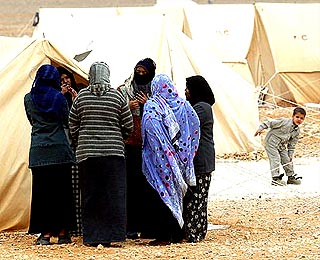
The UN refugee agency says some 24 million people worldwide have fled their homes due to environmental factors, and warns that their ranks could swell tenfold by mid-century spurred by unchecked climate change. That would cause immense political, social and economic upheavals in many corners of the world.
 Two studies released ahead of the Copenhagen Conference next week say that on current trends, Earth could warm up by up to 6.4 degrees within this century. This will lead to a rise in sea level, submerging many existing islands and low-lying land, including heavily populated river delta areas where some of the world’s greatest and most populous cities are located.
A recent report, released by World Wildlife Fund and financial services Allianz, concludes that the world's diverse regions and ecosystems are close to temperature thresholds, or "tipping points". A possible rise in sea levels by 0.5 meters by 2050 could put at risk more than US$28 trillion worth of assets in the world's largest coastal cities.
But it is hard to find the universal political will to tackle this looming threat of a globe strangled by man’s economic activity.
Carbon reduction means reduced industrial output, loss of jobs and income, and loss of votes for politicians. In very poor emerging economies like India, they want their chance to catch up with the affluent countries in the West and reduce abject and widespread poverty among their population. Asking them to cut back on their carbon emission without any kind of compensation from the rich countries is certainly unfair.
Climate change also knows no geographical and national boundaries. Managing the global environment to slow down the rate of global warming also requires a great deal of money. The British Commonwealth has proposed a fund of US$10 billion to help poor countries cope with the suffering of carbon reduction. On a global scale, this is like a drop of water in a vast ocean.
Our ‘good life’ unsustainable
But the problem with global warming cannot be solved by political, economic, and technological means alone. Essentially, it is a philosophical problem: how shall we live our lives as a species?
 At the moment, our civilisation is premised upon limitless economic growth, forever expanding international trade, eternal increase in the production of goods and services, and of course, more people plunging into the dream of the good life through endless consumption of more goods and services.
We have forgotten that this idea of a good life and human progress is simply not sustainable on a planet with limited resources and energy supply, where nature’s ability to heal itself also has a limit. A limited world simply cannot satisfy our limitless greed forever. This is simple logic.
Despite our scientific brilliance and our technological innovativeness, we still have to go back to the basics of human values, and ask ourselves whether or not to be satisfied with just enough.
Otherwise, 10 more conferences like the one in Copenhagen will not stop the Earth from hurtling towards self-destruction.
Perhaps we will learn the true lessons of life, after we have to cycle home from work to our house lit by candles – long after I am gone.
SIM KWANG YANG can be reached at kenyalang578@hotmail.com.


