




Q&A with a media bull detector (Pt 1)
Annual surveys of public perception of ethical professions by Roy Morgan Research in Australia consistently show that Australian journalists are as least trusted as used-car sellers and insurance brokers, advertising people and real estate agents. Would our mainstream journalists fare any better? You wouldn’t think so.
Annual surveys of public perception of ethical professions by Roy Morgan Research in Australia consistently show that Australian journalists are as least trusted as used-car sellers and insurance brokers, advertising people and real estate agents. Would our mainstream journalists fare any better? You wouldn’t think so.
While the Australian media is perceived as unethical because of their puff pieces and sensational stories in their chase for ratings and readers, criticisms of our mainstream media consistently point to their shallow reporting of public affairs and abject failure to expose human rights abuses and instances of state-sanctioned racial and religious discrimination.
Indeed, commendable is our mainstream journalists’ record for serving the state, but dismally poor in reporting the common concerns of the community.
To be fair, for each case of sloppy unethical journalism, there are many instances of enterprise reporting. Public perception surveys are only as accurate as the human respondents are able to understand via a phone call what they think is ethical. And that, we know, is highly subjective and, to an extent, culturally influenced. That’s the limitations of what we can gather from public perception surveys. Nevertheless, they provide a stimulating discussion point.
After having worked in both the Malaysian and Australian newsroom, I admit much is lacking in Malaysian journalism in terms of editorial leadership, journalistic tenacity, investigative fervour and narrative quality. Until we improve, the onus lies with the reading public to declare that they deserve better from editors and journalists.
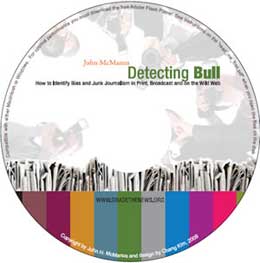
Thus, the timely publication of ‘Detecting Bull: How to Identify Bias and Junk Journalism in Print, Broadcast and on the Wild Web’ to help us sieve the goods from the pile. ‘Detecting Bull’ is one of the many accessible resources that Malaysian readers might find handy in holding our mainstream journalists accountable.
 I provide in two parts my interview with its author, John McManus (
right
), on his take on today’s journalism. While his observations are drawn from the US experience, his comments apply to Malaysian journalism.
I provide in two parts my interview with its author, John McManus (
right
), on his take on today’s journalism. While his observations are drawn from the US experience, his comments apply to Malaysian journalism.
Eric Loo: What are the working assumptions in ‘Detecting Bull’?
John McManus: There are three cardinal assumptions:
1. Citizens can no longer rely on traditional sources of news. We have entered what Brooke Gladstone of National Public Radio's On the Media calls a ‘buyer beware’ environment for news. Traditional media like network newscasts and newspapers have amputated much of their reporting and editing staff and are more prone to cut corners than in the past. Advertising and public relations reports are masquerading as news in many short-handed newsrooms. Sensation is replacing substance, particularly investigative reporting. New providers of journalism are arising – citizens, corporations, online publications; some would include (talk show hosts) Jon Stewart and Stephen Colbert. Some of these newcomers are terrific, but many produce reports of questionable reliability. Hidden conflicts of interest abound. As a consequence, citizens now have access to more information purporting to be news, but less of it is trustworthy.
I don't think of Stewart and Colbert as talk show hosts since they don't take calls; but they are comedians. In ‘Detecting Bull’ I classify them as self-described fake newsmen. That having been said, college students love their shows and they do a great job of holding polls to account, though clearly from a liberal perspective.
2. Reliable news is a necessary, though insufficient, condition for democracy. The news media constitute a nation's central nervous system. They connect us with each other's pain and progress. They help us make sense of daily events, making informed collective decisions possible.
3. Citizens can – and must - learn to distinguish reliable journalism from the pretenders and support it financially.
Apart from its interactive contents, how is ‘Detecting Bull’ significantly different in its thesis from your book ‘Market Driven Journalism’ in 1994?
The books overlap very little. ‘Market-Driven Journalism’ is a theoretical exploration of how markets – for consumers, advertisers, investors and sources – shape news produced by profit-seeking corporations. ‘Detecting Bull’ is a practical guide designed to help citizens discover bias and discern between quality and junk journalism (news that's simple, emotional and compelling, but unimportant). The chapter in ‘Detecting Bull’ about institutional (primarily corporate) barriers to describing reality as well as humans can relies on the thinking in Market-Driven Journalism. Otherwise the books explore different subjects.
What are the common ‘bull’ you see in today’s traditional media (that is, newspapers, TV and radio)?
We're seeing a cheapening of most American newspapers – more crime news, less investigation, less depth, less breadth, more advertiser influence; more reliance on PR, more sensation. But there is still some vestigial quality reporting. On the national cable scene we're also seeing the rise of niche marketing that violates core journalistic norms of impartiality. In ‘Detecting Bull’ I describe how Fox has decided it can earn more dollars playing to the political right than competing with other networks for the middle. MSNBC with Olbermann and Maddow play to the left for similar reasons. Of course, they don't admit this. Fox even tried to trademark the phrase ‘fair and balanced.’ I can't imagine they really think they are fair and balanced, but for Fox, news is just a way to make a buck.
How has your professional and academic experience shaped the writing of ‘Detecting Bull’?
 ‘Detecting Bull’ draws most heavily on my experience directing ‘Grade the News’. For more than six years I spent every day evaluating the ethics and quality of Bay Area news media – print and broadcast. I developed
seven yardsticks
of journalism quality based on the Code of Ethics of the Society of Professional Journalists.
‘Detecting Bull’ draws most heavily on my experience directing ‘Grade the News’. For more than six years I spent every day evaluating the ethics and quality of Bay Area news media – print and broadcast. I developed
seven yardsticks
of journalism quality based on the Code of Ethics of the Society of Professional Journalists.
Each of these measures had to be explained to our student content coders clearly enough that they could apply them to any kind of news story. That got me thinking very systematically about ethical standards and what constitutes socially responsible news.
Learning by doing is indeed a most effective way to teach students the fundamentals of ‘socially responsible’ journalism. However, in parts of Asia – such as in Malaysia (my home country), Singapore, Indonesia, Sri Lanka - where race and religion are defined by the state as sensitive topics – how does one reconcile between the government’s definition of ‘socially responsible reporting’ and the journalist’s responsibility to report ‘without fear or favour’?
This is an important question that you are probably much better qualified to answer than me. Journalism has to be culturally sensitive; it can't be effective if no one pays attention. But at the same time, it's the job of the journalist to puncture popular myths and to remind the public of its ‘better angels.’ I think the only way to do this is to be sensitive to local cultural norms and to demonstrate that the paper has a bias for the common good – something I argue for at some length in the book. I think the public will listen to criticism if it believes it's well-intentioned - that the news outlet is ‘on their side.’ News media also have to be ready to take severe criticism from entrenched powers.
Today’s newsroom environment has indeed changed compared to just 10 years ago. What do you see are the changes that have improved the quality of journalism?
Most of the changes in the last decade have diminished the breadth and depth of journalism in the US. That's because staff at newspapers, magazines, networks and local TV stations have been sharply reduced.
On the plus side, the Internet is the best medium for news we've ever seen. It supports multi-media presentations of text, voices, images and video, letting reporters tell stories more vividly. It allows a public conversation to take place; readers can respond to stories and those comments can be published adjacent to the original article. Stories can be interactive with databases that readers can manipulate. Information can be layered; those who want to go deeper can find links to additional information, including links to original sources and other Web sites.
The Internet allows everyone to be a journalist as well as a news consumer, reducing barriers to enter the market to near zero. Distribution costs are also near zero, unlike print on paper, which must be carried to doorsteps. Space on Web sites is nearly inexhaustible, in sharp contrast to space in newsprint and especially time in a broadcast.
Indeed, because the Internet ‘allows everyone to be a journalist’ thus providing more diversity of news and views, we’re also seeing the proliferation of rhetoric, platitudes, goss and dross, negativities, controversies, conflict and self-serving agendas published on blogsites dressed up as ‘independent’ news sites. Evidently, the ‘bull’ runs as wild online as in the traditional media. Is this a fair observation?
I think the Web has allowed for the possibility, gradually being realised, of far greater diversity - and bull-slinging - than we've ever had in the public forum. That puts greater pressure on the public to be able to evaluate the quality and veracity of information. In fact, that's the reason I wrote ‘Detecting Bull’ - to provide a systematic method for separating reliable news from the rest.
What do you see are the changes that have undermined the quality of journalism as we know it today?
Paradoxically, the Web has also allowed retailers to reach consumers more efficiently and at lower costs than before when they had to pay local newspapers and broadcast stations to get their message in front of consumers. Classified ads used to generate as much as a third of newspaper income; most of these personal ads have migrated to Web sites like Craigslist and Ebay. Newspapers in the US have also chosen to offer everything they present on paper, and more, for free on the Web. With fewer subscribers and many fewer advertisers, newspaper revenues have fallen sharply.
Read Part Two here .
ERIC LOO left Malaysia for Australia in 1986 to work with the print media. He currently lectures at University of Wollongong, Australia, and also mentors international journalism students via UPIU , run by United Press International. He is founding editor of Asia Pacific Media Educator. His recent books are 'Best Practices of Journalism in Asia' (2009); and 'Journalism in Good Faith: Issues and Practices in Religion Reporting' (co-authored with Mustafa K Anuar, 2009). Email: eloo@uow.edu.au


Are you sure you want to delete this comment?
This action cannot be undone.