




Q&A with a media bull detector (Pt 2)
Utusan Malaysia is pro-government and anti-Anwar. That’s the line we’ve been reading so far in news reports and letters on the Anwar-Saiful trial. I suppose that makes most online news-sites pro-Anwar and anti-government?
An Umno incumbent would certainly not see Utusan as pro-government, but fair and reflective of public opinion, although Pakatan Rakyat members would think otherwise. The media are only as politically biased as the editorial content does not align with particular readers’ politics.
Utusan Malaysia is pro-government and anti-Anwar. That’s the line we’ve been reading so far in news reports and letters on the Anwar-Saiful trial. I suppose that makes most online news-sites pro-Anwar and anti-government?
An Umno incumbent would certainly not see Utusan as pro-government, but fair and reflective of public opinion, although Pakatan Rakyat members would think otherwise. The media are only as politically biased as the editorial content does not align with particular readers’ politics.
Thus, my preference for PBS, CBS and the New York Times in the coverage of the Obama presidential campaign than Fox TV; or Malaysiakini, Malaysian Insider and Malaysia Today for news on Malaysian affairs than The Star, NST or Utusan .
Indeed, we tend to defer to particular media for news, analyses and commentaries that confirm and reinforce our political views and moral values. Thus, slanted reports are ‘truthful’ and substance to some, but ‘bull’ and schlock to others. Where most stories published by armchair journalists are generated from public relations materials and government handouts, “bull” and “real news” are becoming more similar by the day.
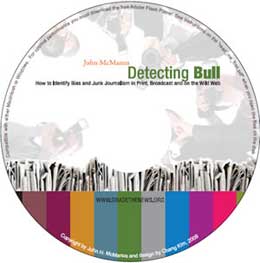
 For a hint of how low the commercialised mainstream media have fallen, here’s the second part of my interview with John McManus (
left
), author of ‘
Detecting Bull: How to Identify Bias and Junk Journalism in Print, Broadcast and on the Wild Web
’
For a hint of how low the commercialised mainstream media have fallen, here’s the second part of my interview with John McManus (
left
), author of ‘
Detecting Bull: How to Identify Bias and Junk Journalism in Print, Broadcast and on the Wild Web
’
EL: Detecting Bull to an extent alludes to a commercialised media environment where journalists are losing touch with their public and a moral sense of purpose. What can journalists do to reclaim their function as a ‘champion of the common man’ (Joseph Pulitzer, 1879, St Louis Post-Dispatch)?
JMM: Most codes of news ethics place the burden of doing the right thing on the individual journalist. But journalists are simply employees who do as they are told or risk their jobs. Journalists should organise to create a counter-balance to institutional demands to maximize return to owners or shareholders. If they are successful, their news organization probably will succeed as well. The task of socially responsible journalism is to help the community served understand and respond to current issues and events. News media that do that well will be in demand. Maximizing public understanding and maximizing return to owners/shareholders, however, are usually not compatible goals.
Today’s journalism classroom environment has also changed compared to just 10 years ago. What do you see are the areas in today’s journalism curriculum that need critical reforms?
I haven't studied j-school curricula enough to shed much light on this question. My personal feeling is that the emphasis in journalism education ought to be more on critical thinking and ethics and somewhat less on skills.
Indeed, ‘good’ journalism, as I often share with students, is more than the ability to string words into sentences and paragraphs in an inverted pyramid. A solid foundation in ethics, moral and spiritual values, fair-mindedness, a sense of right and wrong, common decency – these are attributes that students need to learn for themselves, and internalise for life. From your experience as a journalist and now as a teacher, how have you ‘inspired’ these attributes to your students who have no prior knowledge or experience with the constraints of professional journalism?
I agree with you completely. As a teacher, I try to stimulate and guide the discussion, but let students explore the logical outcomes under different scenarios of journalism. "It will soon be your world," I say. "What do you think will logically follow if various kinds of journalism were to proliferate – journalism as entertainment, as sensation, as biased toward any particular partisan side, as oriented more toward good news, or even to be absent." If they do the reasoning and come up with the examples, the learning is deeper and lasts longer. Plus, I get to learn something from them.
If I may share my recent experience as a visiting lecturer at Auburn University Montgomery, Alabama from August to September 2009. My brief was to ‘expose’ the students to a more ‘international perspective’ of journalism practices and cultures. For a context to suss out the ethical issues in reporting, I asked the students to cite their main gripes about the American media. Unsurprisingly, they said the US media are blatantly biased (such as Fox Television), just as we know that Malaysian mainstream media and bloggers are invariably biased although they’d like to think otherwise. The students’ other gripes are: Journalists don’t follow the rules of honesty and integrity. Journalists are hypocrites. Journalists are overly negative, sensational. Journalists are obsessed with the ‘rich and famous’, trivia and gossip.
The American students’ criticisms are not much different from my Australian journalism students’ at University of Wollongong, NSW. Interestingly, working journalists I teach online with the Asian Centre for Journalism at Ateneo University in Manila, and journalists at the workshop I conducted at the Malaysian Press Institute in January [2009], likewise cited similar gripes. Indeed, knowing what’s wrong with journalism does not necessarily prompt professional journalists to consciously do something to fix it. You’ve alluded earlier to the organisational and economic constraints that undermine the standards of ethical journalism. Where do we go from here?
 I think these students have seen through the much of the news media – pretty much correctly. When I wrote Market-Driven Journalism: Let the Citizen Beware? back in 1994, the response among most American academics was derision – ridiculous to use economics as a way of understanding news content! Journalism is a profession, not a business, they protested. Well, they've changed their tune and now it's not uncommon for people to say news is market-driven rather than a public service. In their defense, it has become more so since 1994.
But I fear that many students in the US look cynically at the news, at least partly, as a way of justifying their wish to ignore it. And, as I argue in Detecting Bull, that's a mistake that will lead them to disaster.
In the book, I argue for a civic revival. News literacy is just a part of that, but a necessary part. In the US money has corrupted the legislative and executive branches of government. Candidates cannot even contemplate running for office until they have persuaded powerful special interests to pony up large sums for their candidacy. They are then beholden to their financiers. Special interest activism and public lassitude, especially among the young, have led to paralysis of government at the national and state levels.
We are in real peril, as evidenced by the Bush administration's misleading – but uncritically accepted -- case for the disastrous war in Iraq and the deregulation of Wall Street over the last decade, which led to a global recession (except on Wall Street). Teaching and motivating young people to see their self-interests in becoming politically informed and active is the way out. After all, what happens in the future will affect them more than the generations dying out. It's what teachers and textbooks are for!
Is it a case of the public deserves the media they get?
No, I think this blames the victim and lets the industry off the hook. (Industry bigwigs use this rationalization to defend themselves. We'd love to do quality journalism, they protest, but the public won't sit still for it. I address this myth directly in Market-Driven Journalism, Ch. 9). The public deserves quality media. But to get it, they will have to be able to discern substance from schlock, and support it financially.
Read Part One here .
DR ERIC LOO left Malaysia for Australia in 1986 to work with the print media. He currently lectures at University of Wollongong, Australia, and also mentors international journalism students via UPIU , run by United Press International. He is founding editor of Asia Pacific Media Educator. His recent books are 'Best Practices of Journalism in Asia' (2009); and 'Journalism in Good Faith: Issues and Practices in Religion Reporting' (co-authored with Mustafa K Anuar, 2009). Email: eloo@uow.edu.au


Are you sure you want to delete this comment?
This action cannot be undone.