




Biding time for regime change
In my annual trips home, as the plane descends into KLIA, seeing those tree-lined highways, undulating hills, sprawling green and suburbia laid out like a checkers board, I sometime ask myself why did I leave. And, what keeps drawing me back?
In my annual trips home, as the plane descends into KLIA, seeing those tree-lined highways, undulating hills, sprawling green and suburbia laid out like a checkers board, I sometimes ask myself why did I leave. And, what keeps drawing me back?
March 8, 2008 was one of those rare occasions when Malaysia beckoned me home. At last, a regime change was possible.
 The joy of coming home, though, is short.Pessimism creeps in, as it often does, when I skim through the usual shallow coverage of government news in the papers and listen to the lament of families and friends.
Young families are laden with uncertainties of their son and daughter's access to quality education from primary to university level. They are fearful of increasing crime in the face of poor policing.
They are numbed to the corruption that permeates the many layers of the civil service, the public and private sectors. Most are resigned to being second-class citizens in a nation increasingly divided by race and religion, and governed by incompetent bureaucrats, complacent and protected in a culture of political patronage.
Where is reform?
Two years ago, my friends and colleagues were pretty excited. Reformasi! Hidup Pakatan Rakyat (Long live Pakatan). People power and so forth.
 Today, they're
reformasi
fatigued. "What reformasi?" they ask.
Today, they're
reformasi
fatigued. "What reformasi?" they ask.
"They're (the opposition) fighting among themselves."
"They're only interested in power - for themselves."
A few from the more reflective literati set, however, are keeping faith that a change of regime will happen in their lifetime. It's only been two years, they say. If it takes another two or twenty, they will stay the course.
There's still a glimmer of chance. For now, we will relive that moment when Malaysians were fired up with optimism, fleeting that might be.
Incidentally, March 8 is also Commonwealth Day. 54 member countries of about two billion people - rich and poor - are reminded of their shared value for democracy and freedom, that the best democracies are achieved through dialogue and partnerships between government, business and civil societies.
From the outside looking in, the partnership between our government and business (the media included) is uncomfortably intimate to the extent that accountability and good governance is inevitably sacrificed on the altar of corruption.
Here's where our civil societies become significant as their political presence grow stronger with greater freedom to speak in public than just 10 years ago despite being treated by the state as thorns tolerated on the side to serve as token indicators of ‘Malaysian democracy'.
The female side of things
March 8 also happens to be International Women's Day . The day celebrates the achievements of women in areas previously denied them by gender discrimination. It was first held in 1911 in Austria and Germany to honour women's rights and their productive functions in societies. Since then, women's achievements in politics, business, academia, civil societies, culture and arts have stayed on its trajectory, especially in the Western world.
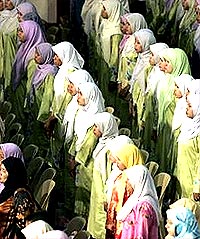 As I reflect on March 8, 2008, amidst the celebratory women's parade in Sydney, I wonder if politics back home would be any different if women had led the discourse.
I recall from a young age in the playgrounds that girls certainly smelled sweeter and looked nicer than sweaty boys whose status in the pack were marked by their mastery of F-words and fisticuffs.
Adolescence taught us that females were more dependable in organizing the logistics of end-of-school term parties. In the face of a potential brawl we'd send the girls. They seemed to be better negotiators because they were better listeners. The blokes - we're somehow programmed to whack first reason later. Quick to speak, slow to listen.
With the mess that Pakatan is in, perhaps we should rally the women. Women are the cornerstone in a family. Hard to argue with that, I think. Just as they are most efficient multi-taskers who hold the purse strings, manage the families, nurture the kids, ease the load and pick up after their husband and sons, they'd be good at putting the Pakatan house back in order. Given their inherent patience, emotional intelligence and capacity to listen then act, they'd be good at rebuilding the coalition.
As the English journalist, GK Chesterton (1874-1936), renowned for his observations of life's paradoxes said of the women's movement: "Twenty million women rise to their feet with the cry, 'We will not be dictated to'-and proceeded to become stenographers." But, on a more serious note, he observed: "A woman uses her intelligence to find reasons to support her intuition."
Lest we forget, a woman spearheaded the reformasi movement in 1998. The ‘accidental politician' established Keadilan one year later. In 2008, she relinquished her seat to her husband currently in a messy convoluted trial over allegations of rear-butting a male aide.
Until the trial ends, we're the butt of party jokes here and overseas with anyone having a passing interest in Malaysian politics. In the eyes of the foreign media, our government looks downright stupid, its legal pursuit a desperate case of denigrating a public figure perceived as the only viable catalyst for a regime change.
From the outside looking in, and with the International Women's Day a reminder of possibilities, I wonder if the coalition of opposition would be in a better state if the wife had led with the husband in tow as political strategist.
 Many knew Pakatan was a convenient marriage of incompatibles in 2008. But we hoped the ménage à trios would last because the partners shared a common political goal that transcended racial and religious fault lines.
No sooner was the honeymoon over when deviants in the union, driven by power and greed rather than public service, jostled for turf rights and numerical representation by race and religion. Thus began the gradual dimming of the reformasi beacon.
In the spirit of International Women's Day and to refire the light of reformasi , I'll end with a section from Wan Azizah's paper Perempuan di Parlimen: Bukan Sekadar Jumlah.
Admitting to being an ‘accidental' politician borne out of cataclysmic circumstances in 1998, she wrote:
"The experience in Malaysia has shown that women tend to take a greater interest in politics in times of crisis. Certainly, Malaysian women have responded strongly to the events surrounding the political persecution of leaders of the opposition.
"One of the most gratifying aspects of Keadilan's popularity is that a substantial proportion of its supporters are women. As daughters, sisters, wives and mothers, they could readily empathise with the victims of abuses. I share the view that the struggle for justice must be continued even outside the sanctioned perimeters of elections held once every five years.
"The cause of justice must be fought for vigorously at all times so as to create ultimately a government and society that is not only just but that provides dignity to the people. Although my journey into politics was not a deliberate and concerted plan, everyone has the right to use the arena of electoral politics to promote their cause. My cause is justice, especially for women, and for the disenfranchised and other marginalised groups in society.
"A Chinese proverb has it that a mountain is made up of many pebbles and that the ocean consists of millions of drops of water. In short, whatever the adversities and obstacles placed in our paths, Malaysia's women will answer with the universal chorus of common humanity: we shall overcome."


Are you sure you want to delete this comment?
This action cannot be undone.