




Why bother reforming the economy?
“The reformist school is what I and the prime minister belong to. My view is that the 10th Malaysia Plan has already recognised that the target does not really make sense any more. It is there just to comfort some people.
“The reformist school is what I and the prime minister belong to. My view is that the 10th Malaysia Plan has already recognised that the target does not really make sense any more. It is there just to comfort some people.
“More importantly, the new approach that will be put in place will include merit-based, market-friendly, transparent and fair criteria. If it is strictly adhered to, you might see the development of a really sustainable and competitive bumiputera community.”
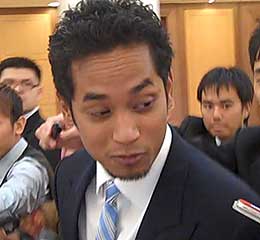 That’s straight from the horse’s mouth, Khairy Jamaluddin (
left
), two weeks ago.
That’s straight from the horse’s mouth, Khairy Jamaluddin (
left
), two weeks ago.
The operative phrases here are “if it is strictly adhered to” and “the development of a really sustainable and competitive bumiputera community”.
The first posits negative connotations almost immediately. The second is somewhat positive but sullied, perhaps, by the ubiquitously nonsensical use of the adverb “really”. And then one gets the sense that this is just another round of spin and hubris by a manifestly corrupt regime that is either fast running out of ideas, or desperately bankrupt of ideas.
It wants to move the Malaysian economy into a more dynamic ‘globalised’ entity. But it can’t. Mostly it’s because of the lack of political will. It knows that any so-called real reform means, to use a tired old cliché, to cut off one’s nose to spite one’s face. On the one hand it is the Malay dilemma.
On the other hand it is the ‘crony capitalists’ dilemma. Like it or not, the Malaysian economy is an economy of what I call ‘invested interests’. And the bulk of these invested interests include the pusillanimous cretins who occupy positions of power and influence in Umno and the BN.
NEP root of corruption
To open the economy to market competition requires the regime itself to become unambiguously transparent in its political and economic policies. The two are not mutually exclusive. One bedevils the other by feeding off each other.
This is the vertebra of the vast patronage system. It has spawned worsening levels of corruption at all levels of the Malaysian so-called government, its nested political parties and businesses private and state-owned, and all levels of Malaysian society.
 So much so the system as one finds it today has become embedded as an invertebrate that is owned and controlled by the political cretins who have, since 1946, developed a siege mentality that is no different to the kinds found in Zimbabwe, South Africa, China, Russia and any of the Arab states.
In time future generations of Malaysians - Malays, Chinese, Indians, Christians and the indigenous people - will be left with the carcass of the economy after the vultures of yesterday, today and tomorrow have devoured every morsel of this most finite and, in world terms, small economy.
It is pointless in reforming the economy. Because the regime is far too gutless to deal with the real issues behind the ongoing pathos of an increasingly sick economy that will, in time, drive away foreign investors in bigger droves than Malaysia has been experiencing in the last five or so years.
What is on the nose - as if this were a surprise - is the ratcheting up of corruption in Malaysia. What has spawned this corruption is the New Economic Policy (NEP). Despite claims to the contrary, the NEP was never discarded, or replaced by the National Development Policy (NDP). The NDP was in effect a ruse to lower Malaysia’s political and economic risks. It sought to placate (and, ipso facto , entice more) foreign investors.
The NEP was never placed in abeyance after 1990. And the NEP was never fitfully successful overall.
NEP serving privileged
 That the likes of Khairy and his bosses Najib and Muhyiddin (
second from left
) still refer - with a strong whiff of right-wing nonchalance - to the 30 percent Malay equity, tells a different story than the one Khairy is trying to spin. That this issue is dredged up time and again because “it is there just to comfort some people” amounts to cockamamie - pure and simple.
That the likes of Khairy and his bosses Najib and Muhyiddin (
second from left
) still refer - with a strong whiff of right-wing nonchalance - to the 30 percent Malay equity, tells a different story than the one Khairy is trying to spin. That this issue is dredged up time and again because “it is there just to comfort some people” amounts to cockamamie - pure and simple.
Who are these “some people”? Surely not those who simply do not see the value in work, let alone possess the ethic for it. They do, however, seem to have the unending appetite to lepak (hang out) at shopping malls and the Central Market day and night, with the belief that they’re entitled to be propped up on state crutches that are, in truth, funded by Malaysian taxpayers and not by Umno or the BN’s feudal lords’ own money.
The NEP has not created an economy that has managed to pull away entirely from its agricultural base. Neither can we credit the NEP for creating nothing more than one of the region’s low to medium cost manufacturing economies.
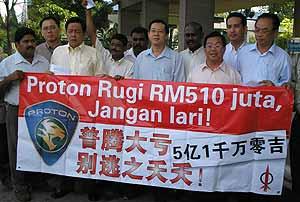 The NEP has been front and centre of the ostensible creation of the culture of dependency among those lazy Malays who deem it their sole right to be mollycoddled by the dominant Malay nanny state because it is, apparently, “their country”.
When Dr Mahathir Mohamad launched his privatisation policy in the early 1980s, it was, according to nutty neoliberal economists, to have underpinned the NEP so that the policy would track ‘more market friendly reforms’. To that end the NEP would enlarge the economic pie, as it were, to deliver the 30 percent equity to all Malays by 1990. It didn’t happen. Obviously. And Malaysians, including many Malays, know why.
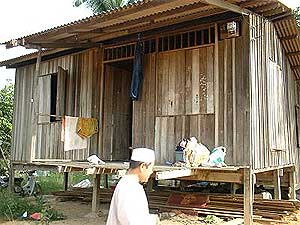 Instead of the Malays seeing improvement of their socio-economic lot, it was the regime’s cronies who wildly came up trumps every time, at every turn, in Mahathir’s New Crony Policy. Mahathir oxygenised the policy to the extent that it bred corruption, collusion and nepotism writ large through the state patrimonialist network of patronage.
All Mahathir had done was create a class of rentier capitalists who, time and again, depended on the regime’s largesse of opaquely distributed state business contracts and licences and who were protected by the regime against global economic competition.
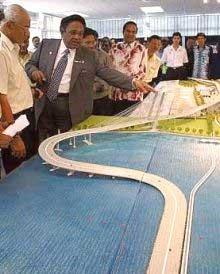 With so much “development” suddenly booming around the country, fueled by debt, and building sandcastles like Dayabumi, the longest bridge, the tallest towers, and even flagging the necessity of Mahathir’s crooked bridge (
left
) and the like, and as long as Malays were told that 30 percent of all this development was their investment held in trust by the Malay state, the NEP was “successful”.
With so much “development” suddenly booming around the country, fueled by debt, and building sandcastles like Dayabumi, the longest bridge, the tallest towers, and even flagging the necessity of Mahathir’s crooked bridge (
left
) and the like, and as long as Malays were told that 30 percent of all this development was their investment held in trust by the Malay state, the NEP was “successful”.
Mahathir may be able to lie to some people some of the time, and fool some people some of the time, but he cannot lie and fool all of the people all of the time. Khairy, Najib and Muhyiddin, and the morons who head the wholly bigoted, small-minded Malay NGOs Perkasa and Gertak, would do well to not follow in Mahathir’s invertebrate persona. But one suspects it is too late. These groups have installed Mahathir as their Fuhrer . Sieg heil !
Political posturing
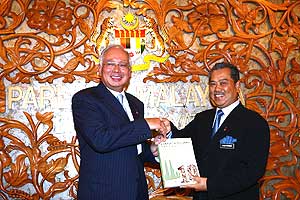 Najib (
left in photo, Muhyiddin right
) has gone on record as saying he would
never
, ever, dismantle his father’s legacy - the racist NEP. Muhyiddin is a mouse in a Pied Piper fable. He makes the dumbest and most disgraceful remarks with opportunistic intent and malice. Najib should put Muhyiddin out to pasture where he can manufacture his bigoted dung on his estate.
Najib (
left in photo, Muhyiddin right
) has gone on record as saying he would
never
, ever, dismantle his father’s legacy - the racist NEP. Muhyiddin is a mouse in a Pied Piper fable. He makes the dumbest and most disgraceful remarks with opportunistic intent and malice. Najib should put Muhyiddin out to pasture where he can manufacture his bigoted dung on his estate.
Khairy, who likes to pass himself off as a public intellectual, is playing two hands, two faces and a forked tongue. He can’t help himself. He can’t be trusted. He has made his millions under the rubric of being Malay and the entitlements of the NEP.
 The only time these political cretins can be taken seriously is if and when - and that’s a big ‘if’ and a big ‘when’ - they grow a spine and acknowledge that the NEP was and continues to be an overwhelmingly racist policy; a stupendous economic folly; a cancerous ulcer licensing all-out corruption at all levels of Malaysian society, especially in politics and business; a monumental fraud of untold proportions because it has conned all decent, hardworking and full taxpaying Malaysians since 1970 regardless of their race, colour or creed; an unadulterated waste of precious public money; a colossal harbinger of institutionalised racism that is etched into law and heralded by an equally xenophobic constitution; the sole purveyor of anti-democratic politics and abuse of human rights - with the exception of the Malays and the regime’s business cronies, of course; all these things.
And most of all, a hopeless obstacle on making real - “real”, Khairy, and not “really” - political, economic and social reforms.
Their first move has to be - without question, without the slightest hesitation - to kill off the NEP in all its incarnations, once and for all time. “The development of a really sustainable and competitive bumiputera community” may only come after this, and not before.
If the 30 percent target does not make any sense any more, as Khairy claims, then why on earth does the Umno regime continue to hold on to it? Why not bury it altogether?
It just doesn’t make sense. Not one of Khairy, Najib or Muhyiddin’s political bleatings has ever made sense. They are merely politically populist speeches for popular Malay consumption. They also target Malaysian voters with an eye to the next federal election.
Special rights or vested interests?
To expect real changes would be to expect Gunung Tahan to spontaneously erupt. Killing off or whittling back the NEP won’t happen. It’ll mean killing off Malay special rights and privileges. Paring them back will amount to the same. These spineless grots wouldn’t dare do this because they are part of the vested interests.
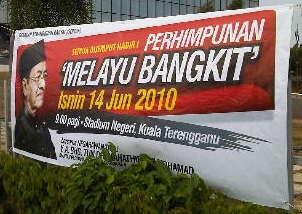 To lose power means they’d lose their own vested interests and, therefore, those of their cronies and nepotists. That is the ‘Malay’-sian ‘national interest’ defined.
It defines the political structure, institutions and processes of Malaysia and the immorality, depravity and thuggishness of Umno and the BN - the very characteristics exemplified by their equals in Zimbabwe, South Africa, China and Russia.
MANJIT BHATIA, an academician and writer, is also research director of AsiaRisk, a political, economic and risk analysis consultancy in Australia. He specialises in international economics and politics, with a focus on the Asia-Pacific.


