




What will it take to reform?
A kindly mainstream editor told me not too long ago that Malaysians who have left the country have no right to ‘criticise’ the government. The subtext was: If ex-Malaysians wish to write critically of the Malaysian system, they should come home and stay for good. Only then can they enjoy the ‘privilege’ to comment.
A kindly mainstream editor told me not too long ago that Malaysians who have left the country have no right to ‘criticise’ the government. The subtext was: If ex-Malaysians wish to write critically of the Malaysian system, they should come home and stay for good. Only then can they enjoy the ‘privilege’ to comment.
 Although understandable from where the editor sat, his stance represents the tunnel vision and insularity that dominate our mainstream newsroom. Where we expect the media to challenge and confront the government, what we get is a media that conform and comply.
Our editors and leader writers seem to hear, see and say no evil despite the obvious multi-layered corruption, discriminatory policies and poor governance that are running the country down in Transparency International’s corruption perception index.
Meanwhile, concerned Malaysian expatriates, inspired for a while by the March 8 election outcome two years ago, are tracking the more robust coverage of online news sites for any positive signs of system change, but which continue to elude us all.
It sometimes feels like a lost cause when I read the same old reports of the same old specious rhetoric from the government and the opposition. Countless letters and commentaries from the online community show that some are still hopeful of a regime change in their lifetime. Most are, however, showing signs of fatigue, resigned to the nation being shaped, soured and corrupted by a culture of patronage politics, racial discrimination and sectarian hostility.
What will it take to spark real reforms? One theory has it that if fundamental change is to occur in politics, it must emerge from those least expected to make that change.
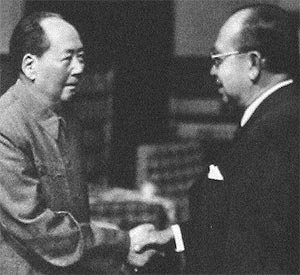 For example it took a staunch anti-Communist Richard Nixon to visit Beijing in 1972 and shake hands with Mao Zedong for the diehard anti-Communists in the United States to see the light in establishing ties with China. Nixon defied the dominant anti-Communist discourse of the 60s and 70s.
His visit to China led the Americans and other world leaders to reassess their ideology, thus the sensibility of engaging with China. Our second Prime Minister, Abdul Razak Hussein, visited Beijing and shook hands with Mao in 1974 - which warmed the hearts of many Malaysian Chinese.
The ‘Nixon-in-China’ effect
American management academics, Forrest Briscoe and Sean Safford described Nixon’s break from the status quo as the ‘Nixon-in-China’ effect. In a research paper on “Activism, imitation and the institutionalisation of contentious (business) practices” (2008) they note that social activist movements are usually successful, initially, in mobilising public demands for changes in institutional practices by dominant corporations.
But the success is often short-lived. Its overall impact is limited because initial changes in institutional practices fail to filter down to smaller companies who look to the dominant corporations as the benchmark. If the dominant corporations don’t change for good, it’s business as usual for the smaller players.
 The ‘Nixon-in-China’ effect was adapted from the phrase ‘Nixon goes to China’, a political metaphor widely used in the late 70s to refer to the impact that hardline conservative leaders have in forging fundamental reforms. Nixon’s visit to China marked the starting point of normalising Sino-American relations.
Applied to our political environment, the ‘Nixon-in-China’ effect implies that if any fundamental change is to occur, it must emerge from the dominant ruling party. Just as ‘it took Nixon to go to China to normalise Sino-American relations’ it may take a Najib, an Umno and the majority Malays to make the first move towards fundamental reforms, towards the eradication of race-based policies.
It would take Umno to initiate a proactive review of the NEM to facilitate any productive discussions of how Malaysian human capital could be better harnessed for the benefit of all. It would take PKR to initiate the practice of consensual politics, which would a refreshing change from the current diatribe, to facilitate purposive dialogue with the government.
Positive waves
Imagine the positive waves if by a stroke of the wand the government were to declare a review of the race-based quota system in university admission, that affirmative action policy be rewritten and replaced with an equal opportunity system.
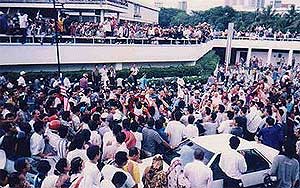 Indeed, persistent clamor for reforms from civil society groups and opposition parties have gotten louder with time. The march for reforms right after March 8, 2008 did gain some traction. The government, predictably, responded likewise - they carted off the agitators to jail. Here, Newton’s third law of motion quite clearly applies - to every action there is an equal reaction. Protests begot confrontations. Civil activism begot government resistance.
The will to adopt fundamental reforms in Malaysia must, by the ‘Nixon goes to China’ logic, come from the hardline conservatives. Activists will clamor for reforms until they’re hoarse. If the government is unwilling to go beyond sloganeering to engage with civil society groups and opposition parties, the clamor and protests will remain as what they are.
Failing that, we will hope for another cataclysmic event to turn us around and put us back on the road to fundamental reforms.
DR ERIC LOO left Malaysia for Australia in 1986 to work with the print media. He currently lectures at University of Wollongong, Australia, and also mentors international journalism students via UPIU , run by United Press International. He is founding editor of Asia Pacific Media Educator. His recent books are Best Practices of Journalism in Asia (2009); and J ournalism in Good Faith: Issues and Practices in Religion Reporting (co-authored with Mustafa K Anuar, 2009). Email: eloo@uow.edu.au


Are you sure you want to delete this comment?
This action cannot be undone.