




Hindraf vs DAP, time will tell
The Human Rights Party (HRP), an offshoot of Hindraf, has got zero seats to lose in the next general election. DAP on the other hand, has got Indian votes to lose aplenty - the estimated vote swing of 35 percent from the last election.
The Human Rights Party (HRP), an offshoot of Hindraf, has got zero seats to lose in the next general election. DAP on the other hand, has got Indian votes to lose aplenty - the estimated vote swing of 35 percent from the last election.
Yet according to a Hindraf insider, neither DAP nor any of the Pakatan leaders have bothered to reach out to the movement since March 8, 2008, with the sole exception of Zaid Ibrahim.
 On April 14, DAP secretary-general
Lim Guan Eng
had said, “For this reason [Malaysian First], whilst I will meet with any group seeking a dialogue, I am not keen to initiate discussions on my own with organisations based on a purely communal instead of a Malaysian agenda.”
On April 14, DAP secretary-general
Lim Guan Eng
had said, “For this reason [Malaysian First], whilst I will meet with any group seeking a dialogue, I am not keen to initiate discussions on my own with organisations based on a purely communal instead of a Malaysian agenda.”
In response to Lim on the same day his remarks appeared, I commented: “Oh come on Guan Eng: Wasn’t your appointment of erstwhile Deputy Chief Minister Mohd Fairus [Khairuddin] a communal formula and the Penang top line-up of 1Chinese, 1Malay, 1Indian also the same? You could have handled Kg Buah Pala better - on the agenda of not letting poor people be cheated by government agencies.”
Lim had earlier refused to entertain the Hindraf deputation on Kg Buah Pala and other issues on the excuse of their ‘communalism’. As if his unprecedented appointment of Malay and Indian deputy CMs were not driven by race considerations.
Not surprisingly, the Indians - much earlier than the rest of us - had seen through the duplicity of DAP’s ‘beyond race’ First-ing campaign. In the same month of April, Hindraf adviser N Ganesan offered that Hindraf is willing to disband if racism and the religious bigotry that victimise Indians could be eliminated.
Back in late 2007, the Hindraf movement had been the first having the guts to give voice that it is the federal constitution’s Article 153 on the ‘special position’ of the Malays that promotes racial inequality. For his pains, HRP pro-tem secretary-general P Uthayakumar is facing sedition charges, and his case is up for mention this week.
 The closest that DAP has come to making an oblique challenge to Article 153 was when its MP Tony Pua (
right
) suggested that the bumiputera discounts on houses worth above RM500,000 be done away with.
The closest that DAP has come to making an oblique challenge to Article 153 was when its MP Tony Pua (
right
) suggested that the bumiputera discounts on houses worth above RM500,000 be done away with.
PAS president Mohd Hadi Awang responded by saying Pua’s proposal was the latter’s personal view and never raised, discussed or agreed by Pakatan. Hadi was quoted in the media as saying, “The rights and privileges of the Malays and the bumiputeras should be retained because the majority of the poor in the country were bumiputeras and that they had a right to the privileges.”
Article 153 is the elephant in the room that DAP pretends not to see. Haven’t you noticed that it’s only DAP trumpeting Malaysian First while its two allies have been indifferent?
No more vernacular schools
Perhaps we should borrow Hadi’s words - personal view and never raised, discussed or agreed by Pakatan - and infer that First-ing is a political rebranding purely from DAP’s Chinese (and English-speaking Indians) approach.
Not only that, the Pakatan critics slam Hindraf for ‘Hindu Rights’ but PAS’s Islam is no issue to them. Lim Guan Eng (‘above racism’) rejects Indian concerns from the Indian viewpoint but is silent on Hadi’s insistence on Malay privileges.
Thus far, DAP has sidestepped tackling the tough task of explaining the form in which Malaysia First is to take, but trust Mahathir Mohamad to rise to the occasion.
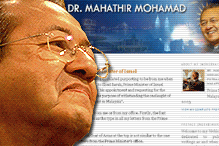 In his
blog posting
on Oct 13, the ex-premier lays the cards on the table.
In his
blog posting
on Oct 13, the ex-premier lays the cards on the table.
Dr M said, “The Chinese and Indians interpret 1Malaysia to mean amendments to the constitution to eliminate provisions for the special treatment of the Malays and their protection by the Rulers, removal of the quota for Malays in the civil service, termination of the NEP, termination of the 30 percent quota for Malays and indigenous people in business, termination of the quota for awards of licences, contracts and APs.
“All awards to be on a competitive basis and open to all irrespective of race. They also expect perpetuation and maintenance of Chinese and Indian schools by the government."
Chinese and Indian First-ers want all of the above, but fail to give thought to what is expected of them in return. Getting something for nothing is unrealistic in the light of the Malays in the main rejecting any change to the status quo.
What the 1Malaysian1st lunch - most certainly not free - will cost is spelled out clearly by Mahathir: “The Malays generally interpret 1Malaysia to mean real adoption of the national language as the home language by every citizen as happens in other multiracial countries. They also expect the abolition of Chinese and Tamil schools and ensuring the private sector has a fair participation of Malays and other bumiputeras.”
Precisely what I forewarned on Sept 24, three weeks prior to Mahathir weighing in. I’d written: “I’m all for Mandarin and vernacular schools. And thus, I do not see how DAP’s Malaysian First ambition can square with the continued existence of Chinese schools.”
On what basis is Mahathir's 1Malaysian1st interpretation? Aside from the constitution articles on language and religion, Article 160 defines Malay but does not define any other race in the country.
DAP has been like a slick salesman trying to sell his slippery product without revealing its price and terms and conditions.
The quid pro quo for Malaysian First stated above is to be extracted on language. And by extension culture and traditional values of which vernacular education is the vehicle, if not the ultimate conversion of self-identity to become Ridhuan Tee, or that ‘King Kong-ing’ Chinese ustaz, or the ‘Hindus-worship-rats’ Muslim missionary (who, by the way, tried to convert his resistant Hindu father to Islam).
Hindraf in political equation
Most recently, A Sivanesan’s guttersnipe attack on HRP only goes to show that DAP is feeling the heat. Of the three Pakatan parties, it is DAP that is most threatened by the impact of HRP on the Indian vote bank.
If we take the Hulu Selangor by-election as a study, we can see that Zaid failed to carry the Indian votes, or at least enough of it. Neither his own party PKR, nor their partner DAP delivered.
With the coming Batu Sapi by-election in Sabah, a three-cornered fight between BN, Pakatan and SAPP will split the votes to the detriment of Pakatan. By the same token, HRP creating three-cornered fights in the next general election will likely siphon away the working-class Indian votes from DAP.
The power-hungry DAP is salivating over potential Malay votes. Despite all its bending over backwards to Islamism, the party will not win Malay hearts and minds because their going on the stump quoting Arabic is largely a show.
With focus on pandering to the Malay electorate, the Indian does not figure in the DAP political calculus. Don’t tell me that the Tamils have no heroes (there’s only Caliph Umar Abdul Aziz?), their scriptures are not worth quoting (no outrage over the rat-worship slur?) and their temples not worth visiting (and this is not even asking DAP to take action against the wanton destruction of the houses of Hindu gods).
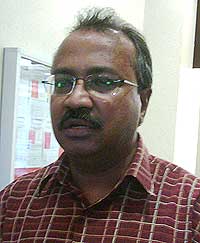 Clearly, Uthayakumar (
right
) is the one carrying the torch since he’s still in the game whereas others from the breakaway Hindraf factions are history.
Clearly, Uthayakumar (
right
) is the one carrying the torch since he’s still in the game whereas others from the breakaway Hindraf factions are history.
Uthaya feels Pakatan rode the makkal sakthi wave to power but there’s no payback as he cannot recall a single critical and pressing Indian problem that any of the opposition MPs have ever tabled in an emergency motion in Parliament.
“Where is the change?” asks Uthaya. How is Pakatan any different from the previous Umno regime in the states they control now with regard to the Indian poor? In fact, to Uthaya, while Indians had gotten a raw deal in Barisan, they’re getting no deal at all from Pakatan.
So HRP may walk alone. But remember, they’ve got nothing to lose electorally. However, DAP’s thuggish attacks on Hindraf indicates to us who it is that’s feeling threatened.
HELEN ANG used to be a journalist. In future, she would like to be a practising cartoonist. But for the present, she is in the NGO circles and settling down to more serious writing and reading of social issues.


Are you sure you want to delete this comment?
This action cannot be undone.