




The right to be free
Whassup? I ask a friend who seemed out of character lately. ‘Same old, same old,' he says, unconvincingly. Brief silence, and then ... Susie's gay, he says.
Whassup? I ask a friend who seemed out of character lately. ‘Same old, same old,' he says, unconvincingly. Brief silence, and then ... Susie's gay, he says.
I know the family well since they left Malaysia in the early 90s. Susie (name changed) topped her class in high school, graduated with distinctions from university. As like her peers, she had her fling of boyfriends. Which puzzles me.
A demure girl... was Susie predisposed to become a lesbian? Did she doubt her sexuality because of her disappointing relationships with men? When did she realise she was gay? Does it change how I see Susie, now that I know? Yes, initially. I was quick to judge. It was just as quick I felt the inconsistency, nay the hypocrisy, in my reaction.
While I'll readily walk the streets to protest for the rights of ethnic minority groups, I may hesitate to do likewise for the lesbian, gay, bisexual and transgender community.
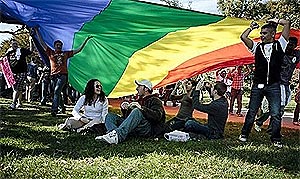 The chink lies in my reaction to Susie's homosexuality - reaction that's shaped by what I was taught as a child about how boys and girls should behave. Boys play with sticks and stones. Girls play with beads and flowers. Boys run, girls prance. Boys lead, girls follow. And so forth. Gender roles and sexual identities were internalised at a very young age.
My friend feels he has failed his daughter. Did he not spend time talking to Susie about relationships and sexual identities during her formative years? What changed her, he wonders, as he turns the pages of the family album - there she is, Susie in her primary school uniform, at her 21 st birthday party, at her graduation.
Could he have seen the signs and arrested the development sooner. Or, could it have been arrested if the outcome was inevitable?
When your child turns out to be gay, the reality hits home hard. It's now less a question of whether homosexuality is right or wrong, but a quest to make some sense of what caused the change in a child's sexual orientation, and how will parents live with it.
The causes of homosexuality have been variously theorised along the nature-nurture line, with no definitive answer except for the notion that sexual orientation is learned at an early age and developed through a complex interaction of environmental, psychological and anatomical factors - and sexual experimentation.
Killed for shaming the family
‘Susie's still our daughter,' my friend says. ‘We will still love her no matter what.' Indeed, as it should be. But we know there are as many who have been ostracised, disowned, and in some societies, killed, because they have shamed the family.
My friend feels he too has become a target of shame, discrimination and persecution just as Susie felt she was before she came out. Michael LaSala, author of Coming Out, Coming Home: Helping Families Adjust to a Gay or Lesbian Child (2010), terms this as ‘courtesy stigma', experienced by those who are friends or family of the stigmatised. In an article in Psychology Today, LaSala defers to American author and mental health researcher, Patrick Corrigan, who has identified two types of courtesy stigma: "vicarious" and "public".
When parents feel what their gay children go through - the discrimination, the fear of verbal abuse and physical assaults - that's ‘vicarious stigma'. When family members are made to feel they are responsible for their children becoming gay and thus their stigmatising conditions, that's public stigma .
LaSala says that in his 25 years of practising psychotherapy, his "most distressed gay clients are the ones who cling to the notion that being gay is shameful, perverted and indicative of weakness. In their minds, the treatment gays and lesbians receive is justified and proof of how wrong they are for having same-sex attractions".
La Sala adds: "Parents of gays and lesbians, like their children, must be able to withstand the slings and arrows that come with living in a world that persecutes those who challenge its restrictive norms. In order to develop and maintain good self-worth , gays, lesbians and those who love them must grow to learn that some of the established ideas are just plain wrong."
In Australia, parents of gay children are taking this path, as LaSala describes, by establishing support groups such as Parents, Families and Friends of Lesbians and Gays and Gay Family Support .
Demographic surveys in the 90s generally show 60 to 70 percent of Australian adults were opposed to homosexuality. Attitudes today are changing, though, towards greater tolerance primarily because of perceivably more positive media portrayal of the LGBT community. But views on same-sex couples remain polarised.
In Malaysia, we know many parents are as closeted as their gay children are as fearful of being persecuted. Which will remain so, as long as society continues to mock, deride and discriminate sexual minority groups whose behaviour are seen to conflict with what the mainstream consider to be normal, regardless of whether these norms and values respect the fact that we're all "born free and equal in dignity and rights" and are "endowed with reason and conscience and should act towards one another in a spirit of brotherhood" (Article 1, Universal Declaration of Human Rights).
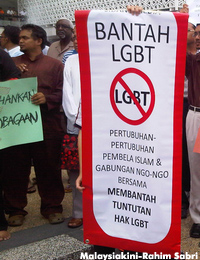 Since 2008, sexuality issues in Malaysia have been becoming more visible and talked about in open forums such as Seksualiti Merdeka, despite the rabid protests from ultra-conservative groups such as Jaringan Melayu Malaysia, whose clichéd vitriolic statements are not surprising, although their hysterical self-righteous condemnation of the LGBT community reminds me of who among them shall cast the first stone.
Indeed, who among the JMM members could say ‘Wallahi' that, behind closed doors, they have not committed nor thought of sexual acts that would be considered as carnal sins - sins by which they invoke to judge the LGBTs of committing?
Homosexuality crosses faith lines. So, I thought I'd seek my pastor's wisdom: Would he allow a gay to worship in church, I ask. After a moment's hesitation, he says - and I paraphrase here: He clearly stated that he doesn't agree with the gay lifestyle, and why he doesn't agree with it based on biblical teachings. It was short of saying God hates the sin but loves the sinner.
Yes, he'll welcome a gay person to worship in church because Christ loves us, regardless of our background. Whether the gay continues to live the way he does, the pastor believes the gay's relationship with God will show him the way back to the straight and narrow.
However, if the gay person were to encourage his lifestyle among the church congregation, he will put a stop to it, just as he would put a stop to any action by any person that separates us from God's ‘created order', which leads to other complex questions. I left it at that.
My conversation with the pastor came to no clear conclusion. And, that's OK. Ultimately, society's approach to the issue of homosexuality should be guided not by self-righteous moral judgment but by respect for the dignity and rights of LGBTs and an interest in understanding their fears and struggles just as people across all religious, gender, political and racial lines are entitled to.
ERIC LOO left Malaysia for Australia in 1986 to work as a journalist. He currently lectures at University of Wollongong, Australia, and also mentors international journalism students via UPIU.com, run by United Press International. He is editor of a refereed journal Asia Pacific Media Educator published by SAGE Publications (New Delhi) and has conducted journalism training workshops in Australia, Malaysia, Indonesia, Singapore, India, Papua New Guinea, Hong Kong, and Laos. Email: eloo@uow.edu.my


