




Reporting anti-West protests
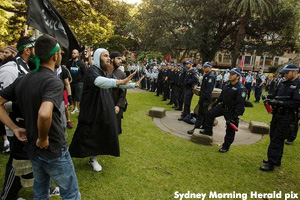
One wore Adidas track pants. Another, a Puma hoodie and Nike sneakers. Some wore baseball caps, sunnies and body-hugging T-shirts. Majority donned black headbands emblazoned inwhite Arabic scripts. As they marched from Sydney’s Town Hall to Martin Place, they ranted “Obama, Obama, we love Osama!” (A stark contrast to the Bersih 3.0 muted chants at Martin Place on April 24)
One wore Adidas track pants. Another, a Puma hoodie and Nike sneakers. Some wore baseball caps, sunnies and body-hugging T-shirts. Majority donned black headbands emblazoned inwhite Arabic scripts. As they marched from Sydney’s Town Hall to Martin Place, they ranted “Obama, Obama, we love Osama!” (A stark contrast to the Bersih 3.0 muted chants at Martin Place on April 24).
For a moment on prime time news on Sept 15, Sydney looked like Peshawar and Benghazi – except that instead of rocks, the protesters hurled plastic water bottles at the police who charged with dogs and pepper spray.
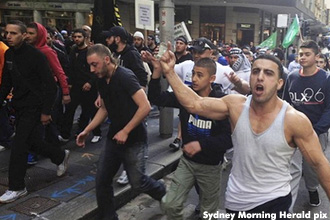 Save for those with Taliban-like beards, white skullcaps and thobe, many wore US-brand designer clothes and used US-made social media technology to mobilise their anti-US protests. Such are the ironies in anti-Western protests by youths growing up in a consumerist social media driven culture.
On a more serious note, I asked my class of 40 journalism students what they felt when they saw the media imageries. Not surprised at the Muslim rage, they said, but somewhat shocked to see children holding placards that said ‘Behead all those who insult the Prophet’ and the adults calling out ‘kill all infidels’.
The intimidating protests by a fringe group had obliterated in one short afternoon whatever good mainstream Muslim-Australians had achieved to show the other side of Islam – one of peace and respect for other cultures and faiths.
An open letter in the Daily Telegraph summed up what many would feel behind closed doors. The dust has settled, but the imageries of jihadist Muslims and cultural stereotypes are etched deeper into the public mind.
The demonisation of Islam as anti-Christ
The Australian media had given fair space to different reactions to the protests and rebuttals . An editorial in the Sydney Morning Herald on Sept 22 reiterated what all who chose to live in Australia should be doing to get along - “bring the best of your culture, leave the worst behind”.
The politics of religion, however, can bring out the best or worst in people: compassion and charity or prejudice and hate; respect and reconciliation or vengeance and violence. This is how the media routinely frame Islam and the West. The ‘clash of civilisations’ is somehow portrayed as inevitable, although the late Edward Said (2001) in his critique of Samuel Huntington’s theory (1993) called it a ‘ clash of ignorance ’.
Indeed, ignorance, prejudice and self-righteous belief in a jealous god among zealots from the monotheistic Abrahamic faiths – Christianity, Islam and Judaism – have brought out the worst in each other and limited their vision of the world through a fixated frame of hostility .
This fixated frame is perpetuated by a conviction in their respective god-appointed missions to preach unto all nations. Protests by Muslims are thus reported in the Western media as irrational Muslim rage ; secularism and consumerist culture is portrayed by media in the Islamic world as moral decadence in a godless society.
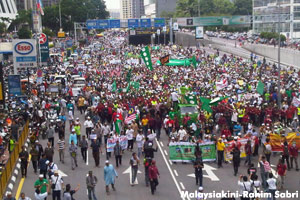 The consequence is the demonisation of Islam as anti-Christ, and in reaction, the escalation of militancy and vengeance by Islamic jihadists against the Western infidels.
Where all should have a right to preach and say what they think, unfortunately there’ll always be those in our midst who will say the stupidest thing to stay on the popularity and power charts – from radio shock jocks and celebrity twitters to pundits and political opportunists – as evident in the ‘ rival parties protest ’ in Kuala Lumpur on Sept 21, the majority of whom wouldn’t have a clue about the film or how the actors were duped.
Freedom of expression: Not when it’s blatant blasphemy
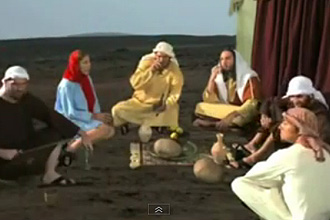 I chose not to see the film 'Innocence of Muslims' (
right
) either. One may be free to be stupid, like some of our politicians in the KL protest. But freedom of expression and assembly, nonetheless, should not mean one is free to denigrate and blaspheme another’s faith.
I chose not to see the film 'Innocence of Muslims' (
right
) either. One may be free to be stupid, like some of our politicians in the KL protest. But freedom of expression and assembly, nonetheless, should not mean one is free to denigrate and blaspheme another’s faith.
Hence, Voltaire’s defence to death a person’s right to freedom of expression even if he didn’t agree with it is not necessarily universal in reality – not when it’s blatant blasphemy and vile racism as in this poster in the New York city subways.
What’s universal is to respect what is good and noble. Which reminds me of a Sufi priest’s teaching at Nizamuddin Basti, a Muslim enclave in New Delhi I visited two years ago with a group of graduate journalism students from Jamia Millia Islamia.
He said something like this: “Before you speak, let your words pass through three gates. At the first gate, ask yourself, ‘Is it true?’ At the second ask, ‘Is it necessary?’At the third ask ‘Is it kind?’”
Likewise, the Christian apostle Paul wrote to the church in Ephesus (in today’s western Turkey): “Do not let any unwholesome talk come out of your mouths, but only what is helpful for building others up according to their needs, that it may benefit those who listen”. One of Buddhism’s Noble Eightfold Paths teaches: abstain from false and slanderous speech and idle chatter that lacks purpose or depth.
‘Go beyond ritually and unthinkingly reporting’
Depth and purpose is what journalists seriously need in their reporting of protests and pronouncements. I teach my students to always remember these elements of good journalism: accuracy, background, context and contents, depth and education.
 Without these elements, what you get are one-dimensional reporting of religion and race-related issues with the stupidest remarks and misleading representations by their ill-informed sources given undeserved space.
Consequently, content and context are compromised. As I remind my students, the fact that something happened or that some public figures had uttered the most idiotic remark, does not necessarily mean it should be reported.
Journalists should go beyond ritually and unthinkingly reporting what they see or hear. Journalists should question who said what to whom and for what purpose in the context of the circumstance that those statements were made.
Thomas Jefferson said of the newspapers during his time (June 11, 1807), “The man who never looks into a newspaper is better informed than he who reads them: in as much as he who knows nothing is nearer to truth than he whose mind is filled with falsehood and errors".
Surely, journalists can do better after two centuries.
ERIC LOO left Malaysia for Australia in 1986 to work as a journalist. He currently lectures at University of Wollongong, Australia, and also mentors international journalism students via UPIU.com, run by United Press International. He edits a refereed journal Asia Pacific Media Educator published by SAGE Publications (New Delhi) and conducts journalism training workshops in Asia. Email: eloo@uow.edu.au


Are you sure you want to delete this comment?
This action cannot be undone.