




Heating up for change
If the prime minister’s minions were to Google ‘Najib Razak big spender’ and ‘Najib Razak big corruption’ they’d know he has long lost his credibility with the people as he continues to appease the conservative base in Umno.
If the prime minister’s minions were to Google ‘Najib Razak big spender’ and ‘Najib Razak big corruption’ they’d know he has long lost his credibility with the people as he continues to appease the conservative base in Umno.
What the mainstream media does not report, the alternative news portals deliver. Hence the home minister’s suspension of The Heat is an exercise in futility.
Every muzzling of the press provides another opportunity for journalists and the people to join ranks and ramp up the pressure on the prime minister to deliver on his pledge for political and social reforms.
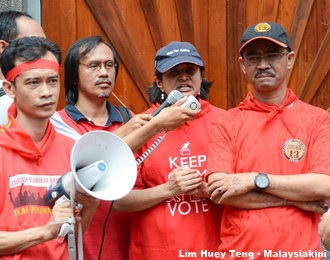 Geramm’s Red Pencil protest on Jan 4 will, I hope, be the first of many protests to forge a sustainable people’s media movement to agitate against state censorship.
Civil society groups have long advocated for greater freedom of information and media reforms, but with limited public support, hence the limited outcomes.
Confronting the government with protests and petitions , and reacting to each media crisis by holding public forums on the media and democracy, takes time and tenacity, money and momentum.
Because civil society groups are manned by committed volunteers and underpaid skeletal staff, and rely on donations and external funding, the momentum is usually short-lived, until the next media crisis.
Agitate for rights of journalists
This is where all who believe that the mainstream media is being used by the government to hang on to power should step up to the plate and join ranks with alternative media organisations to agitate for the rights of journalists to investigate into public interest issues without the risk of losing their jobs.
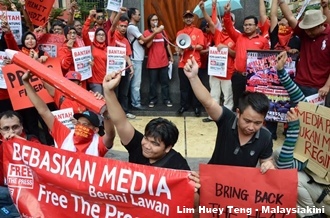 Indeed, it will be an opportunity lost if the government dismisses the ‘Red Pencil’ protest and forum as another liberal lefty talkfest and the police tolerate it as another public inconvenience.
Have we not been pushed to the wall yet by the home minister’s relentless attacks on the media and his ban on Christians from using the word ‘Allah’, which has emboldened the extrajudicial raid on the Bible Society of Malaysia by the Selangor Islamic Affairs Department (Jais) to confiscate copies of the Al-Kitab?
Will it only take worsening fraud, corruption and cronyism and a total collapse of the economy to fire us up for a common cause?
For now, attacking the bottom line of the government’s mouthpieces by channelling our reader support to the alternative media - because they evidently provide more insightful analyses, fairer and broader coverage of national affairs - looks like a more achievable task until the next general election.
Unless it is compelled to change, the mainstream media will continue to take readers for fools. It’s time to boycott those media outlets that subvert their allegiance to the people for the interests of the government. Where readers go, advertisements will follow.
We need numbers to make an impact. Imagine journalists and their readers marching to Putrajaya to press for media freedom and a repeal of the PPPA - just as hundreds of lawyers did in September 2007 to demand reforms in the judiciary following the political interference in the appointments of judges; just as thousands marched the streets for free and fair elections in 2012; just as thousands gathered at Dataran Merdeka on New Year’s Eve to protest against rising living costs.
We know the mainstream media is as pro-government and its journalists are as beholden to the partisan politics of their editors’ since 1987, when anti-government voices were purged in Operasi Lalang under the administration of Dr Mahathir Mohamad.
Mainstream media needs us more
Hence, the intimidated mainstream press that we see today. The mainstream media needs us more than we need it.
Let’s refuse to buy their interpretation of political realities, their version of history. It’s time we tell our own stories and circulate online what we know to be true, stories that reflect today’s political realities than those framed by the mainstream media.
 Rank-and-file journalists, though, are not completely responsible for the obsequious quality of the mainstream newspapers that we read today. The blame is on the ambivalent editorial leadership in the newsroom.
It’s time we harness the powers of the social media to model a shame file of veteran journalists and editors for becoming slaves of the state, for whitewashing the corruption endemic in the public sector, for not asking the critical questions of accountability when politicians propose policies and make pronouncements that polarise the community and alienate the people by ethnicity, class, language and religion.
However, if our stories and relentless press for media freedom are to have any chance of achieving long-term impact, the government and its mouthpieces must be made to recognise the intensity of our anger .
We’re far from taking over the streets and occupying the institutions of government like the people’s uprising in Thailand and Turkey. However, it will be foolish to think a people’s revolution won’t take place when the economic pie gets smaller, as it will, while rent-seeking and cronyism get bigger as they have over the decades under Umno.
Long have we been cocooned in our middle-class comfort, leaving the fight for media freedom, political reforms and social change to civil society groups.
As Malcolm X alluded in his fight for the civil rights of Afro-Americans in the 60s: “The greatest mistake of the movement has been trying to organise a sleeping people around specific goals. You have to wake the people up first, then you'll get action.”
The suspension of The Heat , and the unjustifiable raid by Jais on the Bible Society of Malaysia should be the tipping point.
It should wake us up to the creeping trend of religious and racial exclusiveness, nationalism and state authoritarianism under Najib’s wavering leadership, which is like a runaway truck that is going to crash unless the 53 percent who voted for the opposition in the last general election join ranks with the alternative media organisations and activist groups to ramp up pressure on Najib to deliver on the reformist agenda he pledged to the people in 2009.
ERIC LOO left Malaysia for Australia in 1986 to work as a journalist. He currently lectures at University of Wollongong, Australia, and serves on the advisory committee of UPI Next , a journalism education and training platform run by United Press International. He edits a refereed journal Asia Pacific Media Educator and conducts journalism training workshops in Asia. Email: eloo@uow.edu.au


