




Regional politics turning out to be a family affair
In a matter of a week, Singapore will have a new prime minister and with it, a new milestone in its history.
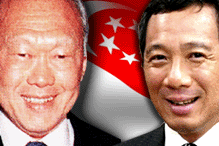
 Though the ascension of Lee Hsien Loong (photo left) to the country's top post has long been foreclosed; what is interesting is that the son of the charismatic former premier, Lee Kuan Yew, is in an exclusive club that includes the children of former presidents and prime ministers.
 He now joins Najib Razak (photo right), the son of former Malaysian premier Tun Razak (Najib is now deputy premier) Gloria Macapagal Arroyo, the daughter of former Philippine president Macapagal and Megawati Sukarnoputri, the daughter of firebrand leader, Sukarno of Indonesia; as the next generation of leaders heading their respective states.
Not far off from our region is Chandrika Kumaratunga, the daughter of former Sri Lankan president Solomon Bandranaike. And in the United States, we have George Walker Bush, the son of the country's 41st president George Herbet Walker Bush. (Interesting nobody calls the last development as 'dynastic politics')
In a matter of a week, Singapore will have a new prime minister and with it, a new milestone in its history.
 Though the ascension of Lee Hsien Loong (photo left) to the country's top post has long been foreclosed; what is interesting is that the son of the charismatic former premier, Lee Kuan Yew, is in an exclusive club that includes the children of former presidents and prime ministers.
 He now joins Najib Razak (photo right), the son of former Malaysian premier Tun Razak (Najib is now deputy premier) Gloria Macapagal Arroyo, the daughter of former Philippine president Macapagal and Megawati Sukarnoputri, the daughter of firebrand leader, Sukarno of Indonesia; as the next generation of leaders heading their respective states.
Not far off from our region is Chandrika Kumaratunga, the daughter of former Sri Lankan president Solomon Bandranaike. And in the United States, we have George Walker Bush, the son of the country's 41st president George Herbet Walker Bush. (Interesting nobody calls the last development as 'dynastic politics')
Whilst it is certainly irresistible for people and analysts to make comparisons of children with their parents, the fact that such comparisons are made at all may seem somewhat unfair.
 As after all, is it really the fault of Lee Hsien Loong, Najib Razak, or Megawati Sukarnoputri (photo left) for that matter as to who and how their fathers turned out to be? Do the children of these leaders have to be really judged by the challenges that once confronted their parents or measured by the very same yardstick used to gauge the achievements of their parents? Or do they really have to be seen as latching onto their parents' coattails and be seen as not of their own people in their own right?
The answer is, no.
Comparisons are odious
Tempting as it always is to make comparisons (as that is more or less human nature), statecraft is about leading a nation and peoples' through crisis and making meaningful differences to the lives of one's subjects.
It is a contact a leader needs with his subjects. And the ability to goad and inspire, to achieve material prosperity is what makes for the test of leadership. This needless to say, has to be done regardless of who his father is, as it forms the guiding principle in political leadership.
Moreover, with challenges and crisis being relative, yardsticks used to measure one man's greatness in an era cannot in any way be deemed apt for yet another.
"The next prime minister must face a more demanding electorate compared to 1959, when people were poor and uneducated" said former premier Lee Kuan Yew when referring to his own challenges when he assumed office.
Apart from the need to understand the complexities and the relationship of relativity to an era; all of the mentioned leaders are products of democratic systems answerable to their electorates at the ballot boxes.
That, in a sense demolishes any notion of dynastic politics existing within the subtext of a feudal culture.
It also dispels notions that family connections play a part in the grooming of potential leaders.
 However, in all fairness it can really get tough for one in a privileged birth to really call his soul and be his own man. When the business dealings of his children began attracting insinuations former premier Tun Dr Mahathir Mohamad lamented the 'unfairness' of it all, because of who his children's father was at that time.
And the problem of stepping out of his father's shadows can get acute when that parent is as charismatic as Lee Kuan Yew or the late Sukarno, either out of nostalgia or the uncertainty people have with a younger substitute.
With a growing tendency to link whatever misstep or genius the offspring of a past leader does to his biological roots; impartial judgements of leaders in privileged births can prove very difficult.
Influence on the son
Former US president, John Quincy Adams found that out because of who his father was. Because president John Adams was known to have an independent streak, that mostly came at the expense of party affiliations people were quick to say the same of the younger Adams. And that was without any understanding of the context in which the president made his political decisions.
 When the current US president and younger Bush decided on his campaign for war in Iraq, many suspected rightly or wrongly, that his father had exercised some kind of influence on his son.
But it soon tuned out that the decision actually belonged to British Premier Tony Blair and not to any bygone US president from a bygone era.
With that revelation, younger Bush not only became his own president, but separate from the other president, who we all now know as his father and former president George Bush.
The same should apply to Lee Hsien Loong, post August 12. He, like Najib Razak and George Bush are their own men indistinguishably separate from their fathers.
JAYA PRAKASH lectures in journalism at FIS Education Centre in Singapore.


