




Singapore gays inch closer to acceptance
In wishing no quarrels with how nature ordains people, Singapore's gay community may soon outlive the ignorance that has tormented them so far. In a sign of changing times, the ridicule and ostracising disapproval of yesteryears may soon give way to a new orientation to accepting homosexuals as 'different', yet same.
For one daringly tweaking the nose of conventional wisdom over the hitherto taboo topic of homosexuals; 37-year-old Derrick must be something of a lightning rod for Singapore's gay fraternity.
For not only does he openly admit to his 'frailties', he is downright forthright about what some have benignly classified as a personality disorder.
"I am open about my being gay. I say it to my friends, my clients and even my family is aware of what I am. It does not matter to me the least what people or society feel about", says the puny, bespectacled, planner visibly angry at how he sees is the deep felt disapproval to homosexuals in Singapore.
In wishing no quarrels with how nature ordains people, Singapore's gay community may soon outlive the ignorance that has tormented them so far. In a sign of changing times, the ridicule and ostracising disapproval of yesteryears may soon give way to a new orientation to accepting homosexuals as 'different', yet same.
For one daringly tweaking the nose of conventional wisdom over the hitherto taboo topic of homosexuals; 37-year-old Derrick must be something of a lightning rod for Singapore's gay fraternity.
For not only does he openly admit to his 'frailties', he is downright forthright about what some have benignly classified as a personality disorder.
"I am open about my being gay. I say it to my friends, my clients and even my family is aware of what I am. It does not matter to me the least what people or society feel about", says the puny, bespectacled, planner visibly angry at how he sees is the deep felt disapproval to homosexuals in Singapore.
"As a matter of fact," quips Derrick wryly; "it's those straight individuals who have given us the publicity that we now receive rightly or wrongly".
Such sentiments by far, define not only the on-going struggles but also the frustrations that Singapore's gay community, numbering a few thousands, have stoically put up with over the years.
Gradual acceptance
 In an interview with
Time
magazine in 2002, the city-state's former prime minister, Goh Chok Tong, pointed to the evolution of time and mindsets as fuelling the now gradual acceptance of gays in the civil service.
In an interview with
Time
magazine in 2002, the city-state's former prime minister, Goh Chok Tong, pointed to the evolution of time and mindsets as fuelling the now gradual acceptance of gays in the civil service.
"We are born this way and they are born that way, but they are like you and me", said the prime minister in an excerpt taken from the interview. By such prescience, the jury on an issue universally acknowledged as conditioned by biology is now straight. And, that statement happening as it did from the former prime minister now puts the issue out of the closet.
However, it still remains a crime to engage in homosexual acts in Singapore; which is not to mention gay marriages and adoption of children by gay parents.
As soothing as the news is for Singapore's gays - closet or otherwise - what's undeniable is the first fresh stirrings of tolerance for a community that for too long has resided in the country's margins.
Writing to express his appreciation in Singapore's Straits Times, Dr Stuart Koe Chi Yeow, himself a gay, said, "This is a big step in making us feel truly at home. As a gay man, I am no longer an outcast because of my sexuality but an equal, contributing member of our meritocratic society".
Equally welcoming the break is Ms Theophania Chia Shujuan, worried that the lack of legal protection may make gays vulnerable to blackmail if they engage in homosexuality.
But as delighted as gays maybe, reasons to review their participation in society could well from the nation's economic imperatives.
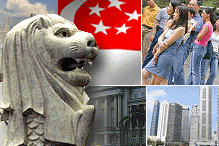 It is no secret that resource-scarce Singapore depends heavily on the talent of its citizenry to make its keeps. To discriminate against a community, whose talents can only contribute to its national wealth amounts to fleecing a goose whose golden eggs can possibly make a difference.
A larger preoccupation could well be with Singapore being a cosmopolitan city, where its million or more foreign nationals may have made an impact on the need to attune to more universally touted mores on sexuality.
Educate society
The choices now confronting Singapore are stark. Should it allow its talented people, regardless if they are gay or not, to live in a socially intolerant place so as to drive them away to greener shores elsewhere? Or is it dead serious about wanting smart, talented people who despite their 'frailties' and proven abilities; are only that way because it was no fault of theirs'?
As evolutionary as is the time taken to acknowledge the gay issue; the progress homosexuals will need to make to gain eventual acceptance in Singapore will in itself, be termed Darwinian. And, all that stands in preventing from being treated as an 'outcast' as described by Stuart Koe Chi Yeow is the march of time; the catalyst the doctor hopes will educate society out of its ignorance.
But as how matters stand between now and that moment in history; the only time of the year when gays make a statement on their sexuality is in the first weekend of August, every year. Running over three days, their parades known as Nations, are held in the outlying island of Sentosa, far from the prying eyes of its population with barely any mention in its local newspapers.
That only gives an idea to the social distance gays need to keep stopping their profiles from emerging in mainstream Singapore society. Inverted the other way, it is also about the time in history that gays in Singapore need to wait out before their moment arrives.
JAYA PRAKASH is a journalism lecturer at FIS Education Centre in Singapore.


