




Pak Lahs masterstroke
It always happens in the history of nation-states; where history itself becomes the sum total of taking the good with the bad and chewing on what its future ought to be.
It happened in South Africa, when the Truth Commission in 1994, freed the newly born rainbow nation of the worst excesses of the apartheid regime, allowing it to chart a forward course.
It also happened in India in 1947 when former premier Nehru's famous 'tryst with destiny' speech was about acknowledging a painful past, as it was about of the moral theme of a momentous break with the past, for the charting of a collective destiny.
And now that moment of destiny's calling has come to Malaysia. It is a call to nurse and heal a nation's bruised soul, after having suffered so much in silence, the nation is suddenly enjoying redemption, like the dawn of a new morning.
It always happens in the history of nation-states; where history itself becomes the sum total of taking the good with the bad and chewing on what its future ought to be.
It happened in South Africa, when the Truth Commission in 1994, freed the newly born rainbow nation of the worst excesses of the apartheid regime, allowing it to chart a forward course.
It also happened in India in 1947 when former premier Nehru's famous 'tryst with destiny' speech was about acknowledging a painful past, as it was about of the moral theme of a momentous break with the past, for the charting of a collective destiny.
And now that moment of destiny's calling has come to Malaysia. It is a call to nurse and heal a nation's bruised soul, after having suffered so much in silence, the nation is suddenly enjoying redemption, like the dawn of a new morning.
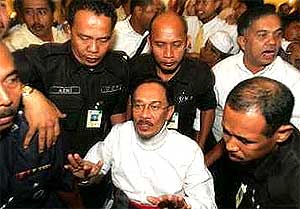 A new morning indeed it was, on Sept 2, 2004 - an historic day - when Malaysia's highest courts ruled with its conscience, to put to rest an issue that for six long years was as painful as it was divisive.
Also punished, were the last vestiges of a bygone repressive era that the world first got a glimpse of from Anwar's famous black eye and the accounts of his police beatings. As painful as that memory must have been, the judges' verdict fully documented, what they themselves must have known was a lost cause, if they had ruled otherwise.
Added to everything, were issues of public interest and suspected public disenchantment with the judiciary, which may have swayed the final historic verdict.
Though justice is seldom poetic, the presence of appeal courts and the silent acknowledgment they lend; has essentially rendered justice elusive.
Judiciary reclaimed
Though delayed justice inevitably amounts to justice being denied, societies that disrespect the professionalism of their courts ultimately court catastrophe.
That much was evident when street protests turned ugly, in the immediate aftermath of the Anwar saga, and when nations began withdrawing their goodwill of support, following his infamous jailing.
However, the greatest casualty arising out of the crisis of Sept 1998, was the judiciary and the damage it incurred.
The crucial role played by a nation's judiciary cannot be dismissed lightly, particularly where matters of state and economic interests are involved.
Their importance is critical, the courts are no laughing matter. They are the last repository of hope, where investors and common citizens can benefit from the belief that a climate of relative equity and predictability prevails, and where the dignity of the human being is enshrined.
Though India is far behind China in terms of economic development although she is catching up rapidly her courts demonstrate a fierce judicial independence that helps to keep her democracy on an even and just keel, without posing any threats to its constitutionality.
By doing so, it has shown itself as the bedrock of a civilised society.
In the events following the shock sacking of Anwar Ibrahim and his subsequent incarceration, what has followed has been an erosion of appreciation for the courts. Anwar himself obliquely addressed the issue, when referring to his verdict by saying 'this judgment would not have been possible with his (Abdullah's) predecessor'.
 So it follows that something was rotten in the state of Malaysian courts for people to feel the way they did. After all, if grave injustice could happen to a former deputy premier, the reasoning would have reached the inevitable question; what more then to a commoner?
The clear winner in this long, drawn out and painful saga must surely be the judiciary. It too, was the victim of injustice, having laboured under what must have been the very thankless task of carrying out the unpopular, with public sentiment railing against it as it meted out long sentences.
And when the judiciary spoke on Sept 2, 2004, the gospel truth became self-evident. It was all about a nation's pain and the cure that came six years late.
Therefore, it is indeed a completely new morning in Malaysia once again.
JAYA PRAKASH lectures in journalism at FIS Education Centre in Singapore.


