




Contra adrenalin and testosterone
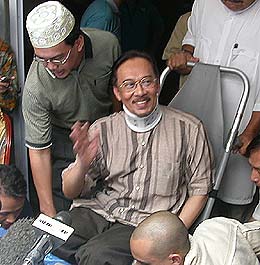
In the few days since Anwar Ibrahim regained his freedom, I have had endless problems buying my usual newspapers. Most of them are selling out early, except for the New Straits Times and the Oriental Daily .
I have also found it difficult to gain access to malaysiakini . Today, as I write this column, the traffic there was so heavy that they put up a second mirror site to accommodate the explosive demand for alternative news.
Meanwhile, Anwar Ibrahim is still headline news on CNN and BBC, after the carnage in southern Russia, and the devastations wrought by Typhoon Frances.
So much for Anwar's irrelevance in politics!
Naturally, in this initial period immediately after Anwar's release from prison, his supporters are basking in euphoria. Even those who do not support him personally, may see the judgment of the Federal Court with a great deal of hope that perhaps democratic reform in Malaysia is finally on the horizon.
Such euphoria and hope are justified of course. For decades, we have lived under a very sterile and claustrophobic political climate. The Anwar affair epitomised what, for us the engaged observers, is the worst spectre of our national life.
However, the euphoria would be misplaced, if it gives rise to false hopes.
In the few days since Anwar Ibrahim regained his freedom, I have had endless problems buying my usual newspapers. Most of them are selling out early, except for the New Straits Times and the Oriental Daily .
I have also found it difficult to gain access to malaysiakini . Today, as I write this column, the traffic there was so heavy that they put up a second mirror site to accommodate the explosive demand for alternative news.
Meanwhile, Anwar Ibrahim is still headline news on CNN and BBC, after the carnage in southern Russia, and the devastations wrought by Typhoon Frances.
So much for Anwar's irrelevance in politics!
Naturally, in this initial period immediately after Anwar's release from prison, his supporters are basking in euphoria. Even those who do not support him personally, may see the judgment of the Federal Court with a great deal of hope that perhaps democratic reform in Malaysia is finally on the horizon.
Such euphoria and hope are justified of course. For decades, we have lived under a very sterile and claustrophobic political climate. The Anwar affair epitomised what, for us the engaged observers, is the worst spectre of our national life.
However, the euphoria would be misplaced, if it gives rise to false hopes.
The whole incident ought to be thought through, and then acted upon, so that we can overcome our Malaysian sickness of reacting to dramatic events according to our bodily discharge of adrenalin and testosterone.
Independent judiciary?
The court decision to free Anwar is like a sprinkle of raindrops after a long drought. Unfortunately, a few drops of long awaited rain do not necessarily make for the beginning of a torrential monsoon season.
 Mind you, I too applaud the integrity of the two judges who set Anwar free, despite their strange reservation that Anwar was probably guilty of sodomy anyway.
Nevertheless, if MGG Pillai is to be believed, there were relentless last-minute pressures from very high places applied on these two judges to change their decisions.
As my friend Pillai would probably agree, in a nation where official news is often cloaked in half-truths and falsehood, rumours have come to assume some degree of unusual credibility. And so, many believe that there was a deal struck between Anwar and his detractors for his release.
This belief in a secret deal has led some malaysiakini letter writers to declare forthwith that we have all been duped in this grand conspiracy by the elite, including Anwar. He is as bad as the others. His past sins are unearthed to show his duplicity. We are all lost, they declare.
False despair is as bad as false hope.
A tinge of cynicism is healthy in a world of half-truths and lies. But we can identify some half-truths and lies, precisely because we know some truths. Total negation of all truths is nihilistic and self-defeating.
It is logically and morally wrong. Perhaps we should just suspend factual and moral judgements on the alleged deal, pending further development in this interesting and unpredictable saga.
Then there are those who hail the release of Anwar from prison as a victory for Prime Minister Ahmad Abdullah Badawi - henceforth referred to as 'Pak Lah' for brevity of space. He has been declared, without qualification, as the real winner in the whole incident.
From here on, as some citizens hope Pak Lah will now take advantage of his new found confidence and stature, and - stepping boldly out of the shadow of his predecessor - launch the nation on a path of reform and greatness. The courts would now be impartial and independent.
 I doubt though, if such a wish for a reform-minded prime minister will be fulfilled in full. Pak Lah now sits at the apex of a long entrenched network of vested interests.
Assuming that he is an enlightened leader with saintly ideals, any of his attempts to reform the superstructure of state is bound to threaten existing interest groups, including the judiciary.
Already, we see the undercurrent of resistance jostling for realignment of power within Umno, leading to the upcoming general assembly. The warlords within Umno, who have built up their considerable war chests over two decades of money politics, are not going to roll over and die, just because of their enlightened leader's exhortation for clean party elections.
We will get a clearer picture only after the Umno people have had their deadly shadow play. But that is beside my point. I am more interested in diagnosing the political thinking of Malaysians, even and especially those who are quite well known as political commentators.
Looking for a saviour
Obviously, a broad cross-section of Malaysian society, including more than a few BN supporters, are just plain happy that we have a new PM who seems capable of shredding the political baggage inherited from his predecessor.
This collective rush of hope and optimism, however, betrays a very Malaysian trait of almost total dependence on good political leadership for deliverance from evil.
It would seem that, nearly half a century of independence has not freed our citizens from the bondage of the many bad values nascent in our traditionally patriarchal communal way of life.
Here, the worst of our Asian values glimmer forth from beneath our veneer of modernity. When people suffer from the yoke of repression, all they can think of is to pray for the arrival of a saviour, who shall descend from the heavens and lead his people to the land of milk and honey, as Moses did.
Few are the lonely souls, who would liberate themselves from this form of self-enslavement, to step forward and do something about the injustices that permeate our warped society through and through.
Eventually, we get the kind of government that we deserve.
This psychological dependence on deliverance by others is fully exploited by our politicians. Political leaders deliberately project themselves as heroic figures with a prophetic aura around their heads, promising almost divine justice as long as the voters give them blind blanket support.
Our mass media have since assumed the function of temples for the deification of political leaders. The daily bombardment of mystification of power serves only one purpose: to seduce and hypnotise an already submissive population so that their existence and survival will gravitate around the alter of a cult leader.
Fortunately, we have the backdrop of world history against which to reflect upon our way forward. The history of the development of democracy in its various forms has always pointed to the replacement of Rule of Man by the Rule of Law.
More often than not, political icons, charismatic revolutionaries and benevolent patriarchs have ended up being avaricious tyrants, rather than the saviours of their people. Despite their various achievements, Napoleon, Hitler, Mao, and Castro are but glaring examples.
The basic tenets of democracy, as they are built into our constitution, and as they are practised elsewhere in the world, are precisely premised upon the suspicion that political power is seductive, addictive and corrupting by nature.
In short, there is no need to idolise or worship political leaders. They are just frail fallible creatures like the rest of humanity. They come and go, and finally die, like the rest of us.
In the context of reform in Malaysia, what is needed is a drastic review of the basic rules of the political game. The kind of rules that govern our political, financial and social institutions badly needs an overhaul.
They favour those small handful of people at the top of the politico-economic food chain, at the expense of the dispossessed, the marginalised and the disenfranchised, irrespective of race.
Enlightened leadership will help change those rules for the better. But justice is too important a common good to be left in the hands of a few well-intentioned politicians.
What is badly needed, now that the political scenario has changed, is for a critical, informed and concerned civil society to emerge, to free themselves and others from the shackles of mental self-enslavement, and begin every public discourse with the message of empowerment and emancipation of the Malaysian consciousness.
For a start, I propose that we should cease being easily mesmerised by the mere glamour of power in all forms. We should steer ourselves away from our obsession with the personalities of political leadership.
Only a critical, thoughtful, compassionate, vigilant citizenry will ensure that those who hold any high political office will have to answer to the people.
They will have to learn to combine their grey matter with the fire of their heart, in order to overcome the unreliable rush of testosterone and adrenalin.


