




Reform the reformists first!
So what kind of political reform do the people of Malaysia want?
This is obviously a loaded question. It assumes that there is a homogenous Malaysian people, and that they all want some kind of reform.
The nature of Malaysian polity is such that Malaysians are invariably divided into ethnic, religious, regional and socio-economic fragments. We are a nation in which the plural population has been dumped into a cauldron, in which the fragments refuse to melt into one homogenous mass.
Then again, given the nature of frail human beings, most Malaysians are more pre-occupied with their daily struggle for survival, rather than grand ideas concerning matters of state.
They do have to run around everyday trying to make a living and pay bills on time. Leisure will be consumed with entertainment, rejoicing in the family, and long inconsequential chit-chats in coffee shops.
After all, they have done their duty of casting their votes in the last general election. There is very little they can do about politics in the meantime. The political business of reform then, should be left to the professional politicians.
So what kind of political reform do the people of Malaysia want?
This is obviously a loaded question. It assumes that there is a homogenous Malaysian people, and that they all want some kind of reform.
The nature of Malaysian polity is such that Malaysians are invariably divided into ethnic, religious, regional and socio-economic fragments. We are a nation in which the plural population has been dumped into a cauldron, in which the fragments refuse to melt into one homogenous mass.
Then again, given the nature of frail human beings, most Malaysians are more pre-occupied with their daily struggle for survival, rather than grand ideas concerning matters of state.
They do have to run around everyday trying to make a living and pay bills on time. Leisure will be consumed with entertainment, rejoicing in the family, and long inconsequential chit-chats in coffee shops.
After all, they have done their duty of casting their votes in the last general election. There is very little they can do about politics in the meantime. The political business of reform then, should be left to the professional politicians.
If their stomachs had been full, and bread prices affordable, the response of most Parisians to the call for the great revolution of 1789 would have been this: "I am too busy. I have to fetch my kids from school."
Fortunately for human beings, people-driven political reforms do occur once in a long while, here and there, to propel human history towards more civilised forms of life, and redefine the relation between the rulers and the ruled.
Make sense of patterns
Closer to home and in recent decades, the basic rules of power relation have been rewritten in Taiwan, the Philippines, Thailand, and most recently, in Indonesia.
Other nations in our region, notably Myanmar, Cambodia, Vietnam, Brunei, Singapore and Malaysia, have remained authoritarian to various extents.
Political scientists might want to ask why major radical democratic reform can happen in some countries, and not in others. They would be tempted to make some generalisations about the conditions under which the seeds of democratic reforms can germinate. It is a tough job, trying to make sense of patterns of change in human societies, but it can give you a good living while trying.
Political scientists and scholars attempt to analyse and explain political change after the fact. Aspiring reformists, on the other hand, do not enjoy wisdom after the fact, when they try to nudge history in the direction of justice for all, or whatever cause they have in mind.
Therefore, it is still relevant for them to ask: what kind of reform do the people want, even if they are not yet conscious of that wanting.
Again, given existing realities in Malaysia, the question is heavily loaded. It is almost rhetorical.
Why, people just want to maximise their pleasure and minimise their pain in the pursuit of happiness of course! Justice is the greatest happiness for the greatest number of people. The minorities can always emigrate to greener pastures overseas.
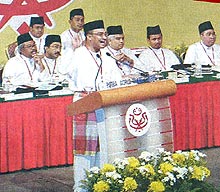
 I can hear this utilitarian dream ringing loudly and clearly in Najib Tun Razak's speech to the current Umno general assembly. For the happiness of the majority race, the out-dated New Economic Policy must continue, without any time limitation perhaps.
Race as the basic unit
There is a difference between Jeremy Bentham et al and Najib Tun Razak of course. Classical utilitarianism gives equal weight to every citizen's claim to happiness, while Najib and his Umno gang would rather resort to race as the basic unit in their demand for happiness.
The weakness with utilitarianism is that it can easily lead to tyranny of the majority. Pushed to its crude extreme, the rights and happiness of the minority can be sacrificed for the sake of the majority. In the case of Umno, the tyranny of the majority takes on a sinister twist when the spectre of the May 13 tragedy was invoked in the current general assembly.
Worse still, Umno brand of racial utilitarianism (or is it utilitarian racism?) does not address itself to the problem of equitable distribution of "primary goods" within the Malay community.
Today, after nearly half a century of pursuing perceived racial equality, some Malays are much happier than others for no legitimate reason. Envy, which used to plague inter-racial relations, now plague the intra-ethnic consciousness of the Malay community itself.
 Therefore, the Malay community today are far more divided than ever, with deeply-entrenched political alienation running along socio-economic, regional, political and religious fault lines.
That sons of former prime ministers of Malaysia are still mouthing the slogans of their fathers' generation is ample evidence that these new Umno leaders have not contributed their own social and political capital towards the evolution of Umno to keep up with new realities. They are living on the fixed political deposit accumulated by their fathers' endeavour. They cannot reform Umno.
Another weakness with utilitarian thinking is that people in general do not always know what will really make them happy. They often make mistakes about what they want in any phase of their life. Most of the time, they fall prey to their narrow selfish view of the world.
Institutional reform
Perhaps our enquiry should be modified. We should start asking ethical deontological questions like "What ought the people want in matters of political reform?"
Some thoughtful readers have written in, suggesting that I should also explore the possibility of institutional reform in Malaysia.
The idea is that, if all institutions of the state function according to democratic principles of accountability, transparency and good governance, all citizens - including and especially top politicians and powerful bureaucrats - will have to engage themselves in the power game on the same level playing field as everybody else.
There will then be no place for authoritarian patriarchs like Dr Mahathir Mohamad. The future of the nation will then depend on a healthy structural system, rather than on the coming and going of individual mortal fallible leaders. The Rule of Law shall then replace the Rule of Man.
I agree with all that. This is the historical route through which the liberal democracies of Europe and North America have evolved, sometimes at the cost of great bloodshed.
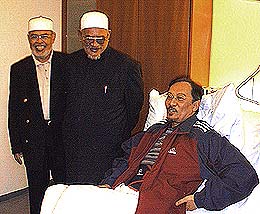 There is one problem in Malaysia. We have a tacit understanding that reforms must be sought through constitutional means. Even Anwar Ibrahim has called for a halt to the politics of peaceful demonstration on the street, even though peaceful demonstrations ought to be considered a constitutional right of citizens.
At the same time, the legion of inter-connected political institutions in Malaysia today are all so ossified that to agitate for change according to existing rules would seem too much of a Herculean task even for Hercules himself!
Take the mother of all institutions, the Federal Constitution. This was meant to be a piece of document that will lay down the basis for a liberal democracy. Yet, the alleged "social contract" of the mid-Fifties in the last century has twisted the original idea of a modern state based on universal rights of citizenship beyond measure. Racism has been institutionalised.
Likewise, the other institutions such as the Conference of rulers, the Parliament, the court, the administrative bureaucracies, the army, the police, the financial, social and religious institutions that were offshoots of the NEP, are all penetrated and subverted through and through with the ethnic-inclined political premises nascent in the Federal Constitution.
Racial sentiments and exclusivist ethnic self-identification have combined to implant a deeply schizophrenic mania in the political consciousness of most Malaysians. They have certainly infected the opposition parties, to the extent that they cannot form a national alliance to mount a credible challenge to the Barisan Nasional.
Unfortunately, political parties are the principle instruments by which radical and extensive institutional reforms can be brought about.
The ruling parties cannot be expected to reform themselves, since they have too much vested interest in the status quo. Therefore, for the possibility of institutional reforms even to exist, the opposition parties must first reform themselves. To borrow from fashionable terminology, the opposition parties must reinvent and reengineer their theory and praxis, and speak to a national constituency with a varied but an inclusive voice.
In short, the self-professed reformists must first go through a radical process of reflection and soul searching, to think and act beyond the debilitating limits imposed by the institution of the politics of race and - by extension - the politics of religion.
Reform the reformists first!


