




Wrestling Leviathan
What exactly is this magical 'civil society' that has become so fashionable in political discourse in Malaysia nowadays?
Here I balk at trying to unravel the question, because a serious discussion on this subject would risk boring Malaysian readers, who - by and large - seem to have a short attention span, especially when reading the written word on a flickering computer screen.
Nevertheless, the term 'civil society' seems to be in vogue, with non-governmental organisations being referred to as 'civil society groups', while even prominent Muslim politicians try to expound their vision of an Islamic civil society.
Frankly, I think this is a healthy trend. Malaysian society is a splintered, fragmented and alienated mess, very much held together by the hegemony of state violence and the frigid framework of formal history. The old structure of archaic assumptions about our mythical 'social contract' is now bursting at its seams. We need to explore new conceptual schemes, in keeping with rapidly changing reality, to discuss politics
What exactly is this magical 'civil society' that has become so fashionable in political discourse in Malaysia nowadays?
Here I balk at trying to unravel the question, because a serious discussion on this subject would risk boring Malaysian readers, who - by and large - seem to have a short attention span, especially when reading the written word on a flickering computer screen.
Nevertheless, the term 'civil society' seems to be in vogue, with non-governmental organisations being referred to as 'civil society groups', while even prominent Muslim politicians try to expound their vision of an Islamic civil society.
Frankly, I think this is a healthy trend. Malaysian society is a splintered, fragmented and alienated mess, very much held together by the hegemony of state violence and the frigid framework of formal history. The old structure of archaic assumptions about our mythical 'social contract' is now bursting at its seams. We need to explore new conceptual schemes, in keeping with rapidly changing reality, to discuss politics
Origins of civil society
The idea of a civil society is a relatively modern, and hence Western, invention. Its origin was contemporaneous with the ideas of parliamentary democracy and the steam engine.
The idea arose in the classical theories on the sovereignty and limitations of the modern state, as postulated by great thinkers like Hobbes, Locke and Rousseau. It concerned different perceptions of the political rights and civil liberties of the citizens in their relative relationship to the state.
Eventually, the idea of a civil society existing independently of the apparatus of state per se, played a large part in the development of the Western model of liberal democracy as we know it today.
It has also been the theoretical cornerstone for the emergence of the concept of fundamental human rights. Perhaps that is why it is so popular among political activists, liberal radicals, and free-market believers.
Following the downfall of the former Soviet block towards the end of the last century, there was renewed interest in the idea of civil society and how it can become the pre-condition for building a democratic way of life and resolving conflicts. It became the hottest topic among all the political sciences.
Exploring the emergence of a global civil society, John Keane has this to say about this modern trend:
"The emerging consensus that civil society is a realm of freedom, correctly highlights its basic value as a condition of democracy. Where there is no civil society, there cannot be citizens with capacities to choose their identities, entitlements and duties within a political legal framework."
Since this is one of those new ideas that has found its way to the realm of public political discourse from the rarefied air of academia, we have no choice but to linger for a little longer on the contribution of the academics.
I make this plea because Malaysian readers in general seem easily bored by the theoretical speculations of academics. This is not surprising. Despite our lip service towards creating a knowledgeable society, decades of education based on spoon-feeding right up to university levels have stifled all curiosity towards creative thinking and pursuit of new knowledge.
Social capital
The notion of social capital has been around for decades. It is with the work of Jane Jacobs (1961), Pierre Bourdieu (1983), James Coleman (1988) and Robert Putnum (1993; 2000) that it has become prominent.
One of the most compelling studies in recent years was done by Putnam and his colleagues in the mid 90s, especially in their novel use of the concept of social capital.
This is how Putnum introduced the idea in 2000:
"Whereas physical capital refers to physical objects and human capital refers to the properties of human individuals, social capital refers to connections among individuals - social networks and the norms of reciprocity and trustworthiness that arise from them. In that sense, social capital is closely related to what some have called 'civic virtue' A society of many virtuous, but isolated individuals is not necessarily rich in social capital."
In other words, interaction enables people to build communities, to commit themselves to each other, and to knit the social fabric. Once again, we are confronted with this question: what kind of civic associations should count as 'civil society groups' in Malaysia?
If we include all forms of formal and informal associations among citizens as 'civil society', then we seem to have a civil society in Malaysia.
The Chinese for instance, have more than 5000 guilds, clans and religious associations. In the case of the Malays, every mosque is a thriving centre of community life, apart from many other bodies registered with the Registrar of Societies. Communal links seem strong in our country, because we are still very much a nation in which communal values are important.
Certainly these civic associations release quite a great deal of social capital, by establishing voluntary connections among members of their respective communities. On the face of it, social engagement seems to be quite the norm in Malaysia.
Ethnic divisions
The trouble is that the great majority of these citizen groups are organised along ethnic lines. The racial divide among these groups means that they could be counter-productive to democratic development and thus would not be effective in resolving inter-ethnic conflicts.
This is where Putnam's distinction between 'bonding' and 'bridging' social capital becomes crucial.
Bonding social capital develops when people get involved with their own kind. This is by far the more popular type of social capital in Malaysia. It would seem natural that people like to associate with those who have similar ethnic backgrounds, social status and educational level.
The trouble is, bonding social capital can serve to reinforce and propagate pre-existing beliefs, including our racial prejudices. The Ku Klux Klan in the US is an extreme example. Where the ideology and membership of bonding associations are both closed and exclusive, the sense of belonging can easily be turned into xenophobic fears and mistrust against those outside the association.
In bridging social capital, on the other hand, people get socially involved with people who are less like them. A neighbourhood association in a racially mixed residential area would be a good example. (How many racially mixed neighbourhood associations are there in Malaysia?)
Putnam thinks that the bridging type of social capital is more conducive towards democratisation and resolution of conflicts. I agree.
The key words here are 'tolerance' and 'trust'. As long as the different ethnic communities live and work side by side, yet in relative mutual exclusion, the superficial tolerance and trust cannot flower into the true spirit of solidarity, co-operation and mutual commitment. Racial unity and ethnic cohesion can be anathema towards building the national social fabric.
Political patronage
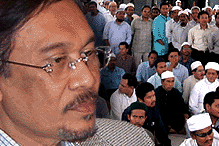 There is a dearth of bridging social capital in Malaysia. That may be one of the key reasons why the process of democratisation is so sluggish in our country. The 'rainbow coalition' that Anwar Ibrahim seeks to forge may have to be born from a clean slate.
Malaysia is also very different from the US. Unlike the US, our nation is of the soft authoritarian sort. Like Hobbes' Leviathan, the monstrous monolithic state penetrates into every level of the citizen's life, from cradle to the grave.
Apart from the many coercive constraints on the freedom of associations, the ubiquitous power of the state tends to seduce, hijack, subjugate, corrupt, and absorb all the social capital under its wings. For various reasons, most civic associations in Malaysia have come under the political patronage and influence of the mainstream political forces at work.
For true civil society to emerge in Malaysia, as a positive phenomenon that will speed up the process of democratisation and help resolve conflicts, we need more than just bridging social capital. We also need them to be independent in relation to the State.
Real civil society must also redefine the distance between social groups and the power centre. Irrespective of how they are labelled by the government themselves, they do not have to be pro and anti government necessarily. They may engage both ruling and opposition parties, to further the cause of democratisation. They have to build the widest possible network of alliances, even beyond national borders. But they must stand on their own two feet, financially, emotionally, and intellectually.
More than the arrival of any single enlightened political saviour from the heavens, the building of a civil society will be the fulcrum upon which the gargantuan monument of power erected by the Leviathan can be dismantled, and the fabric of a democratic society of happy citizens can be re-woven.


Are you sure you want to delete this comment?
This action cannot be undone.