




Kerrying the presidential can
It is hard to imagine a time in modern history when a sitting US president has been as unpopular internationally, as the incumbent.
From reneging on the Kyoto Treaty for climate change to his tax cuts for the wealthy, disinterest in the Israeli-Palestinian conflict and finally, his 'masterpiece' of the Iraq fiasco, George W Bush has perhaps done it all.
If that was not enough, Democratic presidential contender John Kerry's statement, that the president had told him about his disinterest in finding Al-Qaeda chief Osama bin Laden, only highlights further that the president may just well be the wrong man at a very critical moment in history.
It also betrays a sense of naivete at best or sheer incompetence at worse on the part of the leader of the free world - something the world last saw when both Herbert Hoover and Warren Gamiel Harding were occupying the Oval Office.
And like those two failed presidents, George Bush embraces a unilateralism gravely at odds to what history dictates.
It is hard to imagine a time in modern history when a sitting US president has been as unpopular internationally, as the incumbent.
From reneging on the Kyoto Treaty for climate change to his tax cuts for the wealthy, disinterest in the Israeli-Palestinian conflict and finally, his 'masterpiece' of the Iraq fiasco, George W Bush has perhaps done it all.
If that was not enough, Democratic presidential contender John Kerry's statement, that the president had told him about his disinterest in finding Al-Qaeda chief Osama bin Laden, only highlights further that the president may just well be the wrong man at a very critical moment in history.
It also betrays a sense of naivete at best or sheer incompetence at worse on the part of the leader of the free world - something the world last saw when both Herbert Hoover and Warren Gamiel Harding were occupying the Oval Office.
And like those two failed presidents, George Bush embraces a unilateralism gravely at odds to what history dictates.
Bush's failings at least from a foreigner's point of view are legendary. Out of nature or perhaps nurture, his crude and divisive remarks have outraged many.
'Infinite justice', the slogan he gave in the opening days of the Afghan adventure justifiably offended many moderate Muslims world wide, so much so that no sooner had the campaign begun, than he was forced to find another term.
That coupled with his poor debating skills, seen through scowling and caustic remarks, do not endear him to his international audience, who had expected some statesman-like decorum.
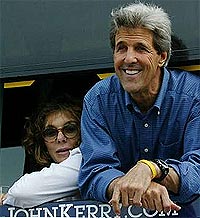 So when Kerry appeared, he stole a march on Bush. The Massachusetts senator has displayed elegant manners, intelligence and a pledge to return to multilateralism. The last item must unquestionably be Bush's Achilles heel.
"Kerry would change the United States' tone in international relations - there would be less bullying and unilateralism," said Indonesian politician Andy Mallarangeng in an interview with Singapore's Today paper.
In fact that was exactly what Kerry promised through his pledge of 'smart diplomacy', which he plans to use in bringing US troops back home from Iraq within six months.
What is even more galling is the plain refusal of Bush and his vice-president Dick Cheney to accept the findings of many independent fact-finding committees, that proclaimed no linkage between then Iraqi president Saddam Hussein and weapons of mass destruction (WMD), or of his links with terrorists.
By robbing the moral basis for war, Bush has hurt US credibility causing it to be a somewhat untrustworthy partner in future engagements involving foreign states.
Presidential anaemia
So what can be expected on Nov 2, the Tuesday that is constitutionally enshrined for Americans to pick their new leader? For one thing the world can certainly expect unprecedented voter turnout - an obvious sign that something is rotten in the state of America.
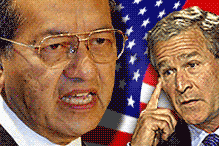 It could also point that change is in the air, perhaps a 'regime change'; something endorsed in a open letter to US Muslims by none other than former Malaysian premier Dr Mahathir Mohamad.
There are spitting image similarities between the times when Bush's father was the president and now.
As in 1992, the issue is much about the direction of the country and where it is headed. And it is about jobs 1.6 million jobs have been lost since Bush came into office. Also, it is about whether the president is really ever reading the signs at the grassroots.
More accurately it boils down to leadership, which regretfully has not quite been smart, in the way a global front has been rejected in the fight against a new breed of terrorism.
Little wonder, therefore, that as in 1992, voters can be expected to turn out in record numbers, probably driven by disappointment.
And if history repeats itself, it will reveal what it means to carry the presidential can.
JAYA PRAKASH lectures in journalism at FIS Education Centre in Singapore.


Are you sure you want to delete this comment?
This action cannot be undone.