




For whom the bell tolls
The unhappy year of 2004 ended, not with the whimper of inane countdowns at hysterical street revelries in megapolis of the world, but with a big bang that rocked the planet.
A day after Christmas, at 00:58:53 UTC (07:58:53 local time), an earthquake measuring 9.0 on the Richter scale struck in the Indian Ocean, some 160 km off the western coast of Sumatra.
The quake occurred at the extreme western end of the 'Ring of Fire', an earthquake belt that accounts for 80 percent of the world's largest earthquakes.
Ancient myths from many civilisations have told of such apocalyptic upheavals of the heaven and the earth in the past, often in the form of a grand battle between the gods. We modern men have lost our memories of myths, perhaps because we have the myths of science to explain natural phenomena with natural causes.
 This is what science tells us. A fault line estimated to be 1,200km in length suddenly slipped 15m where the India tectonic plate dives under the Burma plate. The seabed of the Burma plate rose by 10m. The sea water was stirred violently.
The energy released by the quake was so massive that it probably even altered the Earth's rotation. Theoretical models suggest that the Earth 'wobble' ever so slightly by up to 2.5cm around its axis, and the length of a day could have been shortened by three micro-seconds.
The unhappy year of 2004 ended, not with the whimper of inane countdowns at hysterical street revelries in megapolis of the world, but with a big bang that rocked the planet.
A day after Christmas, at 00:58:53 UTC (07:58:53 local time), an earthquake measuring 9.0 on the Richter scale struck in the Indian Ocean, some 160 km off the western coast of Sumatra.
The quake occurred at the extreme western end of the 'Ring of Fire', an earthquake belt that accounts for 80 percent of the world's largest earthquakes.
Ancient myths from many civilisations have told of such apocalyptic upheavals of the heaven and the earth in the past, often in the form of a grand battle between the gods. We modern men have lost our memories of myths, perhaps because we have the myths of science to explain natural phenomena with natural causes.
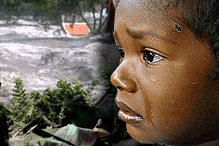 This is what science tells us. A fault line estimated to be 1,200km in length suddenly slipped 15m where the India tectonic plate dives under the Burma plate. The seabed of the Burma plate rose by 10m. The sea water was stirred violently.
The energy released by the quake was so massive that it probably even altered the Earth's rotation. Theoretical models suggest that the Earth 'wobble' ever so slightly by up to 2.5cm around its axis, and the length of a day could have been shortened by three micro-seconds.
Based on one seismic model, the northern tip of Sumatra may have been moved by up to 36m, and the exact map of the area would have to be redrawn.
The sudden vertical collapse of huge land masses under the sea was what caused the giant waves traveling at up to 800km/hr in all directions, forming tsunamis when they neared coastlines, and dissipating their monstrous energy by wreaking destruction upon everything in their path.
The term 'tsunami' comes from the Japanese language, meaning tsu (harbour) and nami (wave). The name was coined by Japanese fishermen who returned to port to find the harbour area completely decimated by giant waves, though no waves were sighted on the open sea on their way home.
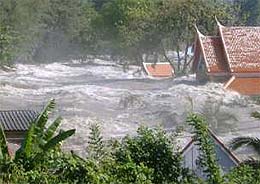 Tsunami waves travel underwater, and have very long wavelengths of up to 100km. That is why people travelling on the surface of the ocean may not be aware of these sea-monsters rumbling beneath their vessels. Since tsunamis are not formed by the wind and the moon, to call them "tidal waves" is technically wrong, and discouraged by oceanographers.
Compassion fatigue
On Boxing Day 2004, the tsunamis unleashed their fury upon the shorelines of Indonesia, Malaysia, Sri Lanka, India, Thailand, Burma, and the Maldives. Even the east coasts of Africa, especially in Somalia and Tanzania, were badly hit, despite being located 4,500 km or more west of the epicentre.
Thanks to satellite television, the sights and sounds of the horror that has been inflicted upon a large swathe of humanity across two continents have been beaming into living rooms across the world.
At the time of writing, the total death toll stands at 155,000, with two-thirds coming from Indonesia, and one-third or more being children. Obviously, the actual number will be much higher, if they do not give up counting, and if they can find all the corpses. .
Then there are the God-knows-how-many millions of displaced people, survivors who have to live with the trauma of losing everything they own and their loved ones, while desperately going about their daily business of scrounging for food, fresh water and medicine.
Malaysians, for the most part, have been saved by the land mass of the island of Sumatra, though fishing communities along the north-western coasts of the Malayan peninsula have not been spared.
 Every life lost to natural disaster is a singular tragedy. The outpouring of grief and assistance offered by the Malaysian public in aid of their less fortunate fellow citizens does display the better side of our national psyche.
Since natural disaster on this grand scale knows no national boundary, neither should the compassion of humanity.
After all, the Indian Ocean earthquake was the fourth most powerful since 1899, and the most deadly due to the highly populated areas affected by the ensuing tsunami.
By now, TV commentators and print journalists have exhausted their store of superlatives used to describe the terrible aftermath of the tsunami waves. No sane person can absorb this daily barrage of tragic tales without feeling a profound sense of pain and loss. The only risk of over-exposure in the media is that of creating compassion-fatigue.
Fortunately, compassion is still very much the global order of the day. The people of Great Britain donated 60 million within the short span of a week after the disaster. Traffic on the Internet has exploded since, with websites and blogs offering information and rallying for donation and assistance for the tsunami victims.
The show of solidarity, empathy and compassion by citizens of the world across religious, racial and national boundaries gives you some hope about this very imperfect world.
For the moment at least, whether the aid and the money reach the actual victims is a matter of grave concern. The international community - if such a community exists on the political level at all - is totally unprepared for the gravity and extent of the problems at hand. Too much politics and too much bureaucracy stand in the way. Now we have to worry whether the US$3 billion pledged by governments of the world towards relief effort will be fully paid up and utilised.
God's punishment?
Inevitably, there are always those odd individuals who wonder aloud whether the tsunami disaster has not been God's punishment for mankind.
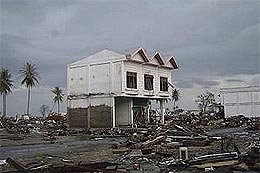 I am always uncomfortable with individuals who seem to have a direct line to God, and know every divine intention with such intimacy. It is only natural that we want to make sense of something that is beyond our comprehension. But in the face of so much widespread suffering, it seems unkind to turn the whole tragedy into a silly morality play, of good versus evil, neither of which we know very much.
If anything else, the almost instant destruction wrought by the tsunamis does give a timely reminder of the fragility of our existence, both as a species, and as individuals.
In our unreflective daily living, we tend to assume that we are each centre of the universe, and that we homo-sapiens are destined to be masters of this Planet Earth. We moderns tend to have this anthropocentric world view, believing that, with the near omnipotent tools of science and technology, we can 'conquer', 'tame', 'enslave', 'manipulate', 'exploit', and 'control' Nature.
The optimism of modernity inherited from the European Enlightenment has duped us into believing that the planet is solely ours to use, for our pleasure and comfort, all in the name of economic development, pursuit of happiness and historical progress.
 Our collective helplessness in the face of natural disasters like the tsunami is a reminder that we are no match for Nature, and the idea of life on earth as a deadly struggle between man and nature ought to be examined. We may install and improve our early warning systems and save lives, but we will not deter planet earth from such periodical outbursts.
If anthropologists are to be believed, the species of Homo-sapiens has taken a mere few million years to evolve on this fragile planet. The earth itself was born some 4.5 billion years ago. If the past life of the planet is compared to a 24-hour day, then our species has only appeared during the last minute of the last hour of the day.
In those millennia and eons long past, our Earth has gone through all kinds of cataclysmic contortion resulting paradoxically in this wonderful living blue planet that we enjoy today. It will continue to work out its incomprehensible and violent history without any regard for the puny will of a puny species like ours.
In fact, what little we know about this infinitely huge physical universe tells us that we, as a species and as individuals, are a pretty minute insignificant presence.
Nevertheless, this insignificant presence is nothing short of a miracle. As far as we know, this tiny third rock from the sun in a galaxy among billions of galaxies is the only place where we have life, in a lifeless inorganic cosmos. Among the many life forms, we are the only ones daring to stare at the stars, dream dreams, make beautiful music, and contemplate upon the divine and infinity. That is why every life is so precious, because it is so unique.
That is why we should mourn the loss of so many lives that have perished in the tsunamis, and the many more that are dying around the globe from unnecessary causes.
Ask not for whom the bell tolls
It tolls for thee.


Are you sure you want to delete this comment?
This action cannot be undone.