




Tear down the Parliament roof!
I read in the Star an ad placed by the Malaysian Parliament, inviting applicants for the post of parliament researchers.
I am intrigued. Will this move automatically improve the quality of debate in the house? Will it then make Parliament more relevant to the ordinary citizens, even if the debates are telecast live?
First, there are the practical problems. There are now over 200 Members of Parliaments in the Dewan Rakyat. In any long sitting, such as the Budget Session usually held in October, something like 42 days are allocated for the debate. Everyday, a host of YBs from a host of political parties will be standing up and sitting down, trying in vain to get a chance to do what they are elected for: to talk.
Who is to decide then, which MP will get the assistance from the pool of 10 researchers on the Parliament staff? And how can the researchers help? What kind of research are they expected to do? Will they have the political sense to understand the more subtle nuances required for grave deliberation on serious matters of state, or will they end up writing inane speeches to be read out by the YB, whose only wish is that he has made a speech?
I read in the Star an ad placed by the Malaysian Parliament, inviting applicants for the post of parliament researchers.
I am intrigued. Will this move automatically improve the quality of debate in the house? Will it then make Parliament more relevant to the ordinary citizens, even if the debates are telecast live?
First, there are the practical problems. There are now over 200 Members of Parliaments in the Dewan Rakyat. In any long sitting, such as the Budget Session usually held in October, something like 42 days are allocated for the debate. Everyday, a host of YBs from a host of political parties will be standing up and sitting down, trying in vain to get a chance to do what they are elected for: to talk.
Who is to decide then, which MP will get the assistance from the pool of 10 researchers on the Parliament staff? And how can the researchers help? What kind of research are they expected to do? Will they have the political sense to understand the more subtle nuances required for grave deliberation on serious matters of state, or will they end up writing inane speeches to be read out by the YB, whose only wish is that he has made a speech?
For the YB, the pressure to make a speech during the sittings is fantastic. The party bosses expect it; and the constituents would want to know if you merely sleep in the house.
The standing order provides that the Speaker will call whoever catches his eyes first to speak. But he also observes certain conventional practices. Priority is always given to those senior members of the house, as well as those who hold senior positions in their respective political parties. That means the front benchers.
The first term back benchers may be hopping up and down in his chair, sometimes up to over 30 times, without having caught the Speaker's eyes. It is a case of the Speaker looking, but not really seeing the poor desperate honourable member. Some Speakers develop the "Nelson's eye": his left eye seems blind to the opposition benches sitting a breathe away to his left.
When finally his turn comes towards the end of the debate on any particular bill, the poor green-horn YB discovers to his dismay that he is allocated only a few minutes, when he has prepared pages and pages of his political wisdom for the occasion. This is especially so when the Opposition Leader and the BN front benchers have had their hours dispensing endless pages of their political wisdom!
Speak off the cuff
It would seem that the junior members of the House would need their researchers the most, and yet would have the least use of their assistance. The seniors, except those from the DAP, would have their party resources behind them, to prepare well-researched speeches anyway.
In the end, it might have been better to just do away with prepared speeches, forget about researchers, and speak off the cuff. After all, are politicians not professional talkers?
Indeed, the whole thing about parliamentary debate is meant to be the spontaneous cut and thrust of oratorical eloquence that generates interest when members speak off the cuff. Up till the early 80s, there was a rule in the Standing Order that forbade speeches read verbatim from a prepared text.
 Shortly after his election to the Speaker's Chair in 1982, the late Tun Mohd Zahir Ismail - with the help of the House Standing Committee - had an amendment passed allowing members to read from their prepared speech. From then on, spontaneity died in the house, most of the time.
That is why televising Parliament proceedings now would bore Malaysian audience to death.
For a start, most of the business going on in that august chamber is about minor legislation on seemingly irrelevant issues that do not concern your average citizens. Even when the bills are controversial, they are couched in such esoteric legal mambo-jumbos that the content even eludes many members of Parliament. Trust me; Parliament business is not sexy.
What you get most of the time when Parliament sits is a series of mind deadening droning blind reading of prepared texts. There he is, the honourable member who happens to command the floor, slightly hunched over the microphone, eyes fixed on his precious text, filling the tall cold hall with his droning monotonous voice. That is when other members make a bee line to the cafeteria, closely followed by the reporters.
I have a sneaking suspicion that the reporters who are assigned to Parliament are equally bored with the speeches. Some will not have the slightest inkling of what is going on of course. Unless a YB distributes copies of his speech texts, it is unlikely his speeches will be reported at all. Even if the speeches are covered, like an after thought, you can be sure they will be condensed into unrecognisably brief form.
Confrontation and drama
Newspapers thrives on confrontation and drama, not on well researched reasoned arguments. To grab headlines, members will have to resort to confrontation and drama. A conscientious member of Parliament may have slogged over his speech for a week, and if and when it is delivered, the press may give him two paragraphs, if he is lucky.
 On the other hand, if a member merely stands up, makes a silly or controversial comment on another member, or on the sexuality of women, there is bound to be an uproar, followed by an exciting shouting match, the throwing of things by an errant member, and concluded by one member or another being rejected or admonished by the Speaker. That makes for a good story in the press.
After all, why would a member of Parliament make any speech at all? Why indeed, if not for the hope that his speech will be reported, and he will be seen by his constituents as having discharged his duties? If his well-researched speeches are never given the coverage that they deserve, why should he do any research at all?
That members of Parliament need researches to help them improve the quality of their debate is a myth, as things stand now.
All the bills that are tabled in Parliament originate from the ministry that has jurisdiction on matters covered in the bills. They are drafted by special teams in the Attorney General's chamber first, then given various going-over by various vetting processes, before they are tabled. In the whole process, the cabinet holds the last say.
When the bills have finally arrived, the members from the ruling parties would have been briefed in the pre-council meeting, held before the actual Parliament sitting. The opposition members would not have a clue of what to expect, until the bills are tabled for fist reading, which can be done just two days before the actual debate during the second and third readings.
Once the bills have gone through the motion of being tabled, whatever any member says on the bill is entirely extraneous to the intent and content of the bill. The bill must be passed, and the party whips are there to ensure that all members toe the party line. The quality of debate is never an issue for the members!
In short, there is very little room for the Parliament to play its role in serving as a real political forum, and in providing checks and balances against possible executive excesses. To call the Malaysian Parliament a rubber stamp is to insult that very useful office equipment.
Reforms needed
We should not be surprised. A good set of rules alone cannot ensure a good game. It depends also on the quality of the players, on how they play the game, and how they choose their referees. It also depends on spectators who have a stack in the game.
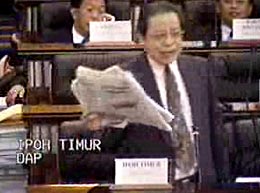 In his opinion piece entitled Needed Urgently: a Better Parliament, my friend Liew Chin Tong has outlined the reforms that need to be brought to our fossilied moribund legislative chambers. I agree with all that. They are the sort of things that Lim Kit Siang has been saying in the Dewan Rakyat for a few decades.
Yet, over the past decades, the Parliament has become even more regimented, until recently even MPs from the Barisan Nasional grumbled that they were being treated like school kids in a classroom. In short, parliamentary reform will not come from within Parliament House itself. It will only come from outside the Parliament, in a political precess that has yet to happen, involving voters from across the nation, as part and parcel of the realignment of political power in a congruence of forces at work.
Of course the Parliament is the supreme political institution in the land, embodying as it does the general will of our sovereign nation. Tragically, that it needs reform escapes the great majority of citizens. It is a barometer of our political health or political sickness. The greater tragedy lies in the fact that critical minds can only see the poor performance of the members of Parliament, without seeing at the same time, how our entire political process needs an overhaul, which should also include radical reform to our opposition parties.
Now that the Parliament roof is very much in the limelight, perhaps I should call for tearing down the roof of that not so august house, metaphorically speaking, just so the light of enlightened democracy can gain access to the politicians inside.


Are you sure you want to delete this comment?
This action cannot be undone.