




Japan for the UN? Think again
So, it is official.
Singapore a nation, which like the rest of its Asian neighbours suffered greatly from Japanese militarism, will now lend its support to Tokyo for a seat at the UN Security Council.
Whilst the decision firmly places the republic alongside the United States, it will be interesting to watch how in the period leading to any final acceptance of new members, Asian nations will react to the Singapore decision.
And it will also be interesting to watch how the rest of the permanent UN Security Council members, China, Russia, Britain and France who have endorsed India for the coveted prize, will take to interpreting the support Japan is now getting.
Yet what is interesting are the implications behind the unstinting support Tokyo is deriving from Washington.
So, it is official.
Singapore a nation, which like the rest of its Asian neighbours suffered greatly from Japanese militarism, will now lend its support to Tokyo for a seat at the UN Security Council.
Whilst the decision firmly places the republic alongside the United States, it will be interesting to watch how in the period leading to any final acceptance of new members, Asian nations will react to the Singapore decision.
And it will also be interesting to watch how the rest of the permanent UN Security Council members, China, Russia, Britain and France who have endorsed India for the coveted prize, will take to interpreting the support Japan is now getting.
Yet what is interesting are the implications behind the unstinting support Tokyo is deriving from Washington.
Happening as all these does; at a time of heightened anxiety with China and the long running disputes both Washington and Tokyo continue to have with Beijing, it certainly does have geopolitical implications.
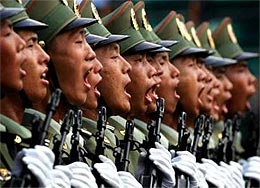 That China is rising, is without doubt, an inevitability that just has to be. That it is rising, as a communist state is what perhaps most troubles, Washington and Tokyo, for that would possibly mean that one day the world may have to contain yet another Red menace.
In case if anybody cares to remember, the Red menace may just have been behind the thinking of US Secretary of State, Condoleeza Rice's statement to making India a powerful state in the 21st century, as a possible means to encircling China.
But having failed at convincing New Delhi or even to try and shake its Non-Aligned Movement (NAM) instincts, Washington was compelled to look the other way.
In case if anybody cares to remember again, Japan was never a member of NAM a body that seeks neutrality in international politics.
As a matter of fact she was so close to the United States, that the obsequious part of their friendship could even mean that if the US asks Japan to stand in a corner Tokyo may just oblige.
Thus that unusually close relationship with the United States makes her bid for the UN Security Council seat, fraught with all kinds of political interpretations that even in the best of intentions, her decisions may be viewed as suspect.
Containing China
But what is suspect may not be a bad thing after all, as far as containing China goes.
Like the playing of the China card during the Cold War to confront the Soviets, active Japanese participation in the World body complemented by her powerful economy can certainly make things difficult for Beijing and work in the US's favour.
For one, it can steal the shine that China is now enjoying through her soft diplomacy in the Third World. And when that is done, the Japanese could interpret their American support to ignore world opinion about how it should view its past whether tinted glasses or not.
And finally, a Japanese seat at the UN may just be the 'reward' for a state that brutalised so many peoples in Asia, and for which it sees its UN participation as some kind of vindication.
If Japan seeks to speak for humanity; she should come clean on the issue of her wartime past and take genuine steps to interpreting history as told by survivors of its horrors.
Like the smokescreen of the so-called 'Co-Prosperity Sphere' sought to champion the eradication of poverty in Asia during Word War II, this modern-day stunt of seeking to represent Asian interests in a global body like the United Nations is sure recipe for apprehension, if not suspect.
So, can a nation that periodically revises its history books to 'varnish' the truth really be capable of holding itself to account, when the real truth about its past is becoming so difficult to handle?
Or can that very nation that so brutalised its Asian neighbours or for that matter refuses to atone, ever be trusted again to do what she promised in an ideologically different setting some 65 years ago?
Beyond all the posturing, Japanese participation in something as hotly debated as the UN is not about simply ignoring its wartime history, though in all fairness, Tokyo has contributed enviably to UN global operations.
And why that is so, is only because they could reasonably afford to allot those kind of funds, based on their wealth.
But if moral high ground should be taken which in any case was what formed the premise behind the Charter in 1945 Tokyo just does not stand a chance.
And with a UN seat though without veto powers she may just have added reasons to keep her distorted history books the way they are; and be America's lap dog in the grand scheme of things.
JAYA PRAKASH lectures in journalism at Nash School of Journalism


