




My neighbour's fire, my haze!
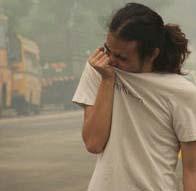
The landscape in the Klang Valley assumes a surreal quality these days, as the annual August haze descends from the grey sky and envelops everything within sight with an opaque oppressive blanket of dust and ash. The acrid smell of burnt earth chokes the lungs and the soul.
In the early morning, the sun smoulders with a sickly crimson halo behind a veil of greyness. In the afternoon, it turns into a dull orange. The sun, the giver of life worshipped by many ancient civilisations, the Apollonian God of reason, knowledge, healing, and goodness, is now desecrated beyond recognition by human folly.
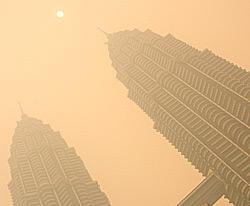
We hear reports visibility in many spots in Malaysia are now less than a kilometre. The sky-scrapping condos a shout away from where I live in Cheras, together with the hill on which they perch precariously, have now disappeared for most of the day. In this rainless suffocating heat, all the tall buildings and landmarks in the Klang Valley sizzle like a mirage that wobbles uncertainly on the horizon.
The landscape in the Klang Valley assumes a surreal quality these days, as the annual August haze descends from the grey sky and envelops everything within sight with an opaque oppressive blanket of dust and ash. The acrid smell of burnt earth chokes the lungs and the soul.
In the early morning, the sun smoulders with a sickly crimson halo behind a veil of greyness. In the afternoon, it turns into a dull orange. The sun, the giver of life worshipped by many ancient civilisations, the Apollonian God of reason, knowledge, healing, and goodness, is now desecrated beyond recognition by human folly.
We hear reports visibility in many spots in Malaysia are now less than a kilometre. The sky-scrapping condos a shout away from where I live in Cheras, together with the hill on which they perch precariously, have now disappeared for most of the day. In this rainless suffocating heat, all the tall buildings and landmarks in the Klang Valley sizzle like a mirage that wobbles uncertainly on the horizon.
The Star carried a picture of the prime minister's grand office building in Putrajaya on their front page, showing the administrative heart of the nation in the grip of a hazy visual seizure. It is symbolic that, implicating the mental haze that clouds the mind of the person running the country inside that ostentatious but leaking palace.
 Driving under the unreal crimson sun in this eerie pseudo brightness, one gets this unsettling feeling as if one has been transported overnight onto an alien planet, as if one has come to inhabit a scene from the latest sci-fi movie. Glancing out of the car window, I saw factory chimneys vomiting columns of poisonous smoke that rises and finally merges seamlessly with the half-light of the grey sky.
Quiet desperation
My imagination begins to take flight. Is this anything like the horrific sky of a nuclear winter that should follow a thermonuclear apocalypse on earth?
The general mood of those people I watch can best be described as one of quiet desperation. Everybody seems to have smarting eyes and scratchy throat. In a country where any kind of information about an emergency is scanty, one can only speculate.
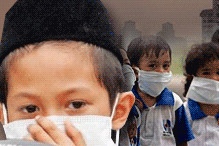
Hospitals and private clinics must be doing brisk business with patients suffering from respiratory disorders of all sorts. One can wonder how this foul air permeating every pore in our body is going to affect the very old and the very young, as well as those who are already sick.
The way people go about their daily business stoically despite their quiet panic tells us much about the Malaysian ethos. By and large, Malaysians do have a lot of trust and faith in their government. The health authorities seem concerned, but on the other hand, things also seem to be under control. As long as the government has not issued any public warnings about pending large-scale disasters, people will just grin and bear it.
They follow advice from the authorities dutifully, staying indoor, drinking a lot of water, avoid open burning, going through the daily tedium of persevering through this very filthy air that they suck into their lungs every second of the day and night, awake and asleep.
They should also pray for divine intervention, for the fires in our neighbouring country to die out, or for torrential rain to lash upon the raging inferno far away for days on end. Unfortunately, the fire and the haze are not a natural disaster, an act of God's will, like the tsunami phenomenon. They are the work of errant human beings, probably the inevitable consequence of greed, ignorance, corruption, and bad governance. The free will of mortal fallible humanity is what gives us this unbeatable unbreathable air.
Patient Malaysians
The Malaysian public will be patient, as long as the authorities say that the situation is under control. That saying usually means the government is controlling the free flow of information about the haze. For eight years since the haze wafted from across the ocean to suffocate our respiratory system, the Air Pollutant Index (API) has been kept a top state secret.
 The implication is clear. The real extent of the destruction of our air must not be revealed, because Malaysians are a pathologically fearful lot. If they get to know the API, there will be panic, and such social commotion as to lead to chaos on the street and threaten national security. This fits in with the mentality of our Malaysian ruling class of mercantile-technocratic elite; that Malaysians citizens in general - like small children - cannot be trusted with the facts of life.
There is another possibility for such secrecy. The people entrusted with the onus of governing our country do not want to scare way tourists who brought to our shores billions of foreign exchange every year. The national economy after all, is a top item in our new national agenda, a matter of urgent national interest. If the people should breathe this bad air and get sick, then it is a small sacrifice to pay for the nation's economic growth.
In this age of instant global communication, sweeping the haze under our Malaysian information carpet is a little like the proverbial ostrich with its head in the sand. Finally, the news of our hazardous haze hits the BBC headlines on August 10, the day the Malaysian ministers decided to lift the ban on the API.
The next day, the government declared a state of emergency over Port Klang and Kuala Selangor, where indices had exceeded the hazardous level of 500. All life is supposed to grind to a halt, as if this would drive away the haze or stop the fire in Sumatra and Kalimantan.
There is no haze without fire, and the fire is burning in my neighbour's backward. The neighbour has apologised, after a fashion, while the senseless burning of large tracts of forested land spreads to over 1000 hot spots. The neighbour has also accused Malaysian plantation companies working the land in Indonesia of being the culprits, and one wonders why Malaysians investors should enjoy any immunity from arrest and prosecution under Indonesian laws.
Beyond their control
This is why it is so frustrating for helpless Malaysians languishing under the full weight of a whole sky filled with venomous haze. The source of the haze is elsewhere, beyond their control.
Obviously, something is amiss with our foreign policy. Asean is near the very top of our diplomatic agenda, but for too long our government has relied on the old tired formula of "positive engagement" when dealing with less considerate neighbours.
"Positive engagement" is nothing but the euphemism for a glass-house mentality. To a great extent, the idea of "live and let live", in mutual respect for one another's sovereignty has worked in avoiding unnecessary international animosity and lowering the risk of regional armed conflicts.
But in the event of a man-made disaster like the haze, which recognises no national boundary, the neighbourly spirit of Asean is found wanting, and "positive engagement" has become an obstacle towards inter-governmental co-operation in solving a common problem.
This annual scourge has persisted for nearly a decade, for Christ's sake! If Asean is not to degenerate into a sterile forum for vacuous talk, surely some form of institutionalised international arrangement could have been in place, to mobilise the collective resources of Asean member states, to tackle cross-boundary problems like the haze?
 Collective financial resources would be required for the expensive business of moving into affected areas experienced fire-fighters and advanced equipment, including the deployment of those from the US and Australia, countries with vast experience in combating massive forest and bush fires for decades past.
There could also have been some standing treaties on the implementation of environmental laws in member states of Asean. If national pride and sovereignty are an issue in this sensitive business, then the treaty can cover only those aspects that affect innocent neighbouring states on issues such as the haze.
This could empower member states to engage in exchange of information, expertise, and enforcement personnel, as well as forming a legal framework to arrest and prosecute those who cause large scale forest and peat fire in any Asean country, irrespective of who they are. Eventually, inter-governmental policies at the highest level would have to be translated into international co-operation at the ground level. That would indeed help make the idea of Asean relevant to the ordinary citizens of member countries.
After all, it may be my neighbour's fire in his backyard, but it is my haze that is poisoning my family in my living room.
Air is the first necessity for human life, ahead of food and water. Surely, I am entitled to decent air, as my most fundamental human right!


