




Cowing the Chinese press
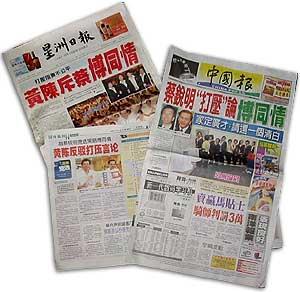
For anyone wishing to gain penetrating insight into Chinese politics in Malaysia, or the inner working of the Chinese community for that matter, it would be a great advantage if he is able to read the Chinese newspapers.
Chinese newspapers here are quite a unique phenomenon really, found nowhere else in the world, outside of China, Hong Kong and Taiwan, both in terms of their circulation, and also in the quality of their production.
I have seen Chinese newspapers in some other countries, and they are mostly limited to reports about mere community events. These are usually very skimpy publications, and probably seldom read by anyone outside the Chinatowns.
In contrast, Malaysian Chinese national dailies enjoy readership numbering in the millions throughout the country, with nearly inch-thick pages providing all the assortment of features that you associate with bona fide national dailies even in developed countries. Obviously, there is no shortage of advertisement revenues, and together, they form a sizeable industry providing hundreds of jobs for journalists and production workers.
For anyone wishing to gain penetrating insight into Chinese politics in Malaysia, or the inner working of the Chinese community for that matter, it would be a great advantage if he is able to read the Chinese newspapers.
Chinese newspapers here are quite a unique phenomenon really, found nowhere else in the world, outside of China, Hong Kong and Taiwan, both in terms of their circulation, and also in the quality of their production.
I have seen Chinese newspapers in some other countries, and they are mostly limited to reports about mere community events. These are usually very skimpy publications, and probably seldom read by anyone outside the Chinatowns.
In contrast, Malaysian Chinese national dailies enjoy readership numbering in the millions throughout the country, with nearly inch-thick pages providing all the assortment of features that you associate with bona fide national dailies even in developed countries. Obviously, there is no shortage of advertisement revenues, and together, they form a sizeable industry providing hundreds of jobs for journalists and production workers.
Apart from the usual fare catering to health care, women's issues, finance pages, hobbies, heartbreak consultancy, plenty of sports, international news, and the latest lucky draw results from so many legal gambling operations, they even have regular pages for anyone with literary aspiration, offering a fertile garden for the birth and growth of uniquely Malaysian Chinese literature.
Forge common identity
Despite the writers' perennial grumbling that Malaysia has yet to produce a literary work of classic proportion that enjoys international acclaim, the quality of aesthetic creativity is sometimes quite impressive. Some writers and poets, often frustrated by the politics in Malaysia, have since moved to Taiwan, there to achieve fame, prestige and fortune.
 There is, or used to be, another unique thing in the Chinese dailies, that is absent from the English and the Malay press.
Apart from the usual letters column, there is a full page everyday reserved for social and political commentaries. Every Sunday, there are pages and pages of very serious discussions, touching on pretty intellectual stuff at times, and it is the nearest thing we have to the London Times literary supplement.
This is, or used to be, fertile ground for a vibrant world of public opinions and critical writings, for budding contributors as well as seasoned resident columnists. Some contributors to malaysiakini like Lee Ban Chen, James Wong Wing Onn, and lately Josh Hong, have been notable writers and columnists in the Chinese press for many years, and they have a faithful following among the leadership.
The newspapers serve as the platform for diverse Chinese groups to forge their common identity as one ethnic community sharing a common destiny within the context of multi-racial Malaysia.
They provide the canvas upon which the political, social and cultural narratives of Malaysian Chineseness are painted and celebrated. Needless to say, they act as an effective instrument in mobilising the collective will and resources of the whole community on issues like the preservation of Chinese schools.
In return, the thriving Chinese schools system, with three colleges jostling to merge into a single university, produce a steady and massive stream of fresh readers, subscribers, business clients and reporters for the Chinese newspapers. The successful symbiotic relationship between the Chinese press and the socio-political network of communal forces at work, points to the key for the survival of the Chinese in a country where they have often been made to feel like alien intruders.
Most progressive best
The temptation to look upon these Chinese newspapers as a bastion of Chinese communal chauvinism is great, especially for those who believe in national unity based upon a single national language.
 To give them due credit though, the Chinese press in our country is pretty global in their outlook, and very Malaysian in their self-conscious character. In that sense, they do represent the worldview of the Chinese business and intellectual elite in their most progressive best.
In a country where business and politics are so closely intertwined, it is only natural that those in power will try to rope in such a free-spirited institution like the Chinese press. Like all publications in Malaysia, the Chinese papers feel the heat of both political and legislative constraints in playing their role as a public vehicle for the whole community.
Nevertheless, right up to the mid-eighties, the Chinese papers were the hotbed of vibrant political activism, furnishing a rare platform for the opposition DAP and the fiercely independent Dong Jiao Zong , the "Chinese educationists" that runs the Chinese schools.
The Chinese papers then were certainly far more democratic than the Malay or the English press, and this fact accounted partly for the success of the DAP during those glorious years for the opposition.
Why character change
Two events in the past twenty years were to change the open character of the Chinese press.
At the height of Operation Lalang in October 1987, the Government suspended the publication of Sin Chew Jit Poh , together with the Star . (The Star then had been alleged to be owned by the MCA, run by the MIC, for the DAP!)
 When publication resumed some time after, the ownership of
Sin Chew
had changed hands. The new owner, the Rimbunan Hijau Group, is the investment vehicle of Sarawak timber tycoon Tiong Hiew King (right), whose close ties with the ruling BN is an established fact.
When publication resumed some time after, the ownership of
Sin Chew
had changed hands. The new owner, the Rimbunan Hijau Group, is the investment vehicle of Sarawak timber tycoon Tiong Hiew King (right), whose close ties with the ruling BN is an established fact.
Even though Sin Chew had become subdued after 1987, fierce commercial competition with Nanyang Siang Pao ensured that comments critical of the government could still be published. Independent political commentary was alive and kicking. Nevertheless, the relative openness of the pre-Lalang days had been lost forever.
The nail to the coffin of lively independent journalism in the Chinese press was the MCA takeover of the Nanyang Siang Pao a few years ago. With the two giant publishing groups reined into the BN stable, the democratic vibrancy of the Chinese papers in the past vanished overnight. In one fell swoop, the MCA has achieved what the ISA and repressive press laws have failed for years: to subjugate the independent spirit of the Chinese community.
 The launching of the new
Oriental Daily News
two years ago, offered some hope for the opening of public opinions in the Chinese press once again. Although it is owned by another timber interest group from Sarawak, this new kid on the block - in the face of a brutal onslaught from the established BN-friendly giants - has to fight for every single subscriber and every new advertiser.
The launching of the new
Oriental Daily News
two years ago, offered some hope for the opening of public opinions in the Chinese press once again. Although it is owned by another timber interest group from Sarawak, this new kid on the block - in the face of a brutal onslaught from the established BN-friendly giants - has to fight for every single subscriber and every new advertiser.
Two years on, the Oriental seems to have survived. They are probably still losing money, but the gestation period for the breakeven point for a successful paper is five years or more anyway.
In their bid to open up their market, they have inadvertently tried to fill the democratic vacuum vacated by Sin Chew and Nanyang , in the name of journalistic professionalism. They have since recruited some of the critical writers and columnists who had boycotted Sin Chew and Nanyang earlier. Open political forum featuring outspoken personalities has also become their regular programme, and full page report of the proceedings makes interesting reading material.
Chinese politics
Another regular activity that engages the Oriental Daily News seems to be the sometimes acrimonious war of words with their competitors across town. The avalanche of coverage on the recent MCA and Gerakan party elections gave ample material for this verbal altercation.
 The
Oriental
has indeed broken some new ground in these messy affairs. Organising a public forum for the MCA presidential challenger Chua Jui Meng to meet the Chinese community is one such bold move. Whatever their motive, this novel approach in their coverage of very sensitive political news must have irked incumbent MCA leadership to no end.
The
Oriental
has indeed broken some new ground in these messy affairs. Organising a public forum for the MCA presidential challenger Chua Jui Meng to meet the Chinese community is one such bold move. Whatever their motive, this novel approach in their coverage of very sensitive political news must have irked incumbent MCA leadership to no end.
Naturally, there have been allegations from their competitors that the Oriental is perhaps less inclined towards the leadership of Ong ka Ting & company. In their own defence, the senior editors of the Oriental Daily News promptly declared that newspapers are not mere commercial enterprises governed by the balance sheet, but are also public vehicles that should have their independent journalistic standards over and over partisan interests.
As long as the debate on whether newspapers should also be a public vehicle or a mere instrument for politico-business interests still occupies journalists, then there is that glimmer of hope for the Chinese press. Whether it is a new dawn, or the last death throes of democracy is far from certain.
What is certain though is that the outcome of this debate will determine the Chineseness of the Malaysian Chinese evolving down the corridor of our national history.


